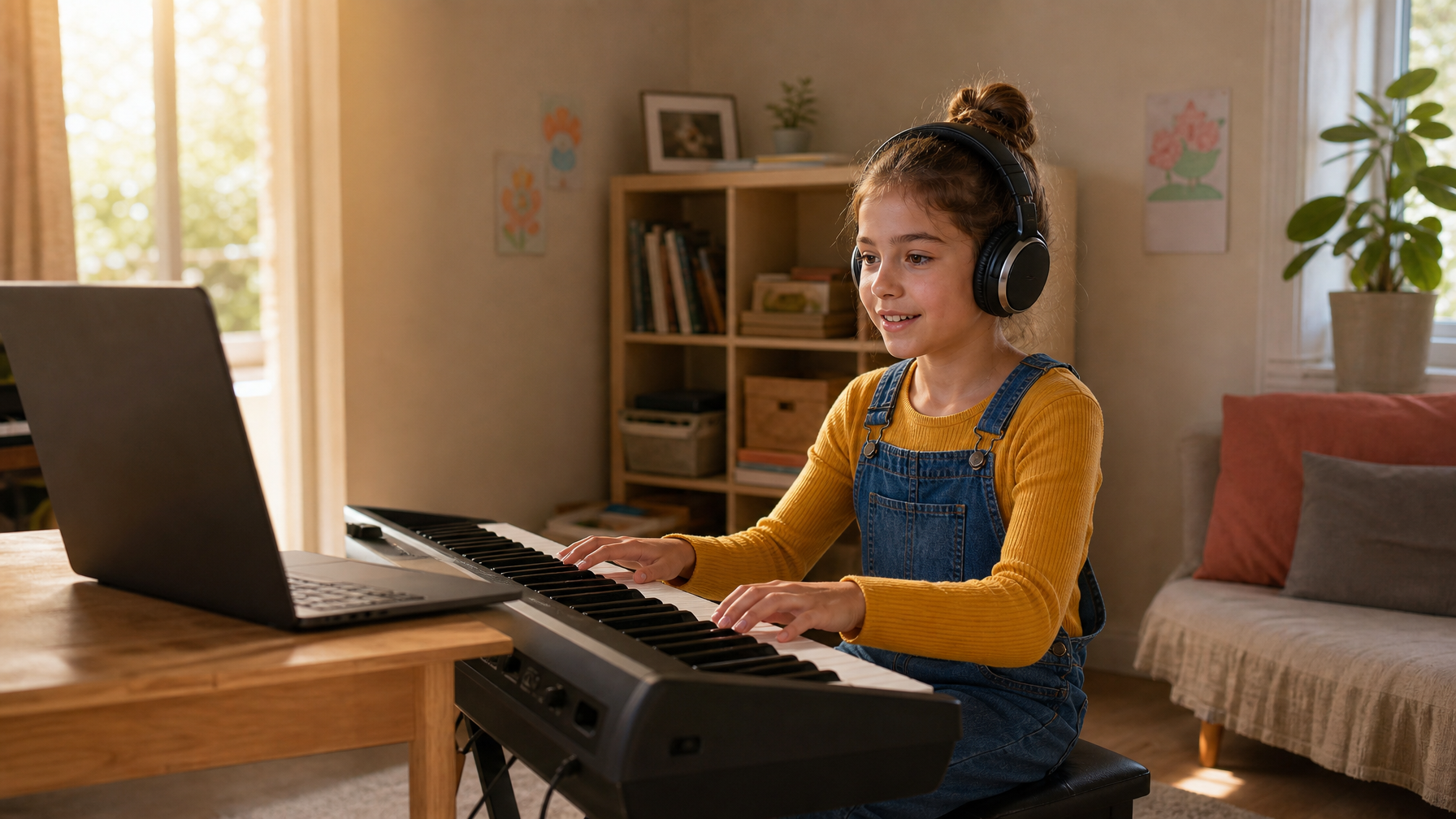
Online music lessons have come a long way from the awkward video calls of a few years ago. In 2026, a kid can take live piano lessons with a professional musician, join a small-group songwriting class, or get weekly guitar instruction with a teacher who assigns specific practice and follows up the next session. The format varies significantly across platforms, and that difference matters more for music than almost any other subject.
We compared five of the most used platforms for online music lessons for kids, what each does well, and who each format actually serves.
The short version: Outschool offers the broadest variety of live music classes and 1-on-1 lessons across instruments and genres, with vetted teachers and flexible booking. TakeLessons is a strong tutor marketplace for independent music teachers. LessonFace specializes specifically in music and offers strong instructor search tools. Fender Play is an app-based option for guitar and bass beginners. And Music Teachers Now connects families with credentialed music educators for 1-on-1 instruction.
Outschool
Best for: live group music classes, 1-on-1 lessons across instruments and genres, kids who want enrichment alongside instruction, ESA families
Outschool offers hundreds of live music classes for kids ages 3 to 18, covering piano, guitar, violin, ukulele, voice, drums, music theory, songwriting, and more. Classes run in small groups or 1-on-1 with vetted music teachers who include working musicians, credentialed music educators, and instrument specialists. Parents can read real reviews from other families before booking and choose exactly the teacher and format that fits their kid.
For families who want more than technical instruction, Outschool has music appreciation classes, composition workshops, group performance opportunities, and music theory for beginners and advanced students alike. The flexible booking model means families can try a teacher for one session before committing to ongoing lessons. For ESA families, music classes on Outschool are eligible in most states through Odyssey or ClassWallet.
- Live music classes and 1-on-1 lessons across most instruments and genres
- Vetted teachers with real parent reviews on every profile
- Flexible booking, try one session before committing to ongoing lessons
- ESA-eligible in most states; enrichment and theory alongside performance
Cons: Pay-per-class model; class quality varies by teacher; no built-in practice tracking between sessions.
TakeLessons
Best for: finding an independent music tutor, families who want a specific instrument specialist
TakeLessons is a tutor marketplace covering music along with other subjects. Their music instructor selection is wide, with teachers for most instruments at various price points. The platform includes scheduling tools, lesson history, and messaging. For a family who wants to search for a specific instrument or style and compare options before booking, TakeLessons provides a solid browsing experience.
Instructor quality varies, as with any marketplace, and the vetting process is less thorough than some alternatives. Parent feedback in music education forums is mixed, with some families finding a great long-term teacher and others reporting inconsistent instructor reliability and limited platform support when issues arise.
- Wide selection of music instructors across instruments and styles
- Scheduling tools and lesson history built in
- Range of price points available
Cons: Instructor quality varies; vetting process less rigorous than some platforms; limited platform-level support when instructor issues arise.
LessonFace
Best for: families who specifically want a music lesson platform with strong instructor search and scheduling tools
LessonFace is a video lesson marketplace focused primarily on music, arts, and language instruction. Their music instructor search is detailed, and the platform is designed specifically for the lesson experience rather than being a general tutoring marketplace that happens to include music. Instructors set their own rates and availability, and families book directly through the platform.
LessonFace has a smaller instructor pool than general marketplaces, which can limit options for less common instruments. The platform does not have ESA payment integration and is not set up for the kind of group class experience Outschool offers.
- Music-focused platform with strong instructor search tools
- Designed specifically for live lesson experiences
- Instructors at multiple price points; flexible scheduling
Cons: Smaller instructor pool than general marketplaces; no group class option; no ESA payment integration.
$20 off your first class WITH promo code: blog
Build the Education your Kid Deserves
Discover thousands of live classes taught by expert teachers, across academics and enrichment.
Browse classesSimply Piano
Best for: self-paced piano learners who want instant feedback, kids who want to learn piano at home without a teacher scheduling sessions
Simply Piano (by JoyTunes) uses your phone or tablet microphone to listen to you play in real time and give immediate feedback on notes and rhythm. Lessons are structured and progress from beginner chords through more advanced repertoire, organized around songs kids actually want to play. The feedback loop is fast enough to feel meaningful, which is more than most self-paced apps deliver for piano specifically.
The limitation is the same one all self-paced apps share: Simply Piano cannot watch your hands. It can tell you whether you hit the right notes at the right time, but it cannot correct a wrist position developing into a repetitive strain problem, spot a fingering habit that will create a ceiling later, or adjust the lesson because your kid is frustrated today. For a motivated beginner who wants to explore piano independently, Simply Piano is a strong starting point. For a kid who needs technique feedback or a teacher who adjusts in real time, it is not a replacement for live instruction.
- Phone mic listens and gives real-time note and rhythm feedback
- Song-based progression from beginner through intermediate
- Structured curriculum; works across piano and keyboard
- Affordable monthly subscription; works without scheduling
Cons: Cannot correct technique or hand position; no live teacher or human feedback; requires a piano or keyboard; self-motivation required to maintain progress.
Payam Music
Best for: families who want a structured, method-driven live piano school with measurable outcomes, kids who have tried traditional lessons and quit
Payam Music is a live piano school, in-person and online, built around the Payam Method: a proprietary approach that introduces piano the way a child learns language, through patterns, techniques, and songs they already love, before traditional sheet music. The method was featured on 60 Minutes in 2026 and is backed by Hadi Partovi, co-founder of Code.org, who now serves as CEO. Hans Zimmer's studio, Bleeding Fingers, has endorsed the program and mentors top students.
The results Payam cites are notable: average students reach their diploma level in four years compared to twelve under traditional instruction, and retention past the first year is significantly higher than the 15-20% typical for traditional piano lessons. Physical locations operate in California, New York, Maryland, and Washington, with online enrollment available. For families who have been through the cycle of a kid starting lessons, losing motivation, and quitting, the method's focus on songs students love and fast visible progress addresses the root cause of that pattern directly.
- Proprietary Payam Method; students learn faster than traditional instruction on average
- Live teachers, not an app; in-person and online enrollment
- Song-first approach; students pick music they are motivated to play
- Endorsed by Hans Zimmer; backed by Hadi Partovi (Code.org founder)
- Strong retention rate compared to traditional piano lessons
Cons: Physical locations limited to CA, NY, MD, WA; online availability may vary; enrollment process rather than drop-in booking; newer program with a shorter track record than established schools.
Fender Play
Best for: beginner guitar or bass learners who want a structured self-paced app, teens and older kids who are self-motivated
Fender Play is a subscription app that teaches guitar, bass, and ukulele through short video lessons organized by song. The format is designed for self-paced beginners and is particularly engaging for kids who have a specific song they want to learn to play. Lessons are bite-sized and progress from basic chords through full songs, which gives early learners a sense of accomplishment quickly.
Fender Play is an app, not a live lesson platform. There is no teacher who knows your child, no feedback on their technique, and no adjustment when they develop a bad habit. For a motivated teenager who wants to learn guitar on their own schedule, it can work well. For younger kids or learners who need feedback and accountability, a live teacher is a better fit.
- Structured beginner guitar, bass, and ukulele instruction
- Song-based learning is engaging and goal-oriented
- Self-paced; affordable monthly subscription
Cons: No live instruction; no technique feedback; requires self-motivation; not effective for younger kids who need a teacher's presence; limited to guitar-family instruments.
Music Teachers Now
Best for: families who want credentialed music educators for 1-on-1 lessons, instrument instruction with verified teacher credentials
Music Teachers Now is a directory and booking platform specifically for music teachers, with a focus on instructor credentials and background verification. The platform covers most instruments and allows families to search by instrument, location, and price. Teachers on the platform tend to be more formally credentialed than on general marketplace platforms.
The trade-off is a smaller pool of instructors than broad marketplaces, and the platform's scheduling and communication tools are more basic. For families who prioritize teacher credentials and want a directory approach to finding a private music teacher, it is a reasonable option.
- Focus on credentialed and verified music educators
- Covers most instruments; searchable by specialty and location
Cons: Smaller instructor pool; more basic platform tools; no group class option.
How to choose by age and instrument
- Ages 3 to 7 — Outschool's live group music classes for young learners make music feel social and fun rather than a solo practice chore. Short session lengths designed for young attention spans.
- Ages 7 to 12, starting an instrument — Outschool 1-on-1 instruction, Payam Music (piano specifically), or TakeLessons gives kids a real teacher who can correct technique and build a practice routine.
- Ages 12 and up, self-motivated learner — Simply Piano works for piano; Fender Play works for guitar/bass. For all other instruments and for kids who want more depth, live instruction is more effective.
- Any age, wanting enrichment alongside performance — Outschool's music theory, composition, and songwriting classes round out instrument practice in a way no other platform offers.
If you're looking for live music lessons with a teacher your kid will actually look forward to, browse music classes on Outschool across instruments and ages.



.svg)
.svg)