Summer STEM camps used to mean a week at a university lab or a community center a long drive away. Online STEM camps have changed that significantly. A kid anywhere can now spend a week building games in Python with kids from four other states, or spend a summer learning robotics from a teacher who's also a working engineer. The quality ceiling has gone up, the geographic barrier is gone, and the options have multiplied.
The catch is that more options means more noise. Not every program marketed as a "STEM camp" is worth your family's time. This guide covers what separates a strong online STEM camp from a mediocre one, then breaks down the main categories so you can match your child's interests to the right kind of program.
What makes an online STEM camp worth it
Before you search, it helps to know what to filter for. Four things tend to separate strong programs from weak ones.
Project-based outcomes. The best STEM camps end with something: a working game, a functional robot built at home with a kit, a short animation, a coded app. Outcome-based camps give kids a concrete artifact they're proud of, which reinforces the learning and tells you something real happened.
Live instruction, not just video content. A camp where your child watches pre-recorded videos for five days is not really a camp. Look for live sessions with a real instructor who can see what the student is doing, answer questions in real time, and adjust when a student gets stuck.
Age-appropriate challenge level. A camp that's too easy bores kids. A camp that's too hard loses them. Strong STEM camps group students by skill level, not just age. Check whether the program specifies prior experience required and whether the teacher checks for skill fit before the camp begins.
Manageable class sizes. In a live coding or robotics session, an instructor managing thirty students cannot give meaningful individual feedback. Look for class sizes where the teacher can actually see what each student is working on.
Coding and technology camps
Coding camps are the most popular category in online STEM, and for good reason. Programming is a foundational skill that connects to nearly every other STEM discipline, and the barrier to entry is low — most kids can start building simple games in Scratch within a week with no prior experience.
Scratch camps are ideal for kids ages seven through ten who are new to coding. The visual block-based interface removes syntax barriers and lets kids focus on logic and creative problem-solving.
Python and JavaScript camps are the right next step for kids who have outgrown Scratch. If your child has already completed Scratch courses and is ready for something more substantial, our guide to moving beyond Scratch and Python covers what the natural progression looks like.
App development and web design camps are a strong choice for older students who want to build something with a real-world application they can show friends and family.
Browse coding and technology summer camps on Outschool to filter by age, skill level, and schedule.
Game design and 3D modeling camps
Game design camps teach coding, creative problem-solving, art direction, and systems thinking at the same time. A kid who resists math worksheets will happily spend three hours figuring out why the physics in their game feel wrong — that's the same problem-solving muscle, running on genuine motivation.
Roblox and Minecraft camps are popular entry points for younger builders, roughly ages eight through thirteen. Roblox-focused camps often incorporate scripting in Lua, which is a real programming language.
Unity and Unreal Engine camps are the right move for teens who are serious about game development as a long-term interest. These are industry-standard tools, and camps taught by working developers offer context that a video tutorial series can't.
3D modeling and animation camps use tools like Blender, TinkerCAD, or Toon Boom to teach digital design, geometry, and visual storytelling. Our beginner's guide to 3D modeling for kids covers what these tools look like in practice and what age ranges they work best for.
Browse gaming and game design summer camps on Outschool to see what's scheduled this summer.
Robotics and engineering camps
Robotics in an online format works differently than it sounds. The best online robotics camps use materials families already have or purchase with a kit, paired with virtual environments for programming and simulation.
LEGO Mindstorms and Spike Prime camps are well-suited for kids ages eight through fourteen. These platforms are robust and well-documented, and the camps built around them tend to be well-structured because the hardware is standardized. Families purchase the kit separately before the camp starts.
Scratch-based robotics simulation camps allow students to program virtual robots without any physical hardware, making them accessible for families who want to try the subject before committing to a kit.
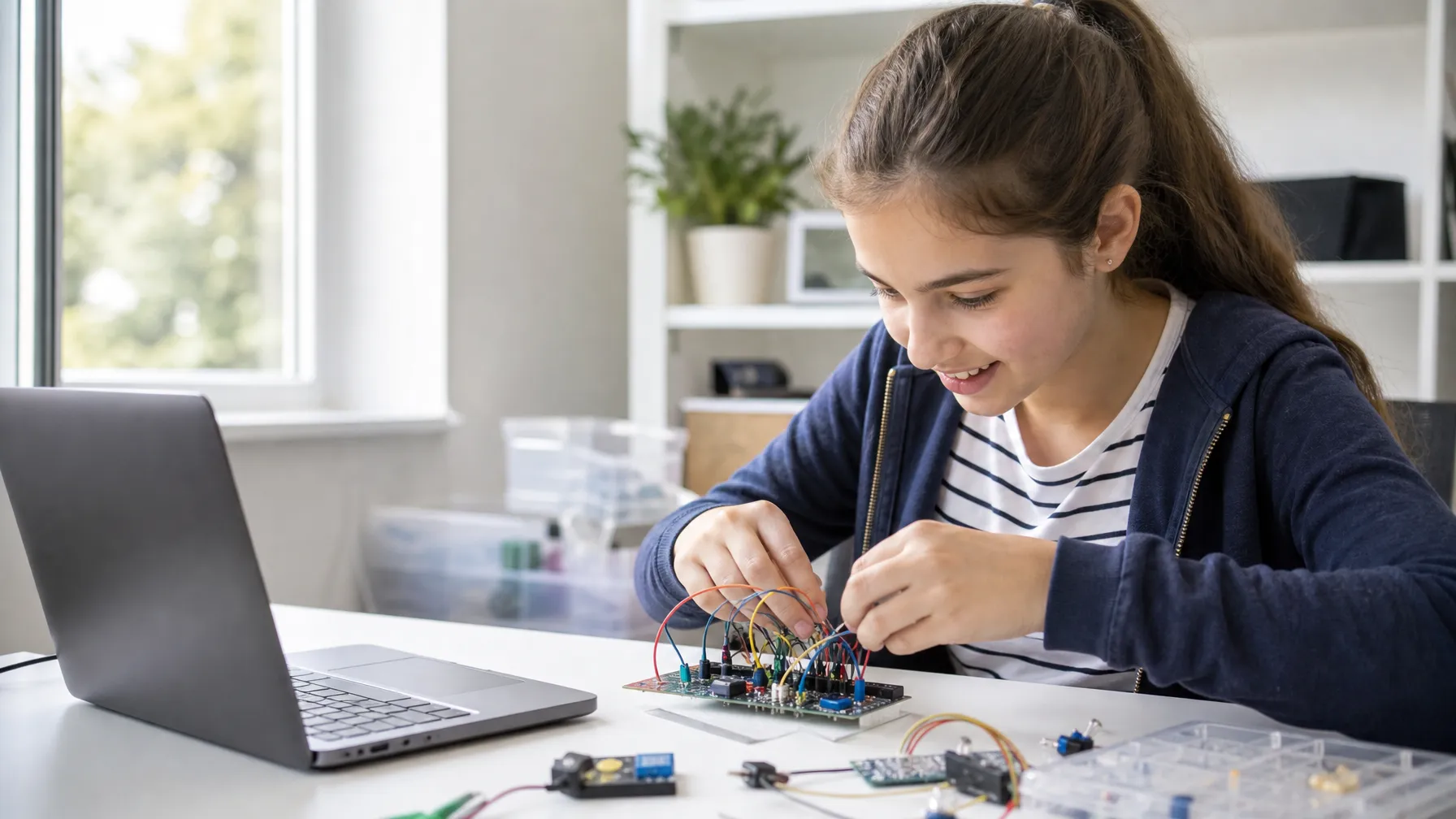
Arduino and electronics camps are the right fit for older students, roughly twelve and up, who want to work with actual circuits, sensors, and code on real-world problems.
For a broader look at what robotics instruction looks like at different levels, our guide to robotics classes for kids covers what parents should know before enrolling.
$20 off your first class WITH promo code: blog
Build the Education your Kid Deserves
Discover thousands of live classes taught by expert teachers, across academics and enrichment.
Browse classesScience camps
Science camps online tend to cluster around three areas: life sciences (biology, ecology, marine science, anatomy), physical sciences (chemistry, physics, astronomy), and earth and environmental science. The range is wide enough that a child with a very specific interest — whale biology, forensic science, space exploration — can often find exactly that.
Lab science camps where teachers guide students through experiments using household materials are the most effective format. The physical act of doing the experiment, even with simple materials at home, reinforces conceptual learning in a way passive observation doesn't.
Specialty science camps on topics like forensic science, marine biology, or astronomy attract kids who are passionate about a specific area and want to go deeper than a general course allows.
Discussion-based science camps on topics like climate science, bioethics, or science history are a strong fit for verbal learners and students preparing for high school or college-level STEM who want to practice reasoning through complex problems.
Browse science summer camps on Outschool to find camps by scientific discipline, age group, and schedule.
Math camps
Math camps are worth separating from the general enrichment category because the best ones look very different from a tutoring session. A strong summer math camp teaches through puzzles, logic problems, competition prep, or real-world applications — not review sheets. Students who find classroom math boring often discover they enjoy math when it's framed as something to figure out rather than something to memorize.
Search for math camps with an explicit approach — competition math, mental math strategies, financial math, applied math — rather than "math review." Browse math summer camps on Outschool to see what's currently scheduled.
How to decide which type is right for your child
A few questions worth asking before you book:
What does your child spend time on voluntarily? A kid who builds in Minecraft for hours is probably a strong candidate for a game design or coding camp. A child who takes things apart to see how they work might be more drawn to robotics or electronics. Following existing interest almost always leads to a better camp experience than choosing what seems most useful.
Is this their first STEM camp, or are they continuing from something? First-timers benefit from broader, exploratory camps. Students who've already done one or two are often ready for a specific tool, language, or discipline.
How do they respond to challenge and deadlines? Some kids thrive in project-deadline environments where something has to be finished by Friday. Others do better with open-ended exploration. Know your learner before you pick the format.
What's the time commitment, and does it fit your summer? A one-week intensive (ninety minutes a day, five days) is a very different experience from a semester-long weekly class. Both are valuable, but they suit different family schedules and different types of learners.
One more tip before you search
Type the specific topic into the search bar first — "Python," "Roblox," "marine biology," "robotics kit" — before applying any filters. Then use the filter button to narrow by age, days, and available times. If you find a teacher whose class looks like a strong fit, message them before enrolling. Teachers can often accommodate schedule requests and will tell you honestly whether the course is right for your child's current skill level. For more on how to use Outschool search effectively, the SEA Homeschoolers Conference recap has a practical walkthrough from Outschool families who've figured out what works.


.svg)
.svg)