Education has not kept up with the world kids are growing up in. Parents feel it, learners feel it, and many people working inside the system feel it too.
John Danner, a serial entrepreneur and long‑time education innovator, argues that if AI can handle more of the “content,” we have a rare chance to redesign what school is actually for.
Danner has founded and led companies across both tech and education, including NetGravity, Rocketship Public Schools, and, most recently, Project Read, which teaches more than 100,000 elementary learners to read. He has been a public school teacher, a charter school founder, and an angel investor in companies like Outschool.
Here’s how he thinks AI will reshape school, and what that could mean for families and educators.
Have we defined the role of teachers the wrong way?
Danner’s most provocative belief is that the role of the K‑12 teacher has been designed in an almost impossible way.
We ask teachers to do two demanding jobs at once:
- Be amazing with kids; building relationships, managing a classroom, nurturing emotions, and supporting diverse needs
- Be deep subject matter experts; explaining complex concepts, adapting instruction, and tracking standards across multiple subjects
At Rocketship, his network of elementary charter schools, Danner saw how rarely these two skill sets overlapped.
In his experience, only a small percentage of teachers were both outstanding with kids and outstanding in content knowledge. This is not a criticism of teachers themselves, but a critique of the structure around them. When we design a role that almost no one can fully meet, we create chronic stress, burnout, and a feeling of never being “enough,” even for the most dedicated professionals.
Rethinking school, in his view, must start with rethinking the job of the teacher.
Elementary is “okay”
The real breakdown starts in middle and high school. Looking across K‑12, Danner sees a clear divide.
In the early grades, schools focus on:
- Socializing and helping kids learn to work with others
- Building basic reading, writing, and math skills
- Establishing routines and early self‑management
The science of reading is improving early literacy outcomes. There is still plenty of room to grow, but the core model of elementary school is not completely out of step with what young learners need.
The picture changes in middle and high school.
Once learners can read and learn independently, many schools double down on what Danner calls “content cramming.” Learners move from class to class, absorb large amounts of information, and are evaluated primarily on how well they can reproduce that information on tests and assignments.
Danner believes this pattern was already questionable before AI. Now, it risks becoming actively harmful. If learners spend years mastering the game of memorizing and regurgitating content, they may graduate well‑trained for a world that no longer works that way.
Why AI may become the best content instructor
Danner expects a major shift in who, or what, delivers content knowledge to learners over the next decade.
He believes that in many subjects, the most effective content instructors will soon be AI systems rather than humans.
AI tutors have some structural advantages
- They are infinitely patient
- They can work precisely at the learner’s pace
- They can respond instantly, as many times as needed
- They do not bring judgment, frustration, or bias into the interaction
At Project Read, which focuses on reading instruction, Danner has seen how the lack of perceived judgment matters. Older learners in fifth or sixth grade who are still not confident readers often feel deep embarrassment, even in the presence of the kindest adults in the room.
When they work with an AI‑powered program, many of those emotional barriers drop. The learner can focus on the work rather than on how they are being seen.
For schools, economics are shifting as well. Early online tutoring and adaptive software were expensive to offer one‑on‑one at scale. AI is pushing the cost of high‑quality support down so far that “how much will this cost per student” may no longer be the main barrier to providing personalized help.
If AI teaches the content, what is school for?
If AI takes on more of the direct content instruction, especially in middle and high school, the central question becomes: what should kids and teens actually do at school all day? Danner’s answer is not to get rid of school, but to redesign it around what humans are uniquely good at.
Imagine a school model where:
- Learners spend one to two focused hours a day working with AI tutors to master core content in math, science, history, language, and more
- Teachers shift their primary focus to social, emotional, and collaborative learning
- The bulk of the school day is spent on building projects, tackling real‑world problems, practicing communication, and learning how to work in teams
He points to extended, hands‑on experiences, such as robotics competitions, as examples. For many learners, a season of designing, building, failing, and iterating on a robot with a team can deliver more authentic science and engineering learning than years of lecture‑based instruction.
In this vision, academic content and social‑emotional growth are not fighting each other for minutes in the schedule. AI handles more of the content load, which frees teachers and mentors to guide the human side of development, helping kids manage conflict, navigate friendships, think critically, and build a sense of purpose. Schools will still hold a custodial role. Many families need a safe, structured place for their children to be from morning to afternoon. Danner does not expect that need to disappear. What he expects to evolve is the experience learners have during those hours.
Why change has been slow and why AI might be different
Online content and instructional technology are not new. For years, learners have had access to:
- Video lessons in nearly every subject
- Massive open online courses (MOOCs)
- Free practice platforms and learning apps
So why has everyday school changed so little? Danner points to three major shifts that make this moment different.
1. A step change in technology and cost
Earlier tools could help, but remained costly or limited. One‑on‑one support was still expensive to provide to every learner. AI has the potential to make high‑quality, personalized help so affordable that cost is no longer the primary obstacle.
2. Parents are more aware and more dissatisfied
In a recent study, Danner conducted on high school attitudes, around half or more of both parents and students described high school as something like a “death march.” They did not feel a sense of belonging or relevance. Instead, they saw four years of required classes to “get through,” rather than to enjoy.
Parents increasingly question whether this structure prepares their kids for the world they are entering.
3. Policies are starting to follow families
During the COVID‑19 pandemic, many families saw school up close, on a daily basis. For some, this heightened awareness of quality and fit for their children. In several states, it accelerated momentum behind models like Education Savings Accounts (ESAs), which allow public dollars to follow students to different education providers.
These policies create more space for new school models, including microschools and AI‑first programs, to emerge and grow.
Taken together, Danner sees technology, attitudes, and policy aligning in a way that makes deep change more likely than in previous waves of innovation.
Why a “frenzy” of experimentation is necessary
In many industries, significant innovation emerges from a period of intense experimentation. Lots of early attempts fail, and a small number become the models others adopt.
Danner believes education now needs that same kind of experimentation.
He argues that:
- Small, cautious tweaks to traditional school are unlikely to be enough
- We need a large number of people trying bold new approaches to school design
- Most new models will not be perfect, and some will not work at all, but learners may still gain more from engaging with a new, thoughtful model than from passively enduring a system that already feels irrelevant
This is especially true, he suggests, because the current high school experience is already failing too many learners. Keeping things as they are is not neutral.
The challenge is funding. Traditional venture capital has long been cautious about education because:
- Consumer spending on education in the United States is relatively low, making direct‑to‑family models harder to scale
- Selling technology into school systems is slow and complex
- Running schools involves real estate, staffing, regulation, and operations that many investors prefer to avoid
Danner imagines a path where public investment helps seed early experimentation and private capital scales the approaches that clearly work for learners and families.
Microschools, ESAs, and parent‑led models
One promising area Danner highlights is microschools, particularly those supported by flexible funding such as ESAs.
Microschools can be:
- Small, often under 50 learners
- Multi‑age and community‑based
- Designed with more flexibility in schedule, curriculum, and approach
He points to organizations building microschools in states like Florida and Texas as examples of early movers. Their founders are often directly involved in shaping ESA policy, ensuring new models align incentives in ways that benefit learners.
At the same time, many parents still gravitate toward more traditional school choices, even when they work in technology or understand AI well. Familiar systems feel safer, especially when the stakes involve a child’s future.
Danner expects a long transition period where new models and traditional schools exist side by side. Over time, successful innovations can shift what families expect from any school.
How AI could widen access and challenge gatekeeping
For decades, education has functioned as a powerful gatekeeping system. Access to certain schools and credentials has often mattered as much as, or more than, what learners actually know and can do.
What happens if AI dramatically expands access to high‑quality instruction, particularly for bright, motivated learners who do not come from privileged backgrounds?
Danner believes that would be a positive and overdue shift. For generations, talent has been lost not because of a lack of ability or drive, but because of limited access to expert teaching and rich learning environments. If a teenager can learn advanced physics, history, or writing with an AI tutor modeled on a world‑class expert, regardless of zip code, the old hierarchies become harder to justify.
This may create tension if those who have benefited most from the current system feel their advantages eroding. But Danner would rather face that tension than continue accepting a quiet, predictable unfairness.
What parents and teachers can do now
The transformation Danner describes will unfold over many years. But there are practical steps families and educators can take right away.
1. Become active learners about AI
You do not need to understand every technical detail. Focus on:
- What current AI tools can and cannot do
- How they are being used in learning
- How costs and capabilities are changing over time
Staying informed helps you recognize when a new tool is worth trying with your learner or in your classroom.
2. Start with your learner’s strengths and interests
Rather than beginning with “What AI tools should we use?” Danner suggests asking “What does my child care about?”
If your learner loves math, storytelling, game design, or history, explore AI‑enabled tools in that area. Notice what genuinely engages them and what does not. The goal is not to find the one perfect platform, but to discover the kinds of experiences that unlock motivation and deeper thinking.
3. Protect and prioritize the human side of learning
As AI becomes more capable at content instruction, the human side of learning matters more, not less. Parents and teachers can:
- Help kids reflect on how they feel when learning with AI
- Create group projects, discussions, and shared experiences that AI cannot replace
- Model curiosity, empathy, and resilience
AI can offer explanations and practice. It cannot replace the experience of being seen, encouraged, and challenged by a caring adult or a supportive peer group.
Looking ahead
Danner envisions a future where:
- Every learner has access to high‑quality AI tutors across multiple subjects
- School days center on collaboration, projects, and social development rather than lectures and worksheets
- Families have more meaningful choices, backed by flexible funding, so they can find or build learning environments that fit their kids
- Talent from every background has a clearer path to develop, because access to instruction is no longer the main limiting factor
We are still at the beginning of that journey. Progress will be uneven, and some early attempts will not work as intended. But for families and educators who are willing to stay curious and experimental, there is a real opportunity to help shape what comes next.
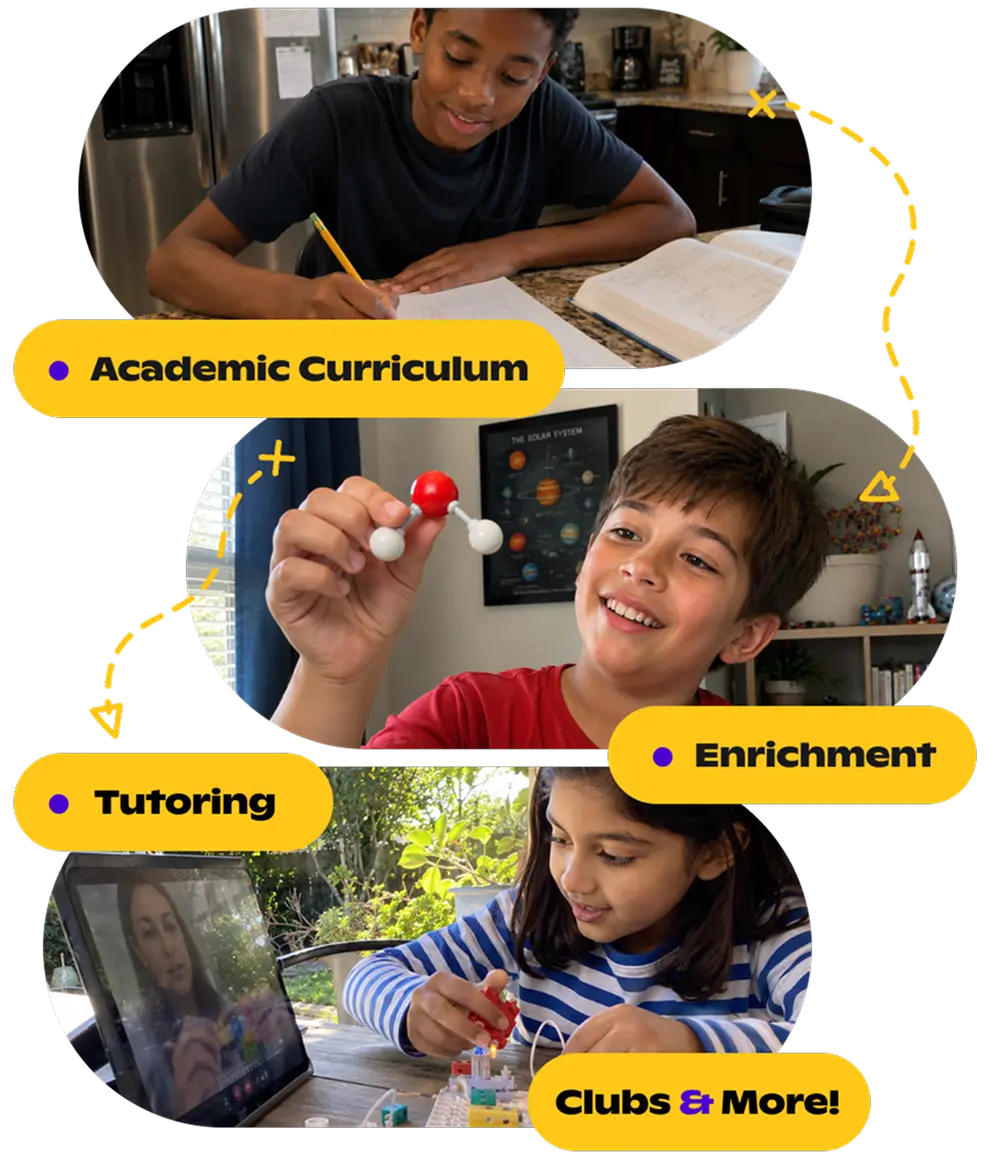
If you are a parent or caregiver looking for flexible, human‑centered ways to support your learner today, Outschool offers live online classes, one‑on‑one tutoring, and full‑term curriculum options that can sit alongside the AI tools you are exploring.
Content adapted from the Outspoken podcast episode, “John Danner on Rethinking the Role of AI in Education.”


.svg)
.svg)