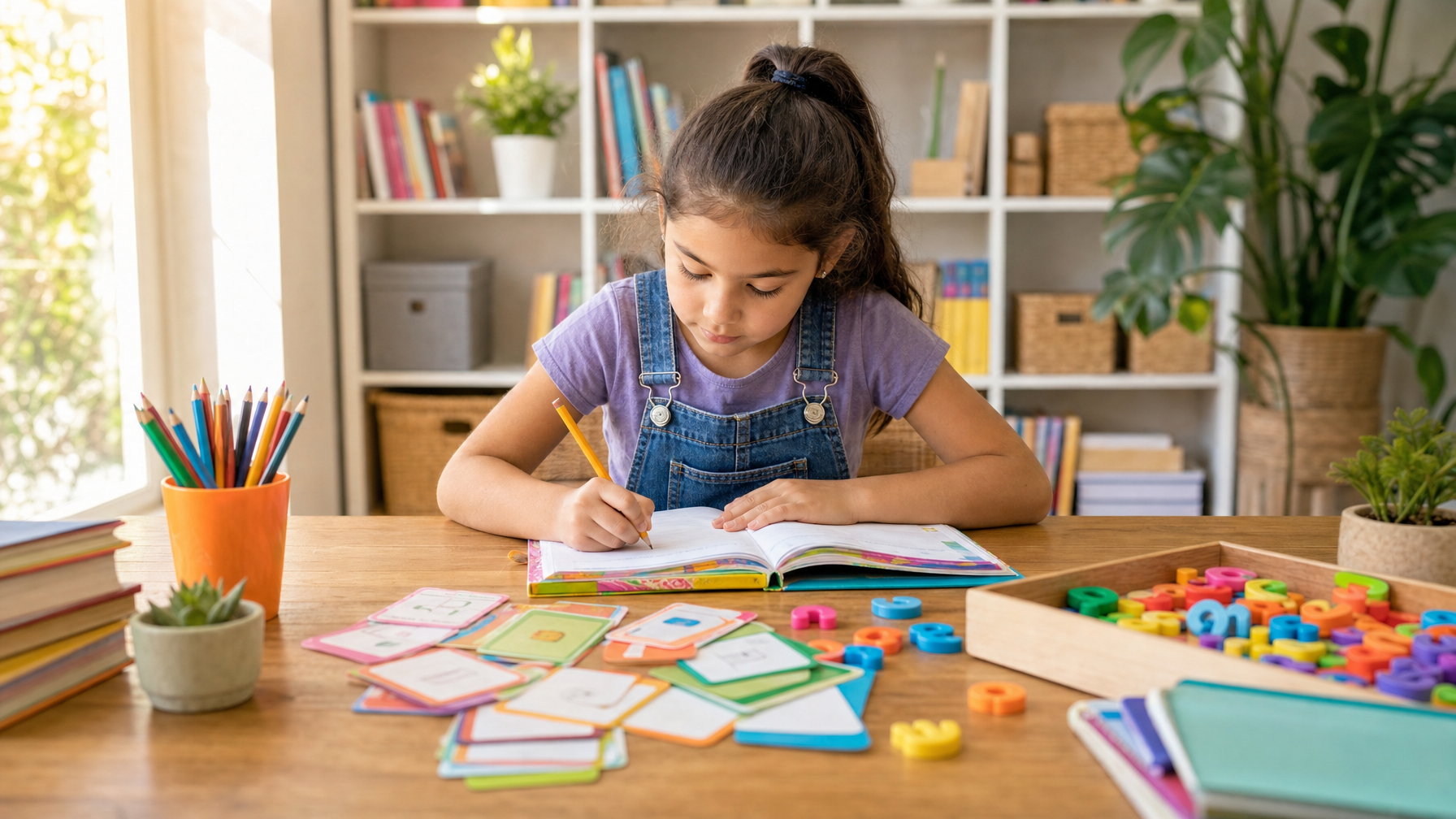
Sixth grade is often when art starts to shift from simple crafts toward more intentional skill-building. As a homeschool parent, all the different ways to teach art at home can feel like a lot to sort through. You may have a middle schooler who is constantly sketching characters, experimenting with digital tools, and finding creative outlets in everyday life. Or you may have a child who feels hesitant after a frustrating experience in earlier years. Either way, 6th grade is a great time to build confidence, strengthen artistic ability, and help creativity keep growing.
In this article, we will explore how to create a functional at-home art space, examine the topics your 6th grader should learn, and provide a framework for choosing an art curriculum that builds both skill and creative spirit.
Overview: 6th Grade Homeschool Art Curricula
According to the National Art Education Association, middle school students are developmentally ready to move beyond simple self-expression and begin intentional creative practice. In other words, they are learning to use specific tools and techniques to achieve a result.
6th grade art at home vs. in a school setting
In a traditional school setting, 6th grade art can have limitations. Typically, a middle school art class meets for 45 minutes once a week. Schools often have a strict budget for materials and rigid schedules, and the focus is often on completing projects within a timeframe to satisfy grading requirements. Students are not always able to explore their creativity or practice a skill to mastery.
On the other hand, in a home environment, your student is more likely to enter “flow state”, which is deep immersion in a creative task. Without the distraction of the bell or peer pressure, your child can spend three hours on a watercolor painting or on creating a complex design in Procreate.
By prioritizing the process of art over the end product, your student can feel empowered to follow their own creative path at a speed that is appropriate for them.
Topics Covered in 6th Grade Art Curricula for Homeschool Learners
In 6th grade art instruction, shifts from play to practice. Students move beyond drawing a house and begin to understand why and how the house looks the way it does.
The elements of art and principles of design
Students in 6th grade learn about visual building blocks and gain a more technical understanding of how art is produced. The elements of art are like the ingredients, and the principles of design are the recipe. Together, your child can make something beautiful.
The Elements of Art are the foundational tools, like line, shape, value, texture, space, and form. The Principles of Design are explored once students understand the elements. Your learner can start to understand how arranging the elements affects balance, contrast, movement, and pattern.
This is where critical thinking comes into play as students learn to place colors and objects strategically. At home, your child may create a realistic cityscape using a vanishing point to create depth.
Color theory and mixing
Students may have learned primary and secondary colors in previous grades. In 6th grade, they may explore tertiary colors, tints, shades, and tones. They can also explore how color affects mood and dive into the process of mixing colors.
At home, you might give your child a color challenge and ask them to only use red, blue, yellow, and white to perfectly match a piece of fruit or other object.
Art History and visual thinking strategies
Art History in 6th grade can involve connecting art techniques with time periods and geographic areas. Students can turn into art detectives by asking questions like “What's going on in this picture?” and “What did I see that makes me say that?” Finding visual evidence to support thoughts will sharpen thinking skills and visual literacy.
At home, you may choose a painting of the week, like Starry Night, and ask your student to defend a popular theory about the painting. Connecting art to other subjects can also help bring history to life and connect art to the real people and places.
Mixed media and sculpture
Exploring mixed media and sculpture allows students to experience art in 3D. Your student may create a robot using paint, recycled material, and textiles. This kind of hands-on learning encourages divergent thinking, a well-established cognitive benefit of art education. This type of art also challenges your student to move beyond "right" answers and instead find multiple solutions to common design problems.
Common Types of 6th Grade Homeschool Art Curricula
Art education in middle school can range from classical training to creative exploration. When comparing curricula, consider your child’s interests and art goals, your teaching bandwidth, and the level of support you would like.
- Classical fine arts programs: These are skills-based programs that typically follow a linear progression and emphasize technical skills, such as drawing, painting, and sculpting. These techniques transport students from simply drawing an eye symbolically to drawing the eye's actual anatomy and shading to show light.
- Process-based programs: This approach focuses on the experience of making art. These programs may provide a prompt, and then the child is free to explore materials and techniques. For example, you can create a 3D sculpture out of recycled materials that represents the word “tension.”
- Art History integrated programs: Combining art projects with studies of historical eras or geographical regions would be an integrated approach. This works well for the holistic homeschooler looking for art lessons to reinforce history units. For example, during a study of the Renaissance, you could pause to do an art project in the style of Leonardo Da Vinci.
- Digital arts and media programs: These programs are designed for the digital learner who would like to learn layering, pixels, and vectors using programs like Photoshop or Procreate. If your student is interested in game design or anime, this may be an engaging choice.
- Video-based and online courses: These programs use professional artists to model techniques in real time. Students can pause, rewatch, and even ask questions. Research from the National Art Education Association (NAEA) shows that modeling is vital for middle schoolers transitioning to more complex work.
Elements to Consider Before Choosing a 6th Grade Homeschool Art Curriculum
Middle schoolers are often harsh critics of their artwork; therefore, your curriculum must provide the technical support they need to feel successful. Here are some elements to consider when choosing your curriculum.
Balance of technical skill and creative expression
A high-quality 6th grade art curriculum will blend technique and experimentation. You can look for programs that teach foundational skills, like perspective, but leave the projects open-ended so your child can apply those skills in ways they find enjoyable and engaging.
For example, instead of a lesson that requires your student to draw one type of house to learn depth, a quality curriculum might teach the vanishing point technique and then challenge the student to design a futuristic city or a surrealist landscape in any way they choose.
Supply management
Middle school art often requires higher-quality materials, such as watercolor paper, drawing pencils, and acrylics.
Some families prefer an all-in-one kit of materials, while others are comfortable curating what they need. Consider the options and cost, and make sure you have the supplies on hand for your child to complete the lessons. Leaving materials and supplies out and available can also invite creativity at times outside of art class.
Instructor expertise and modeling
According to the Association for Supervision and Curriculum Development (ASCD) research, middle schoolers learn best through cognitive modeling.
Being able to see an artist's process, including mistakes and problem-solving, is important to the learning process. Consider if you feel comfortable with modeling techniques or if a video-based online instructor would be more effective for your family.
The digital world
Digital art is sure to appeal to your middle schooler. Consider whether your curriculum path will include programs such as Canva, Procreate, or Photoshop. Your child can learn through experimentation or take more formal online classes in digital art and design. The ability to “fix” a mistake with a single click makes the process less frustrating for certain types of learners.
Requirements and portfolios
Before making a final decision, check your state's homeschool laws to see whether you are required to include a fine arts class in middle school. Regardless, you will likely want to keep a portfolio of your students' work as a keepsake of creative growth and expression.
How to Plan for or Choose a 6th Grade Homeschool Art Curriculum
The focus of 6th grade art may be on investigation and reflection. Cognitively, students are likely ready to think about the “why” behind an artist’s choices. Here’s how to plan a curriculum with those two elements in mind.
Step 1: Consider your child’s artistic identity
Before choosing a curriculum, consider what your 6th grader is currently drawn to. Incorporating natural interests will increase engagement and learning. Does your child like to sketch Marvel characters? Are they fascinated with astronomy? Use those passions as a springboard for art projects.
Step 2: Create an “Elements and Principles" roadmap
Several elements of art and principles of design will be taught in 6th grade. You may plan to spend 3-4 weeks on each element.
For example, if the focus is value, you may spend a week on shading an apple, a week on a self-portrait with shadow, and a week on a landscape with sunlight as the focus.
Step 3: Schedule “artist of the month” deep dives
You can use online digital collections to study one artist at a time alongside your studio work. Incorporate the techniques and styles into your at-home projects. Instead of just looking at a piece of art, your student can perform a master study, attempting to replicate a portion of it to better understand the artist’s process. These deep dives allow your child to incorporate professional techniques into their own work and to think like that artist for a focused amount of time.
Step 4: Celebrate the year
Plan a gallery opening at the end of the year to celebrate and share. You can invite friends or family and have your child write an artist statement for each piece, explaining their process.
This celebration does more than display art; it fulfills the presenting and responding pillars of the National Arts Standards and gives your child a sense of being a contributor to the artistic world.
Example Routines for a 6th Grade Homeschool Art Curriculum
The key to a successful 6th grade art program is consistency over intensity. Your child does not have to paint for hours a day, but they do need a rhythm that supports their creative process.
Your weekly studio routine could look like this:
Monday: Inspiration Day
Spend time looking at specific artists or art movements. Browse digital museums or watch art videos, and immerse yourself as you ask guiding questions to spark your child’s interest and thinking skills. Choose one technique to try this week.
Tuesday: Skill Building
This could be where the hands and brain get a workout. You could spend 30 to 45 minutes of targeted practice on your skill. If you are focusing on value, you could do a 5-step shading scale drawing of a household object. This is not a pressure-filled day, just practice.
Wednesday: Studio Work
On this day, you could put on a playlist and really dive in for a dedicated block of studio time. Your child can apply the skills they have learned in the first two days and try a larger canvas or paper. This is ideally the time for “flow state”, when creativity can take the reins.
End of the week: Digital day and reflection
At the end of the week, take some time to explore digital resources. You could take a photo of Wednesday's work and add digital effects or touch-ups. Also, take the time to reflect on the process, ask thoughtful questions like “What are you most proud of?” or “What would you do differently next time?” This is also a good time to establish a cleaning ritual for your art space and supplies for the following week.
Think of yourself as a studio manager, the person who prepares supplies and provides a calming space. You are also a model of a growth mindset when frustration arises.
Popular Homeschool Art Curricula for 6th Graders
Finding engaging art instruction for a middle school student is not as difficult as it may seem. By combining expert-led online sessions with digital archives, you can create a high-quality at-home art experience.
Outschool’s online curricula and classes
Outschool's 6th-grade art classes can give your child the social interaction and peer feedback that are critical for artistic growth at this age.
Outschool has a variety of options, from digital animation to focused workshops on color theory and impressionism. Students can work live alongside an expert artist, receive feedback, ask questions, and engage in reflective conversations.
Free national resources
Free national art resources can work really well alongside an Outschool class or any other homeschool art curriculum. They add inspiration, extra practice, and fresh ways to explore technique, art history, and creative projects without needing to replace your main lessons.
- The National Gallery of Art offers numerous free resources. The Art Zone allows your student to experiment with composition and color digitally, and their lesson plans provide step-by-step technique instructions.
- The Getty Museum offers a free visual thinking curriculum that helps students look closely at artwork and reflect on the artist's motivation and technique.
- The Library of Congress is the perfect source of inspiration, with millions of free primary source images. Students can explore historical portraits, graphic design, and vintage posters.
- The Smithsonian American Art Museum's education page offers free art and history sets that connect to American history and the artists of that time.
- MetKids from the Metropolitan Museum of Art is specifically designed for 7-12-year-olds and features an interactive map that lets students travel through time and discover how different cultures created art. Includes instructions for at-home projects using household items.
Frequently Asked Questions: 6th Grade Homeschool Art Curricula
Many parents wonder about the specifics of teaching art at home. Below are some commonly asked questions that may be helpful.
How long should a typical 6th grade art lesson take?
A typical skill-building lesson should last 45-90 minutes to allow students time to warm up, do focused work, and reflect. Of course, this is flexible in a homeschool environment, and you can follow your child's lead when it comes to art and the amount of time that is valuable to their process.
Can a 6th grade art curriculum be combined with other subjects?
Absolutely! The Association for Supervision and Curriculum Development (ASCD) suggests that arts integration improves long-term memory. For example, a biology unit on human anatomy can include a drawing to understand muscle structure, or a study of the Earth’s layers can be created through a mixed-media sculpture. This approach makes art a more central part of learning, rather than a side thought.
How do I assess progress in homeschool art?
The portfolio method can work well at this stage. Collect 5-10 pieces spread across the beginning, middle, and end of the year. Compare and look for growth and development in technique. Incorporate artists' statements for your child's perspective. Ultimately, 6th grade art is less about producing a masterpiece and more about building the confidence to explore complex ideas through a visual lens.
Nurturing the Middle School Artist
Sixth grade is an important time for creativity. Your student’s technical skills may finally begin to catch up with their imagination. By providing a structured yet flexible environment, you can turn art class into a highlight of your homeschool week. Whether your child is creating a design digitally or painting a bowl of fruit, the biggest gift you can give is a greater appreciation and understanding of the process.
Sources
A Shared Endeavor: Art Education, Arts Integration, and Comprehensive Arts Education. National Art Education Association, June 2025, www.arteducators.org/wp-content/uploads/2025/06/A-Shared-Endeavor.pdf.
Association for Supervision and Curriculum Development. ASCD, 2024, www.ascd.org.
DeCleene, Kelley. “How Do We Help Student Artists With Cognitive Learning Barriers?” The Art of Education University, 21 Nov. 2022, theartofeducation.edu/2022/11/nov-how-do-we-help-student-artists-with-cognitive-learning-barriers/.
"Education at the National Gallery of Art." National Gallery of Art, www.nga.gov/education.html.
"Getty Education." The J. Paul Getty Museum, www.getty.edu/education/.
“Instructional Modeling.” EBSCO, www.ebsco.com/research-starters/education/instructional-modeling.
"Library of Congress: Prints & Photographs Division." Library of Congress, www.loc.gov/pictures/.
"National Core Arts Standards." National Art Education Association, www.arteducators.org/advocacy/national-core-arts-standards.
Sloan, Willa. “Making Content Connections Through Arts Integration.” ASCD, vol. 51, no. 3, 1 Mar. 2009, www.ascd.org/el/articles/making-content-connections-through-arts-integration.
Walsh, Jackie A., and Beth D. Sattes. “Divergent and Skeptical Thinking: Questioning Strategies for Deeper Learning.” ASCD, 10 Sept. 2015, www.ascd.org/el/articles/divergent-and-skeptical-thinking-questioning-strategies-for-deeper-learning.



.svg)
.svg)