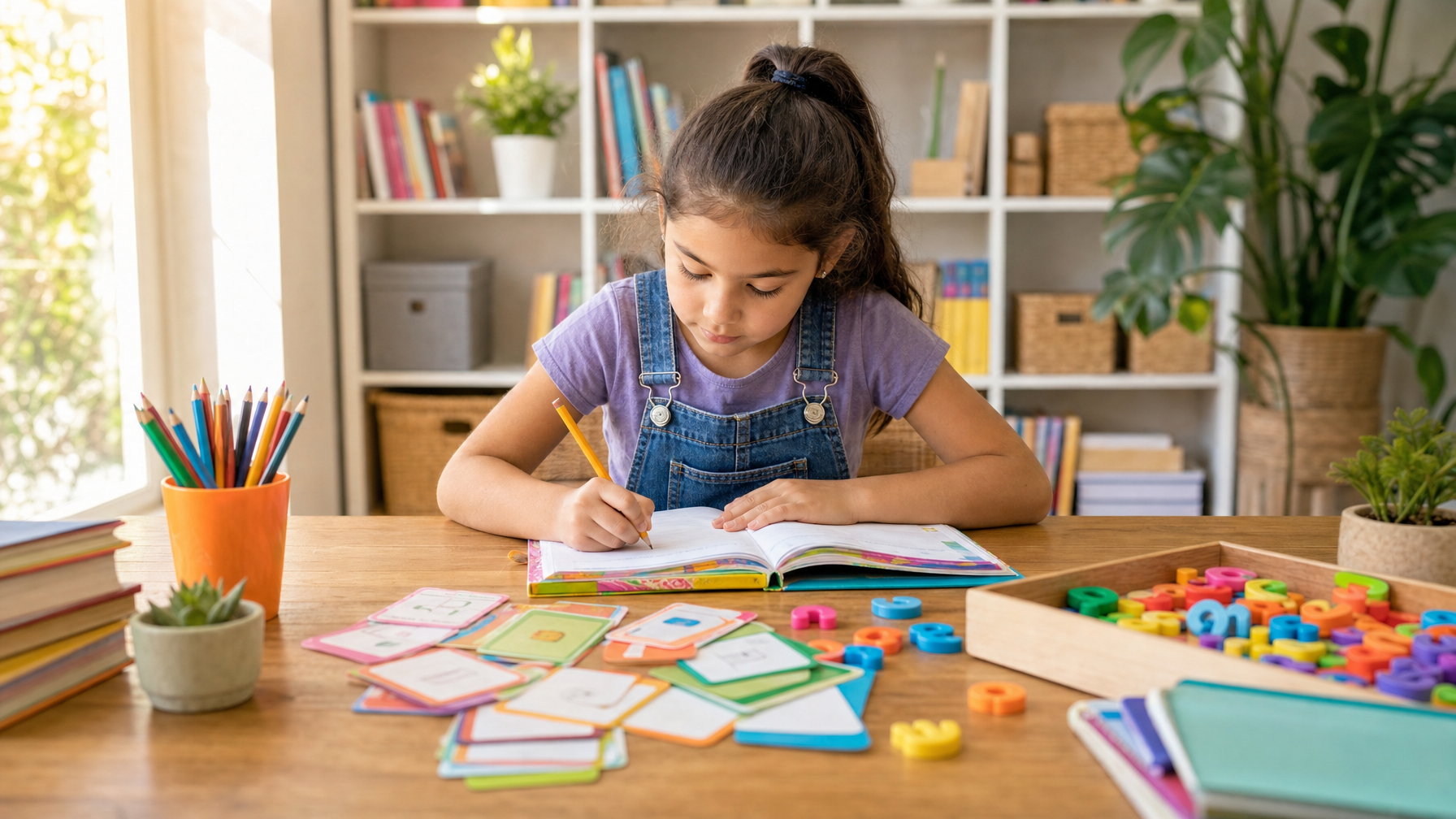
Teaching a 6th grader at home can feel like a real turning point. Expectations are rising, and your child is becoming capable of more complex thinking, deeper discussions, and greater independence. Around this stage, many homeschooling parents start asking what their child should be working toward and how to set goals that support both academic progress and personal growth.
Clear goals can bring helpful structure to an otherwise flexible homeschool routine. They give you a way to focus on core subjects like reading, math, science, and history while also making room for independence, curiosity, and practical life skills. In this article, we’ll walk through how to set meaningful 6th grade homeschool goals, how to choose goals that fit your learner, and which academic and developmental areas are often emphasized during this year.
Overview: 6th Grade Homeschool Goals
Homeschool goals can act as a guide for your school year. They help you decide what skills, knowledge, and habits your child should develop by the end of sixth grade. These goals offer a roadmap that will help you stay focused while still adapting to your child’s pace and interests.
Sixth grade often marks a transition year. Learners may begin to shift from concrete elementary thinking toward more abstract and analytical thinking, and your child may be asking deeper questions, making new connections, and taking more responsibility for their own learning. Because of this shift, many families begin adding goals related to personal responsibility and independence alongside academics.
Homeschool goals may also change during the year. A child may quickly master a topic and need new challenges, or they may need to slow down and take additional time. Regular reflection helps you adjust your goals to better suit your learner.
Education research also shows that strong academic foundations by eighth grade are closely linked to long-term academic success, making the middle school years an important period for building skills in reasoning, literacy, and problem-solving.
Why choosing 6th grade goals is different in a homeschool setting
In a traditional classroom, learning goals are often set by the teacher and aligned to pacing guides and standardized testing schedules. Teachers must move an entire group through a set curriculum within a certain timeline, even if some students need more time to understand a topic.
Homeschooling allows parents to approach goals in different ways. Instead of simply covering the material, you can focus on a deeper understanding. If your child needs extra time to strengthen writing or fractions, you can slow down. If they show strong curiosity about a science topic, you can expand the lesson.
This flexibility is one of the greatest advantages of homeschooling. Parents can shape goals around their learner’s strengths, interests, and readiness while still incorporating grade-level expectations.
Developmental goals vs. academic goals in 6th grade
When planning your homeschool year, it helps to think about two types of goals: academic and developmental.
Academic goals focus on subject knowledge and skills. These include solving math problems, analyzing texts, writing structured essays, and understanding scientific investigations. National frameworks indicate that by middle school, students are expected to explain their reasoning, interpret data, and apply knowledge to real-world situations.
Developmental goals focus on habits and life skills that support learning. Around 6th grade, many learners begin developing stronger executive functioning skills, such as organization and self-monitoring. These abilities are just as important as academic knowledge because they help learners manage their studies and lives.
Homeschool families often blend these two types of goals together. For example, completing a research project about ancient civilizations may build both social studies knowledge and independent study skills.
Research from the Association for Middle Level Education explains that early adolescence is a period of rapid cognitive and social development, second only to early childhood in the pace of growth. Because learners are developing stronger reasoning and self-awareness, 6th grade is an ideal time to build skills that increase independence and critical thinking.
Tracking your goals
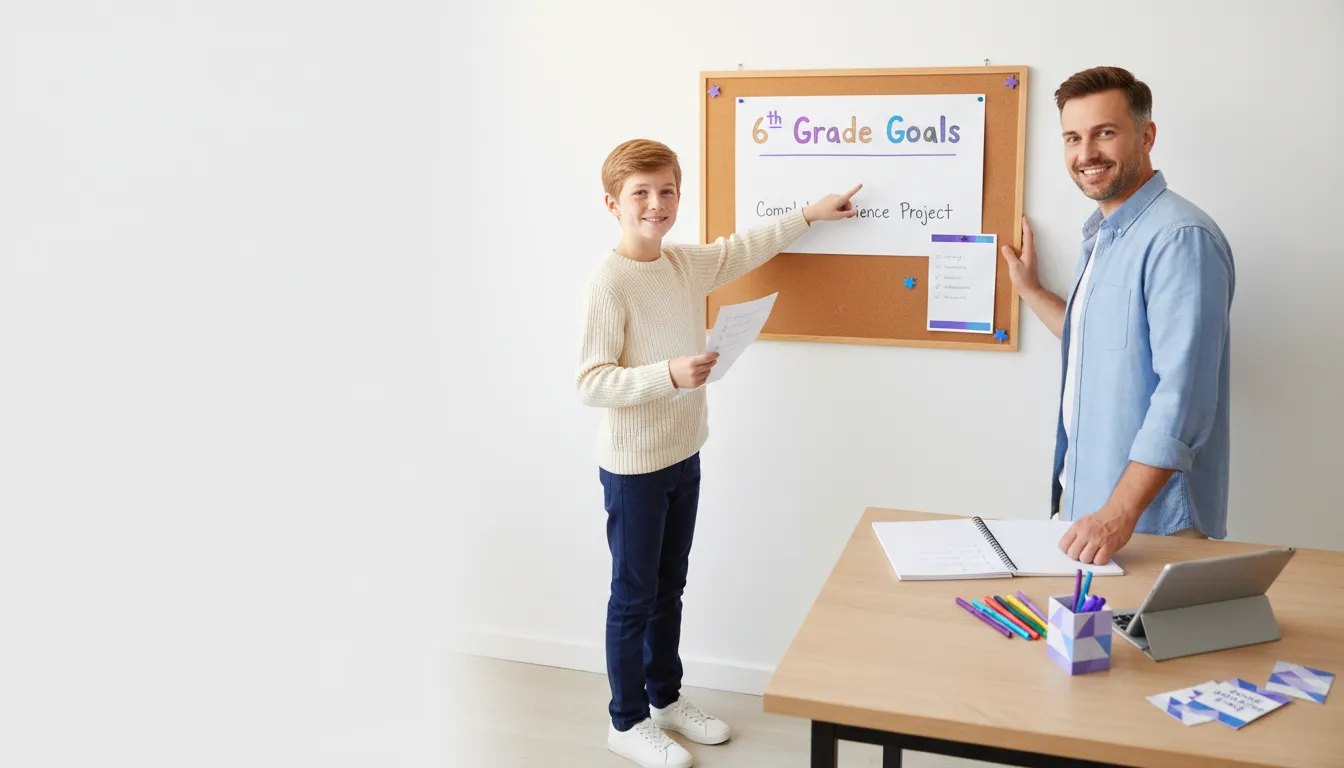
Once you have identified your goals, it helps to create a simple system for tracking progress, and it doesn’t need to be complicated. You can keep simple records through weekly planners, portfolios of past work, or even checklists.
For example, recording writing assignments, books read, and science experiments completed can help you see growth over time and identify areas where your learner may need more support. If your child would like to get involved in the process, a visual habit tracker can be a fun and engaging way to track progress over the year by coloring in a chart after every topic or unit is completed.
Maintaining documentation can also be helpful for families living in states that require homeschool records or evaluations. It is always a good idea to review the homeschool laws in each state before planning your year, so you understand any specific requirements.
Tracking progress does not need to be an arduous task. Instead, you can think of it as a way to observe your child’s learning journey and celebrate the progress they make throughout the year.
How to Determine 6th Grade Goals for Your Homeschool Learner
There is no “right way” to set goals; your learner might do well with structured academic targets, while others prefer an unstructured, hands-on project. The key is to create goals that are challenging for your child while still allowing them to grow and feel confident.
The following steps can help you build thoughtful and realistic 6th grade homeschool goals for the year.
Step 1: Review your learner's current skills
Before setting new goals, take time to look at where your child currently stands. Where do they shine and where do they struggle? Review past work, writing samples, math notebooks, and reading habits.
You might also look at sample questions from national benchmarks, such as the National Assessment of Educational Progress, to get an idea of the types of reasoning and problem-solving your child is currently capable of. This quick review helps you identify strengths and areas that may need additional support.
Step 2: Identify academic priorities
Once you understand your learner’s current placement, it is time to think about which academic areas to focus on during 6th grade. Most families prioritize core subjects such as math, reading, writing, science, and social studies.
At this stage, the focus often shifts toward deeper thinking rather than simple memorization. Learners are expected to explain their reasoning, analyze information, and connect ideas across subjects. Your goals might include strengthening reading comprehension, building writing structure, or developing stronger math problem-solving skills.
Step 3: Consider developmental and skill goals
Homeschooling gives families the opportunity to focus on skills that traditional classrooms may not always have time for. Around 6th grade, learners may begin building independence and taking greater ownership of their learning.
You may want to include goals related to organization, time management, and research skills. For example, your learner might plan a small project, manage a weekly assignment checklist, or conduct independent research on a topic that interests them. These habits will prepare your child for the more demanding expectations of seventh and eighth grades.
Step 4: Connect learning to real life
One of the strengths of homeschooling is the ability to connect academic skills to everyday experiences. Instead of treating subjects as isolated lessons, you can incorporate learning into daily life.
Math might appear in budgeting, cooking, or measuring a garden space. Writing can include journaling, letter writing, or creating short reports. Science might involve experiments, nature observation, or building models.
Step 5: Set flexible and measurable goals
Finally, try to keep your goals clear but flexible. For example, instead of setting a vague goal like “improve writing,” you might aim for your learner to write several structured essays or research reports during the year. If a goal becomes too easy or too difficult, homeschooling allows you to adapt quickly and adjust your expectations.
Remember that progress often happens gradually. The goal is not perfection but steady growth across the school year.
Research from the University of Virginia’s Youth-Nex Center shows that structured goal-setting helps adolescents develop stronger motivation and self-regulation, especially when goals are specific and progress is regularly reviewed.
Common Academic Goals for 6th Homeschool Learners
Academic goals for 6th grade often focus on building deeper understanding and stronger reasoning skills. At this stage, learners are expected to apply knowledge, explain their thinking, and connect ideas across subjects. Many national frameworks emphasize problem-solving, analysis, and communication as key skills for middle school learners.
Homeschool families can approach these subjects with flexibility while still keeping common grade-level expectations in mind. Below are several academic areas that many parents include when planning 6th-grade homeschool goals.
Math goals
In 6th grade math, the focus shifts toward understanding relationships between numbers and solving multi-step problems. The student may learn:
- Ratios and proportions: Comparing quantities and understanding how ratios work. Real-life examples might include adjusting recipes or comparing grocery store prices.
- Fraction and decimal operations: Adding, subtracting, multiplying, and dividing. fractions and decimals while learning when each operation should be used.
- Percentages in the real world: Concepts such as discounts, taxes, and simple financial calculations.
- Negative numbers and integers: How numbers can move below zero, often using number lines and real-world examples like temperature or elevation.
- Multi-step problem-solving: Explaining reasoning and showing each step of their thinking rather than simply producing an answer.
Science goals
Science learning in 6th grade often revolves around observation, experimentation, and asking questions about the natural world. Many homeschool families incorporate hands-on projects to deepen understanding. The typical program includes topics such as:
- Understand the scientific method: Learners practice forming questions, creating hypotheses, testing ideas, and recording results.
- Earth and life science: Topics may include ecosystems, weather patterns, energy, and the structure of living organisms.
- Conduct simple experiments: Experiments allow learners to test ideas, measure results, and observe patterns.
- Record observations and findings: Science notebooks or journals help learners track experiments and reflect on what they discover.
Reading, English, and writing goals
Literacy development remains a major focus during sixth grade. Learners expand both reading comprehension and written communication skills. Common 6th grade learning targets include:
- Read a variety of texts: Learners may read novels, nonfiction books, articles, and primary sources.
- Strengthen reading comprehension: Identify themes, analyze characters, and summarize key ideas from texts.
- Write structured essays or reports: Organizing writing with introductions, supporting details, and conclusions.
- Develop vocabulary and grammar skills: Understanding word meanings, sentence structure, and punctuation helps learners communicate clearly.
- Practice research and note-taking: Research projects introduce learners to gathering information from reliable sources.
To go deeper on 6th grade English instruction, see our guide to 6th grade homeschool English and ELA curriculum.
Social studies and history goals
Social studies in 6th grade often goes beyond basic history lessons to include culture, geography, and historical analysis. Topics often include:
- Ancient civilizations and world cultures: Learners may study regions such as ancient Egypt, Greece, Rome, or early Asian civilizations.
- Geography and maps: Map reading, location skills, and understanding the Earth's physical features help learners see how geography influences history.
- Analyze historical sources: Students examine historical documents, images, and artifacts to better understand past events.
- Connect historical ideas to modern society: Discussions often focus on how past events influence present-day cultures and systems.
Health and physical education goals
Physical health and movement are important parts of a balanced homeschool routine. In 6th grade, you might focus on:
- Physical activity habits: Building a physical routine with activities such as sports, hiking, or biking to support both physical and mental health.
- Health and wellness concepts: Nutrition, sleep habits, and personal health practices.
- Teamwork and cooperation skills: Group sports, community activities, or clubs can help learners practice collaboration.
Art goals
Creative subjects allow learners to express ideas and explore different forms of communication. A 6th grade student may:
- Experiment with different art mediums: Drawing, painting, sculpture, or digital design all help learners develop creativity.
- Study artists and artistic styles: Explore how art reflects culture and historical periods.
- Create projects that connect with other subjects: Art projects can tie into science, literature, or history lessons, helping learners understand topics from multiple perspectives.
These academic goals create a foundation for sixth grade learning while still leaving room for exploration. Homeschooling can allow families to adjust the depth and pacing of each subject so learners can grow confidently throughout the year.
Common Developmental Goals for 6th Homeschool Learners
Sixth grade is a time when learners may begin developing personal responsibility, curiosity, and independence. It is important to foster and celebrate these developmental changes as they will help your child succeed in the future.
Organizations such as the Association for Supervision and Curriculum Development (ASCD) emphasize that middle school learners benefit from opportunities to practice independence, collaboration, and problem-solving. Homeschool environments are especially well-suited for supporting these skills because learning can happen through real experiences, projects, and daily responsibilities.
Below are several developmental areas that many families include when planning 6th-grade homeschool goals.
Building independence
As learners move into the middle school years, they begin taking greater ownership of their learning. They may be able to:
- Manage simple daily tasks independently: Track assignments, gather their materials, or complete lessons with minimal reminders.
- Make decisions about learning projects: Choosing research topics, books, or creative projects that interest them.
- Reflect on their own progress: Short conversations about what went well and what felt challenging.
Strengthening time management and organization
Sixth graders are often developing executive functioning skills that help them handle more complex work. Executive functioning skills such as planning, organization, and self-monitoring develop rapidly during the middle school years. Researchers at Harvard University's Center on the Developing Child note that these skills allow students to manage complex tasks, make decisions, and adapt their learning strategies as challenges increase.
Some examples to incorporate into your homeschool may be:
- Using a planner or checklist: Keeping track of assignments or projects to develop planning habits.
- Breaking large projects into smaller steps: Students organize research, writing, and presentations over several days.
- Establishing a daily learning routine: Consistent routines help develop responsibility and reduce procrastination.
Developing critical thinking and problem-solving
At this age, learners are increasingly capable of deeper thinking and analysis. They are able to begin:
- Asking questions about what they learn: Encouraging curiosity helps and thinking beyond memorizing facts.
- Evaluating information from different sources: Identify reliable information during research projects.
- Exploring solutions to real-world problems: Complete projects related to science, engineering, or community issues to strengthen analytical thinking.
Developing life skills
Many homeschool families include practical life skills alongside academic learning. Some helpful topics to focus on are:
- Budgeting and basic financial awareness: Practice managing small budgets, planning purchases, or saving for goals.
- Participating in household responsibilities: Cooking, organizing, and caring for shared spaces builds responsibility.
- Exploring interests and hobbies: Activities such as music, art, coding, sports, or crafting to help discover personal interests and talents.
These developmental goals help 6th graders grow into confident and capable learners. When combined with academic learning, they create a balanced homeschool experience that supports both intellectual growth and real-life readiness.
Frequently Asked Questions: 6th Grade Homeschool Goals
Many homeschooling parents have similar questions when planning goals for the middle school years. Below are a few common concerns families often have.
Do 6th grade homeschool goals need to follow state standards?
Not necessarily. Homeschool families often use state or national standards as a reference point, but they are not always required to follow them exactly. Standards from organizations such as the National Assessment of Educational Progress or state education departments can help parents understand typical grade-level expectations, but homeschooling allows families to adjust the pace based on their child's needs. The ultimate goal is steady progress and true understanding of the material.
How can I set homeschool goals if my child needs extra support in some subjects?
If your learner struggles in certain areas, start by going back to the basics rather than trying to cover everything at once.
Homeschooling allows you to slow down, revisit earlier concepts, and provide extra practice when needed. Many families break larger goals into smaller steps so their child can build confidence gradually. You can also use additional resources, such as tutoring, small-group online classes, or hands-on projects, to reinforce difficult concepts.
How often should homeschool goals be reviewed or updated?
Most families review goals every few weeks or at the end of each learning unit. This helps you see whether your child has mastered a skill or needs additional practice. Regularly reviewing progress also gives you the chance to add new challenges when your learner is ready. Homeschooling works best when goals remain flexible, allowing you to adjust the plan as your child grows throughout the year.
Supporting Growth Through Goals
Planning goals for your 6th grader does not need to be a high pressure checklist. Instead, consider which priorities are most important to you and your child, support their curiosity, and help your learner build the skills needed for the next stage of learning.
Sixth grade is the year that your child will move from basic skill-building to deeper thinking, problem-solving, and independent learning. By setting clear goals, you can create an environment where your child gains confidence alongside knowledge.
Sources
"A Guide to Executive Function." Center on the Developing Child at Harvard University, 22 Nov. 2024, https://developingchild.harvard.edu/resource-guides/guide-executive-function/.
Association for Middle Level Education. "Developmental Characteristics of Young Adolescents." AMLE, https://www.amle.org/young-adolescent-development/.
Centers for Disease Control and Prevention. "Child Development: Middle Childhood." CDC, https://www.cdc.gov/ncbddd/childdevelopment.
Center on the Developing Child. "Executive Function & Self-Regulation." Harvard University, https://developingchild.harvard.edu/science/key-concepts/executive-function/.
Chiefs for Change. Middle School Strategy: Leveraging the Science of Learning and Development to Inform Education in Middle School. Chiefs for Change, 2022, https://www.chiefsforchange.org/wp-content/uploads/2022/10/Middle-School-Strategy-Leveraging-the-Science-of-Learning-and-Development-to-Inform-Education-in-Middle-School.pdf.
Common Core State Standards Initiative. "Grade 6 Introduction." Common Core State Standards Initiative, https://www.thecorestandards.org/Math/Content/6/introduction/.
Education Resources Information Center. "Developmental Characteristics of Early Adolescents." ERIC, U.S. Department of Education, https://eric.ed.gov/?id=ED192443.
Library of Congress. "Teaching with Primary Sources." Library of Congress, https://www.loc.gov/programs/teachers/getting-started-with-primary-sources/.
National Assessment of Educational Progress. "Mathematics Framework for the 2022 Assessment." National Center for Education Statistics, U.S. Department of Education, https://nces.ed.gov/nationsreportcard/mathematics/.
National Center for Education Statistics. "The Nation's Report Card." NCES, U.S. Department of Education, https://www.nationsreportcard.gov.
National Institutes of Health. "Executive Function Training and Academic Achievement in Adolescents." National Library of Medicine, https://pmc.ncbi.nlm.nih.gov/articles/PMC9111740/.
Youth-Nex Center to Promote Effective Youth Development. "Strategies for Teaching Goal Setting to Middle Schoolers." University of Virginia, https://youthnexdrive.virginia.edu/strategies-teaching-goal-setting-middle-schoolers.


.svg)
.svg)