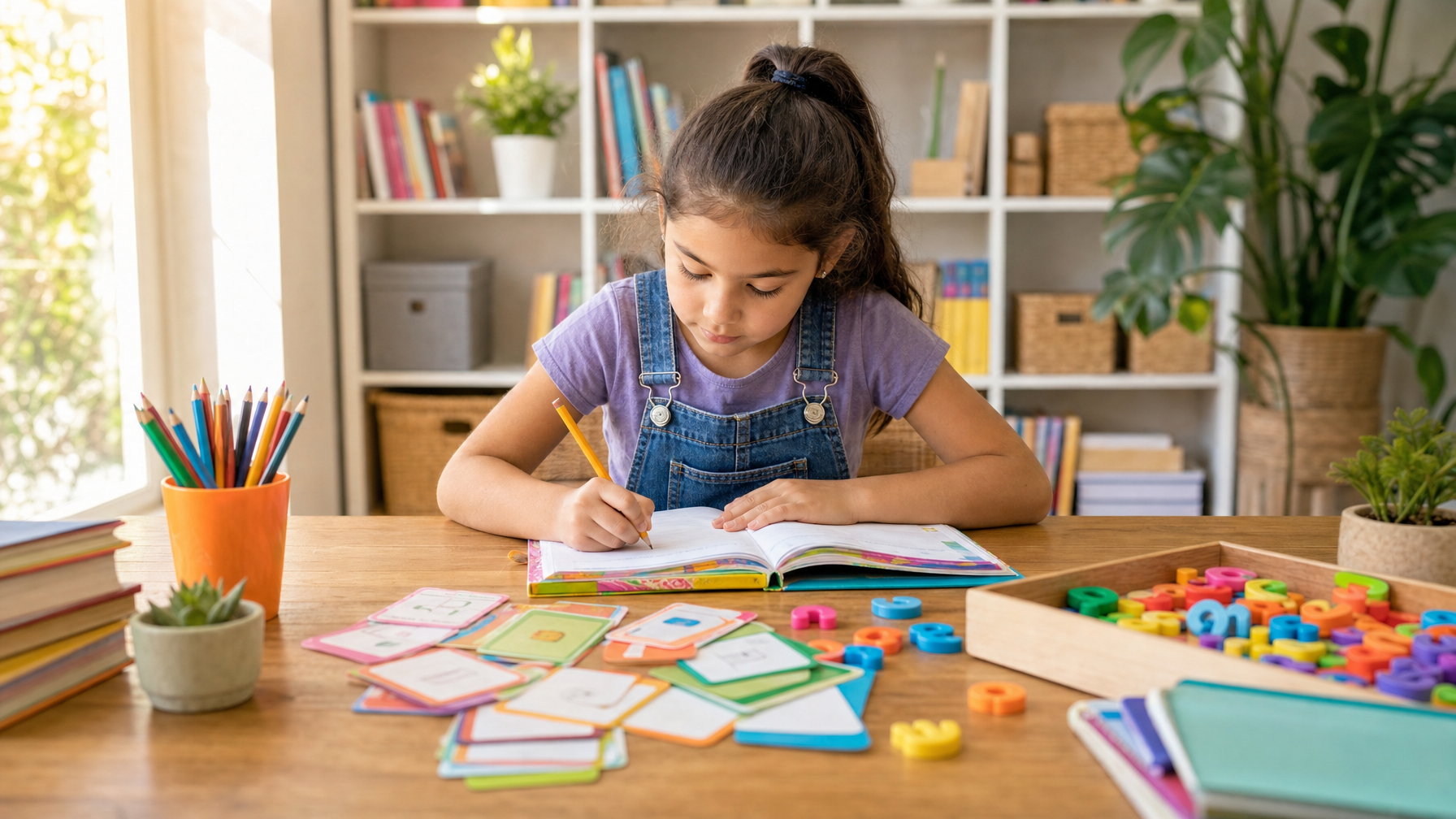
A strong sixth grade writing curriculum gives kids a clear path from simple writing to more organized, thoughtful work, while still making space for creativity. That can sound like a lot, but homeschooling gives you the flexibility to slow the process down, give meaningful feedback, and connect writing to real-life experiences. Whether your student is a natural storyteller or a more reluctant writer, the right program should support both personal expression and the formal skills they need to grow.
In this guide, we’ll look at what a 6th grade homeschool writing curriculum should include, how learning at home differs from a traditional classroom, and how to choose a program that fits your child’s skill level and motivation. You’ll also find planning tips, daily routine ideas, and flexible curriculum options to help you build a writing plan that develops confidence over the course of the year.
What is a Writing Curriculum for 6th Grade Homeschool Learners?
You can think of a 6th grade writing curriculum as a framework that moves your child through the transition from elementary to middle school writing. At this stage, students move beyond the basics and begin organizing ideas, supporting details, and expressing conclusions. They also learn to revise their work and adjust their writing for different purposes.
A 6th grade curriculum typically moves beyond the single paragraph. Your child can be introduced to the five-paragraph essay structure, thesis statement development, and writing using research. For the homeschool parent, the curriculum can act as a guide, leading you through the lessons and skills.
Differences between learning to write at home and in a school setting
There are several key differences between a traditional writing class and what you can accomplish at home. Schools often focus on summative assessments, which are assessments conducted after the learning process, to measure mastery. Things like term papers, standardized tests, and even the SAT are common ways to measure a student's writing skills after the fact. These are high-stakes writing assessments, and with high stakes can come high pressure and high frustration for many students.
In a traditional classroom, thirty students may be taught writing at the same pace, no matter the comfort level. Teachers frequently focus on standardized test preparation, which can lead to a cookie-cutter approach to essays and assignments.
On the other hand, in a homeschool setting, you can incorporate formative assessments during the learning process to improve learning in the moment. Unlike a classroom, where one essay may be assigned per unit, homeschool writing often develops through smaller daily tasks such as journaling, outlining, revising, and editing. Research from the Association for Supervision and Curriculum Development (ASCD) suggests that effective writing instruction requires frequent, timely feedback. Homeschool environments allow for in-the-moment feedback and adjustments throughout the day that traditional schools commonly do not.
Another key difference is that students can spend multiple days on a single composition, reflect on and discuss the process, and write about topics that connect to personal interests or other subjects. This often leads to stronger engagement and a more authentic voice.
Topics Covered in 6th Grade Writing Curricula for Homeschool Learners
Sixth grade is often the year to focus on mastery of a structured, multi-paragraph composition. Your student can find their voice and learn to choose words and writing structures that help them communicate that voice. According to the National Assessment of Educational Progress (NAEP), middle school writers should be able to move fluidly between different purposes: to persuade, to explain, and to convey experience. Teaching the topics below will help to achieve that learning goal.
The writing process
Students can learn to treat writing as a series of steps. Brainstorming, outlining, drafting, revising, and editing are spread across several days.
A typical homeschool approach might include using a graphic organizer on Monday, drafting midweek, and conferencing with a parent at the end of the week before completing final edits. The goal is for your student to understand that all steps are equally important and skipping one will affect the quality of their work.
Grammar and sentence mechanics
Grammar instruction focuses on improving writing. Students may work on pronoun clarity, subject-verb agreement, punctuation, and combining short sentences to create smoother flow. For example, a learner might take a paragraph from their essay and revise it to eliminate repetitive sentence starters or correct unclear references.
Research skills and thesis development
Using resources like the Library of Congress, students learn to find reliable information. They can practice citing their sources and learning the basics of MLA or APA formatting. A core 6th grade skill is moving from a general topic to a specific claim. Learners can practice writing a one-sentence thesis statement that explains what the essay will prove or teach.
Three main types of writing
Students may focus on learning these three main types of writing:
- Persuasive: Sixth graders can begin to distinguish between an opinion and an argument. They are taught to use logic and evidence to support a position. This involves explaining a process or providing facts about a topic. For example, choose a novel you have read and have your child write an essay on “Why this book should become a movie.”
- Expository or informative: Students may learn to organize information logically, using headings or bullet points where appropriate to improve clarity for the reader. At home, you may have your child write a “How this game works” expository piece, all about their favorite app or video game, including the history of the game and how to play.
- Narrative: Students focus on "showing, not telling," using sensory details and dialogue to develop characters and plot. A narrative example might be “The Unexpected Delivery”, about a package that shows up with something mysterious inside. Your child could use their imagination to write about where the package came from, what is inside, and why.
The five-paragraph essay structure
Students can learn to move beyond the single paragraph to a multi-paragraph format. This includes an engaging introduction, three body paragraphs with transition words, and a conclusion that summarizes their main points.
At home, you could have your child write an essay on the perfect backyard ecosystem, with a thesis, supporting paragraphs, and a conclusion. This could easily be tied into your science or history unit.
Common Types of 6th Grade Homeschool Writing Curricula
Selecting a writing curriculum often depends as much on the parent’s teaching style as it does on the student’s learning needs. Because 6th grade is a transitional year, curricula generally fall into several distinct categories based on format and educational philosophy.
- All-in-one language arts programs: These comprehensive programs integrate writing with reading, spelling, and grammar. They are ideal for families who want a cohesive experience where the writing assignments directly relate to the literature being studied.
- Subject-specific writing curricula: These programs focus exclusively on the craft of writing. By isolating the composition, these curricula allow for deep dives into specific genres, such as argumentative essays or creative fiction. They are often used by homeschoolers who prefer to mix and match the best resources for each subject.
- Online and video-based programs: These are increasingly popular during the middle school years, shifting the teaching focus from parents to professional instructors. They also allow for peer discussion and small group collaboration.
- Project-based or creative writing programs: Rather than following a textbook, these programs center on "big projects," such as writing a novel, creating a newspaper, or compiling a research portfolio. These are highly effective for creative learners who appreciate an end product.
What to Consider Before Choosing a 6th Grade Homeschool Writing Curriculum
Selecting the right program requires balancing your child’s current skill level with the perfect amount of challenge. Because 6th grade is a high-growth year, the "best" curriculum is one that provides enough structure to challenge them without causing the frustration that will block the writing process.
Skill level and readiness
Some 6th graders are ready for formal essays, while others still need support with paragraph structure. Choose a program that allows for scaffolding and review. Consider whether your child is a reluctant writer or an eager storyteller.
A reluctant writer may thrive with a highly structured, incremental program that provides specific checklists. On the other hand, an eager storyteller might feel stifled by rigid rules and perform better with a more flexible approach.
Teacher alignment and prep
You can assess how much time you can realistically dedicate to teaching your child. Writing is one of the most teacher-intensive subjects in homeschooling. If you have multiple children or a busy schedule, an all-in-one curriculum or an online video-based program may be more sustainable.
Whatever you choose, prepare to be your child’s writing guide this year, as you answer questions, give feedback and help them organize their thoughts.
Integration with other subjects
Research supports "writing across the curriculum." Consider whether you want a standalone writing program or one that integrates with your 6th grade history or science units. Writing a research report on a historical figure is often more engaging for a middle schooler than writing about a generic prompt.
State requirements and portfolios
Before finalizing a choice, it is essential to review the homeschool laws in each state. Some states require specific standardized testing or the submission of a year-end portfolio.
If your state requires a portfolio, you can choose a curriculum that naturally produces a variety of finished pieces, such as a narrative, an informative report, and a persuasive essay.
How to Plan a 6th Grade Homeschool Writing Curriculum
Planning a year of 6th grade writing lessons will be simplified with a clear developmental arc. A successful plan focuses on building stamina, structure, and style over the school year. Research suggests that middle schoolers benefit most from a "scaffolded" approach that starts with heavy teacher support and gradually moves toward independent mastery.
Step 1: Develop a scope and sequence for the year
It may be helpful to break your year into four quarters, each focusing on a different writing "mode."
For example, Quarter 1 can focus on the narrative (storytelling), Quarter 2 on informative (research-based), Quarter 3 on persuasive (argumentative), and Quarter 4 on a "capstone" project that combines all three.
Step 2: Identify anchor writing projects
Instead of assigning dozens of short papers, you may plan for 4–6 high-quality anchor projects. A 6th grader might spend three weeks perfecting a single persuasive essay on a topic they care about, such as "Why Middle Schoolers Need More Sleep."
This aligns with the National Writing Project’s philosophy, which holds that quality and depth are superior to sheer quantity.
Step 3: Build in revision and reflection
A common mistake in homeschool planning is moving to a new topic as soon as a draft is finished. A strong 6th grade plan sets aside dedicated "Editing Weeks" during which the student returns to an old piece of writing to improve sentence variety, clarify the thesis, or polish the grammar.
You can also allow time for reflection and ask your student how it felt writing or perfecting a composition, and allow them to be an active participant in making any necessary adjustments to learning.
Example Routines for a 6th Grade Writing Curriculum
Establishing a consistent daily or weekly rhythm will likely increase comfort with writing in middle school. A 6th grade writing routine should eventually transition from parent-led instruction to student-led drafting over the course of the week.
Many successful homeschoolers adopt a four- or five-day workshop rhythm that is similar to how professional authors write and work. Here’s an example schedule:
- Monday: The "Mini-Lesson" and Brainstorming: You can start the week with 15 minutes of direct instruction. This might involve looking at a primary source from the Library of Congress to practice note-taking or discussing how to write a hook for an introductory paragraph. Then you may spend the rest of the session brainstorming topics and creating a rough outline or mind map.
- Tuesday: The Rough Draft: This is a high-volume writing day. The goal is to get thoughts onto paper without worrying about spelling or perfect grammar. Encourage the use of journaling and brainstorming techniques; the focus is on flow and logical progression of ideas.
- Wednesday: Feedback Day: In a classroom, this would be peer editing. At home, this is a collaborative session where the student reads their draft aloud. Hearing their own words is a helpful exercise in self editing. As the editor, provide positive feedback first, then identify one specific area for improvement, such as adding more sensory details or strengthening the thesis statement.
- Thursday: Deep Revision and Mechanics: The student returns to their draft to make the changes discussed on Wednesday. This is also the time to check for subject-verb agreement, varied sentence beginnings, and correct punctuation.
- Friday: Publication and Reflection: The student produces a final copy. To build confidence, create a ritual for publishing. This could be emailing the essay to a grandparent, posting it on a private blog, or reading it aloud during a family dinner.
Popular Homeschool Writing Curricula for 6th Graders
Finding the right support for a 6th grade writer often involves a mix of structured instruction and high-quality resources. While many families choose a core curriculum, they often look for supplemental materials to bring those lessons to life.
Outschool’s online curricula and classes
For parents seeking high-quality, real-time instruction, Outschool’s 6th grade writing classes offer a unique solution. Unlike static textbooks, these live sessions provide the social processing that research proves is vital for middle schoolers. On Outschool, families can find:
- Semester-long core writing: Comprehensive courses covering the full 6th grade scope, from paragraph structure to the five-paragraph essay.
- Genre-specific workshops: Targeted classes on creative writing, journalism, or Essay Bootcamps for students needing an intensive focus.
- Live feedback sessions: Small-group environments where students share drafts and receive immediate, professional guidance on revision.
Free national resources
If you want to add variety, depth, or extra practice to your 6th grade homeschool writing plan, free national resources can be a great supplement. These tools pair especially well with an Outschool class or another core writing curriculum by giving your child more chances to practice skills in different ways, whether through primary sources, graphic organizers, digital storytelling, or guided writing support. Used alongside your main curriculum, they can help reinforce lessons, keep writing more engaging, and expose your student to new formats and ideas.
- The Library of Congress: One of the best free resources for 6th grade informational writing is the Library of Congress Teachers Page. They provide Primary Source Sets on topics such as the Dust Bowl and Women's Suffrage. Students can analyze a historical photograph or letter and write a Document Analysis or an evidence-based report.
- Purdue Online Writing Lab: Provides clear, expert instructions on how to format a paper and avoid plagiarism, which are essential skills for the middle school transition.
- National Writing Project: The National Writing Project offers a wealth of free resources for "connected learning." Their "Digital Is" collection offers ideas for how 6th graders can write for the web, create blogs, and engage in digital storytelling, helping bridge the gap between "school writing" and "real-world writing."
- The National Archives: Similar to the Library of Congress, DocsTeach from the National Archives provides interactive activities where 6th graders can "map" a story or "sequence" historical events. This is an excellent way to practice Narrative and Expository writing using real-world evidence.
- ReadWriteThink: Supported by the National Council of Teachers of English, this site provides free, interactive graphic organizers. For a 6th grader struggling to organize an essay, their Essay Map or Cube Creator helps visually plot out a thesis and supporting details before the drafting phase begins.
Frequently Asked Questions: 6th Grade Homeschool Writing Curricula
Navigating the transition to middle school writing often brings up specific concerns for homeschool parents. Here are the most common questions regarding expectations and consistency.
What writing skills should a 6th grader master by the end of the year?
Sixth grade is an exciting year where students may really start to find their voice as writers. Rather than just telling simple stories, they may begin to build solid arguments by using a clear thesis statement to guide their work.
They should get comfortable organizing their thoughts into a classic five-paragraph structure, including an introduction, three body paragraphs, and a conclusion. Your 6th grader should also have experience writing the three main types of writing: expository, persuasive, and narrative.
How much writing should a 6th grader do each week in homeschool?
Consistency is more impactful than volume; most experts suggest daily short writing each day. A balanced weekly routine typically includes 30–45 minutes of writing instruction or drafting four days a week. This should result in one polished piece, such as an essay or report, every 2–3 weeks, supplemented by daily writing, such as journaling or short responses to literature.
Does 6th grade writing need to align with state standards?
Whether your curriculum must align with specific standards depends entirely on your local regulations. You should consult the homeschool laws in each state to determine what you are required to teach and document.
Even in states without requirements, some parents choose to follow Common Core ELA Standards as a general benchmark to ensure their student is prepared for high school and college-level composition.
The Next Chapter
The jump to 6th grade writing is about adding depth and structure. By choosing a curriculum that balances formal essay instruction with creative freedom and utilizing support from quality resources, you can help your learner find their unique voice. This year is the foundation for thel stories and opinions they will write for years to come. With a scaffolded plan and consistent practice, this will be the year your student transforms into a confident communicator.
Sources
Association for Supervision and Curriculum Development. ASCD, 2024, www.ascd.org. Accessed 25 Feb. 2026. "Citing Primary Sources." Library of Congress, www.loc.gov/programs/teachers/getting-started-with-primary-sources/citing/mla/
Fisher, Douglas, and Nancy Frey. Better Learning Through Structured Teaching: A Framework for the Gradual Release of Responsibility. 2nd ed., ASCD, 2013.
National Assessment Governing Board. Writing Framework for the 2011 National Assessment of Educational Progress. U.S. Department of Education, Sept. 2010, www.nagb.gov/content/dam/nagb/en/documents/publications/frameworks/writing/2011-writing-framework.pdf.
National Center for Education Statistics. The Nation's Report Card: Writing 2011 (NCES 2012–470). Institute of Education Sciences, U.S. Department of Education, 2012, nces.ed.gov/nationsreportcard/pubs/main2011/2012470.aspx.
National Writing Project, and Carl Nagin. Because Writing Matters: Guided Development, Techniques, and Reform. Revised ed., Jossey-Bass, 2006.
"The Writing Lab and OWL at Purdue." Purdue Online Writing Lab, Purdue University, 2024, owl.purdue.edu/owl/research_and_citation/mla_style/mla_formatting_and_style_guide/mla_formatting_and_style_guide.html.
"Seven Keys to Effective Feedback." Educational Leadership, vol. 70, no. 1, Sept. 2012, pp. 10-16. ASCD, www.ascd.org/el/articles/seven-keys-to-effective-feedback.



.svg)
.svg)