What is the Charlotte Mason homeschool method?
Charlotte Mason was a 19th-century British educator who believed that children are born persons — whole human beings capable of forming their own ideas from real encounters with the world. That philosophy turned into one of the most beloved homeschool methods still in use today.
If you've heard the phrase "living books" or seen someone filling a nature journal with pressed flowers and careful sketches, you've glimpsed Charlotte Mason in action. It's less a rigid curriculum and more a philosophy of how to live — and learn — alongside your kids.
Here's what the method actually involves, how a typical day looks, and how to figure out whether it's a good fit for your family.
The six core components of Charlotte Mason education
Charlotte Mason (1842-1923) developed her approach through decades of teaching and observing children. She believed that education was an atmosphere, a discipline, and a life — meaning learning happens through the environment you create, the habits you build, and the living ideas you encounter together.
Living books
Charlotte Mason rejected dry, fact-heavy textbooks in favor of "living books" — real literature written by people who genuinely love their subjects. A living book on the American Revolution might be a novel set during the war, or a biography of Benjamin Franklin with narrative depth. The goal is a book that sparks ideas, not one that merely transfers information.
This doesn't mean every book needs to be a classic. Modern books absolutely qualify as living books. The test Mason applied: does the book come alive? Does it have a voice, a perspective, a point of view that invites the reader in?
Narration
Instead of comprehension tests or worksheets, Charlotte Mason used narration — asking kids to tell back what they read or heard in their own words. Narration does more than check comprehension. It requires active listening, internal organization, and genuine engagement with ideas. Kids who know they'll be asked to narrate tend to pay closer attention, because telling a story is more natural than answering multiple-choice questions.
Nature study
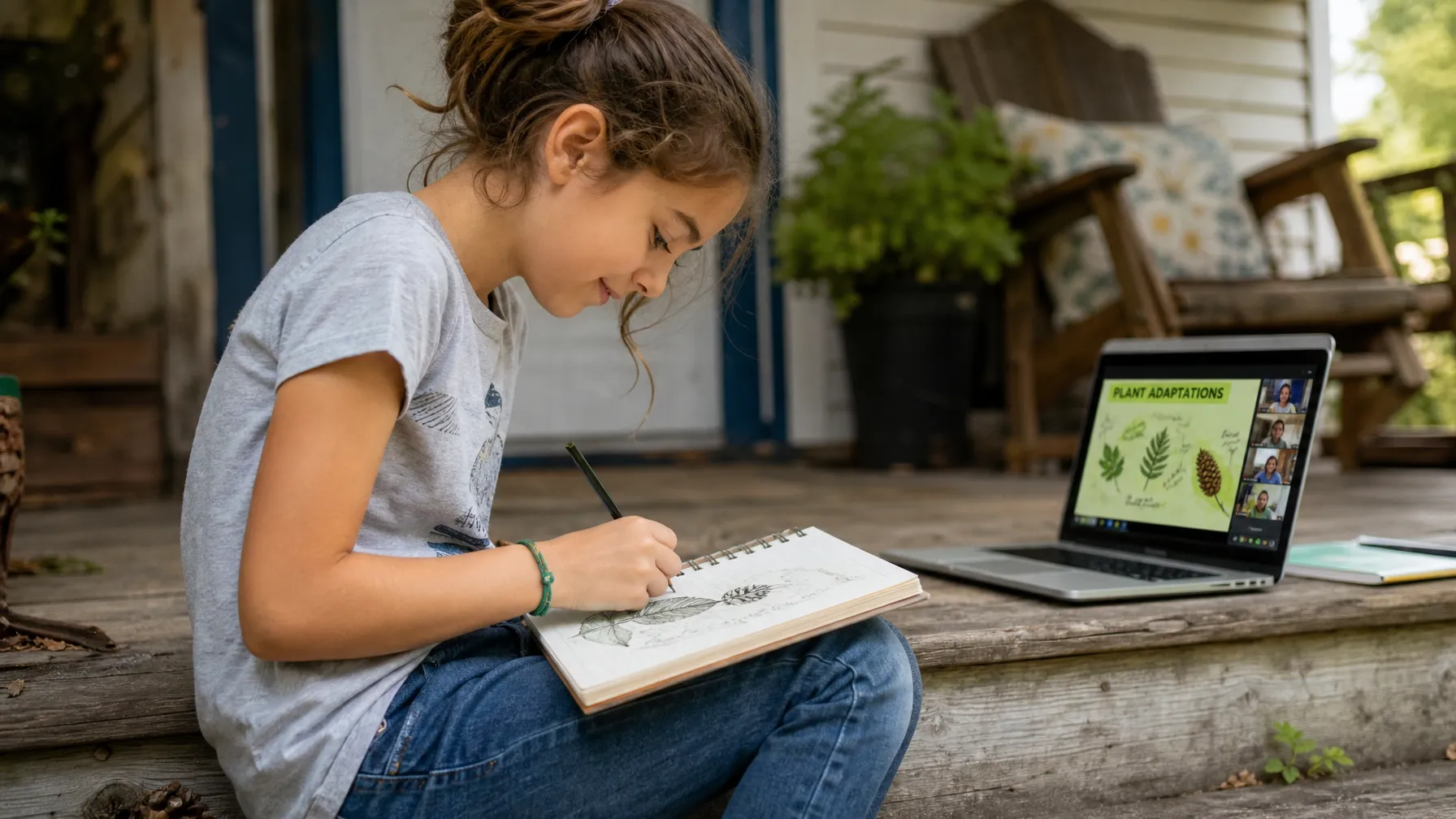
Nature study is one of the most recognizable Charlotte Mason practices. Kids spend time outdoors observing the natural world — identifying plants, watching insects, noting changes in a bird's nest across the weeks — and recording observations in a nature journal. The purpose isn't to learn a species list. It's to develop careful attention, a love of the natural world, and the habit of noticing things most people walk past.
Short lessons
Charlotte Mason believed in keeping academic lessons short — often 15 to 20 minutes for younger kids, 30 to 45 minutes at most for older ones. The idea is that a fully engaged child absorbs more in 20 focused minutes than in an hour of distracted slogging. Short lessons also mean variety: a typical CM morning might include a short reading session, narration, math, a nature walk, and handicrafts — each a discrete, energized chunk of time.
Habit training
Mason placed enormous weight on habits: attention, truthfulness, kindness, follow-through. She believed that habits formed in childhood become the architecture of character. CM homeschoolers work on one habit at a time, slowly and deliberately, rather than addressing behavior as isolated incidents.
Artist and composer study
Charlotte Mason included formal exposure to great art and music as a regular part of life — not as a separate "arts class." Families might spend a few weeks studying one artist's work, looking at prints and noticing technique and mood. Then a composer, listening to pieces and learning about the person behind them. This is one of the most accessible parts of CM for modern homeschoolers: you don't need expertise, just curiosity and consistency.
A typical Charlotte Mason homeschool day
No two CM families look exactly alike, but a morning might run something like this:
Morning
- Poetry or scripture reading (15 minutes)
- Nature journal or outdoor time (30-45 minutes)
- Narration from yesterday's living book (10-15 minutes)
- Math lesson — short and focused (20-30 minutes)
- Reading aloud together (20 minutes)
Afternoon
- Handicrafts or free-form art
- Independent reading time
- Composer or artist study (2-3 times per week)
The rhythm is unhurried. Afternoons are largely unscheduled. Charlotte Mason strongly believed in the value of free, unstructured time for imaginative play and independent exploration.
What ages does the Charlotte Mason method work for?
One of the strengths of the CM approach is how well it scales across ages.
Ages 6-9 (Form 1): Narration is oral, lessons are very short, and nature study forms the backbone of science. Reading aloud is central. Very little is done in writing yet.
Ages 10-12 (Form 2): Written narration begins alongside oral. The book list broadens. History and science deepen, still through living books.
Ages 13+ (Form 3 and beyond): Longer essays, more independent research, and the addition of subjects like rhetoric and classical languages for families who want them. The living books approach continues through high school.
Charlotte Mason vs. classical homeschooling: what's the difference?
Both Charlotte Mason and classical education have a reputation for being rigorous and literature-rich. The core difference is the mechanism of learning.
Classical education (especially the trivium model) emphasizes grammar, logic, and rhetoric as developmental stages — drilling facts in the early years, training argument in the middle years, expressing ideas in the later years. It can lean on explicit memorization.
Charlotte Mason resists drill and rote memorization. She believed that children engage with ideas best through whole, living encounters — not fragmented facts extracted from context. There's genuine overlap, but the philosophy of how children learn is meaningfully different.
Is the Charlotte Mason method a good fit for your family?
The CM approach tends to work well for families who enjoy reading aloud together and want literature at the center of their homeschool, who value slow, deep, unhurried learning over coverage and checklists, and who prefer low-pressure mornings over rigid time-blocking.
It can feel under-structured to parents who want clearly defined grade-level benchmarks or who are anxious about falling behind. If that describes you, it's worth exploring how CM families track progress — many use portfolios and oral narration records rather than tests.
Supplementing Charlotte Mason with live classes
One of the things modern CM families love about Outschool is how naturally live classes fit into a CM rhythm. A weekly online art class with an enthusiastic teacher can anchor your artist study rotation. An online science class focused on marine biology or astronomy gives nature study a live, interactive dimension. Music classes bring composer study to life in a way that recordings alone can't.
Because Outschool classes are pay-per-class with no subscription required, you can add one class to test the waters and build from there — fitting perfectly with the CM value of pursuing depth over breadth.
Browse homeschool classes on Outschool to explore what's available by subject and age.
Frequently asked questions
Is Charlotte Mason a complete curriculum?
It's more of a philosophy than a packaged curriculum. Many families use CM-aligned guides (like AmblesideOnline, which is free, or My Father's World) to structure their book selections and lesson plans. Others build their own using Mason's original books as a guide.
How much does a Charlotte Mason homeschool cost?
It's one of the more affordable approaches because it relies on library books, nature journals, and real-world materials rather than expensive textbooks. The main costs are your book lists (often available at the library) and any supplement classes or programs you add.
Does Charlotte Mason work for kids who struggle with reading?
Yes, with adjustments. The method's emphasis on reading aloud means a child who isn't yet a strong independent reader can still engage deeply with living books through listening. Online reading classes and specialized literacy support can complement a CM approach for kids who need additional scaffolding.
What is narration and how do I start?
Start small. After reading a chapter aloud, ask your child: "Tell me what happened in that story." Don't coach or correct — just listen. For younger kids, even a one-sentence retelling counts. The skill builds naturally over time.
Can Charlotte Mason work alongside Outschool classes?
Very well. Because CM lessons are short and afternoons are intentionally unstructured, there's natural room for a live class several times a week. Many CM families use Outschool for the subjects they want taught by an enthusiastic specialist — a nature science class, a creative writing class, or a foreign language. Try a class today — no commitment required.