Why a book club works differently for homeschoolers
Most book club advice assumes a classroom setting: 25 kids, one teacher, a district-approved reading list, and 45 minutes of structured discussion. None of that applies here.
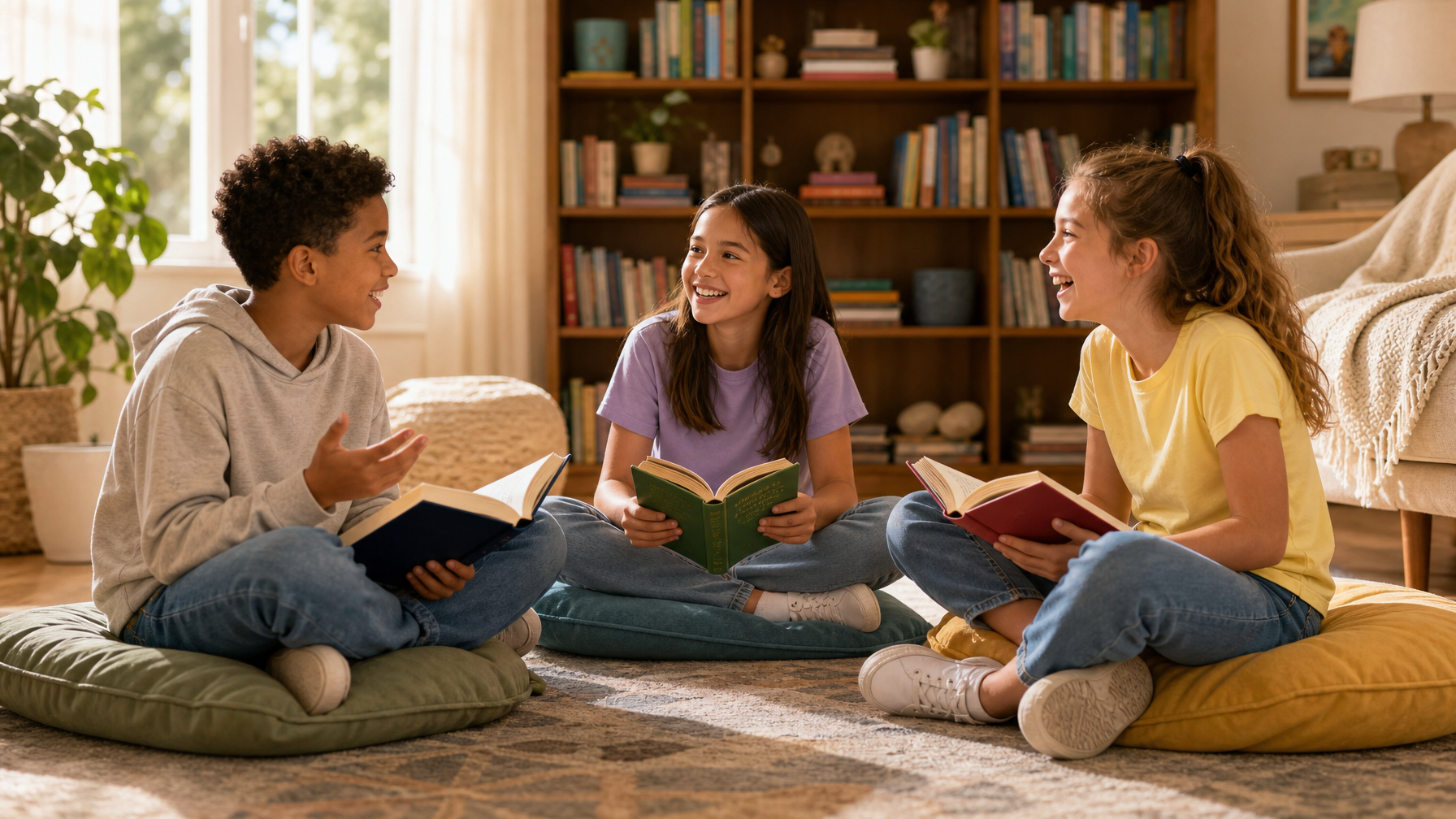
A homeschool book club is closer to a dinner party for readers. It's small, flexible, driven by interest rather than assignment, and only as formal as the families want it to be. That flexibility is its biggest strength and, if you're not careful, the thing that kills it.
Research backs up why discussion-based reading works so well. A meta-analysis by Murphy and colleagues found that structured discussion of text significantly improved students' comprehension, critical thinking, and reasoning about what they read, with effects stronger in small-group formats than whole-class instruction [1]. A homeschool book club is essentially the ideal size for those gains.
Choosing the right age range (and why tighter is better)
The single biggest factor in whether a homeschool book club thrives or fizzles is the age span of the kids involved.
Tight age band (2 years): Easiest to run. Everyone reads the same book at roughly the same level. Discussion flows naturally because the kids are processing the story with similar maturity. Best for ages 8 and up.
Moderate age band (3 to 4 years): Workable with the right book selection. Chapter books with layered themes (like Hatchet or Tuck Everlasting) give younger readers an adventure while older readers pick up on deeper questions. A 9-year-old and a 12-year-old can both enjoy The One and Only Ivan, but they'll talk about different things.
Wide age band (5+ years): Harder to sustain unless you use a read-aloud format where a parent reads to the group and facilitates discussion at multiple levels. This works surprisingly well for ages 5 through 10 with picture books or short chapter books, but falls apart once older kids feel like the material is "for babies."
A good rule: if you're choosing a shared novel, aim for the Lexile range of the youngest strong reader in the group. Stretch up slightly for challenge, but don't stretch so far that anyone is struggling to follow the plot.
Four book club formats that work for homeschool families
There's no single "right" way to run a book club. The format should match the ages, the number of families, and how much structure the group wants.
Format 1: the in-person read-and-discuss
Best for: ages 6 to 12, groups of 3 to 6 kids, families in the same area
Everyone reads the same book (or the same section) before meeting. Kids gather at one family's home, a library, or a park. Discussion lasts 30 to 60 minutes, often with a related activity: drawing a scene, writing an alternate ending, or doing a craft connected to the book's setting.
Frequency: every 2 to 4 weeks, depending on book length
What makes it work: a parent who prepares 3 to 5 open-ended discussion questions ahead of time. "What surprised you?" and "Would you have made the same choice as the main character?" are better than "What happened in chapter 3?"
Format 2: the online book club
Best for: ages 9 and up, geographically scattered families, kids who are more comfortable typing than talking
The group reads the same book and meets via video call. Some online book clubs also use a shared document or discussion board between meetings so kids can post reactions as they read. Outschool's live book club classes run in this format with a teacher facilitating, which takes the planning load off parents entirely.
Frequency: weekly (for shorter books or chapter-by-chapter discussion) or biweekly
What makes it work: a camera-on policy and a facilitator who calls on quieter kids by name. Online discussions die when two kids dominate and three kids watch silently.
Format 3: the parent-led read-aloud club
Best for: ages 4 to 8, mixed-age sibling groups, new-to-book-clubs families
A parent reads a chapter or picture book aloud to the group, then leads a short conversation. This format is especially strong for younger kids who can listen and discuss at a higher level than they can read independently. It also works well for reluctant readers who love stories but resist the act of reading.
Frequency: weekly, 30 to 45 minutes total
What makes it work: choosing books with illustrations, humor, or cliffhangers that make kids beg for "one more chapter"
Format 4: the genre rotation club
Best for: ages 10 and up, kids who already read independently, groups that want variety
Each month, the group picks a different genre: mystery, historical fiction, science fiction, memoir, graphic novel, poetry. Members choose any book within that genre and come to the meeting ready to pitch their pick and compare notes. This format respects individual reading preferences while still creating shared conversation.
Frequency: monthly
What makes it work: the "pitch" element. Kids practice public speaking and persuasion without realizing it, and they leave with a reading list they built themselves.
How to pick books that start good conversations
The book selection makes or breaks the discussion. Here's what to look for:
- Moral complexity. Books where the main character faces a hard choice with no clear right answer give kids something to argue about. The Giver (ages 12+), Hatchet (ages 10+), and Wonder (ages 8+) all work because reasonable people disagree about what the characters should have done.
- A world different from the reader's. Historical fiction, fantasy, and books set in other countries or cultures push kids to compare the book's world to their own. That comparison is where the best discussions happen.
- Characters close to the readers' age. Kids engage more deeply when the protagonist is facing problems they can imagine facing themselves. A 10-year-old reading about a 10-year-old navigating a new school will have more to say than if the protagonist is 30.
- Short enough to finish. An ambitious 400-page novel sounds impressive, but if half the group doesn't finish it, the discussion is dead on arrival. For monthly clubs, aim for 150 to 250 pages for elementary and 250 to 350 for middle school. Save the doorstoppers for summer.
- Available in multiple formats. Check whether the book has an audiobook version. Some kids process stories better by listening, and pairing the audiobook with a print copy lets a wider range of readers participate fully. Audiobooks are a feature, not a shortcut.
One more tip: let the kids vote. A book club that reads parent-chosen books feels like school. A book club that reads kid-chosen books feels like a club.
What kills a homeschool book club (and how to prevent it)
Most homeschool book clubs don't fail because of bad book choices. They fail because of logistics, unspoken expectations, and one or two dynamics that sour the group. Here are the most common killers:
1. The scheduling spiral
Five families try to find a day that works for everyone. They can't. They push the meeting. Then push it again. Then three months go by and the book club is a memory.
Prevention: Set a recurring day and time before you pick the first book. "First Tuesday of every month at 2pm" is non-negotiable. If someone can't make it, they skip that month. The club continues.
2. One kid who hasn't read the book
It happens. The risk is that it becomes a pattern, and the kids who did read start to feel like their effort doesn't matter.
Prevention: Keep the reading load manageable. 100 to 150 pages per month for elementary, 200 to 250 for middle school. If a kid consistently doesn't finish, check whether the books are too long, too hard, or just not interesting to them. Switching to a genre rotation format can help.
3. The parent who takes over discussion
Well-meaning parents sometimes turn book club into a lecture. They explain the themes, correct the kids' interpretations, and answer their own questions.
Prevention: The facilitating parent's job is to ask questions and then wait. Count to 10 in your head after asking. The silence feels awkward, but it's where the thinking happens. If a kid gives a "wrong" interpretation, ask "What in the book made you think that?" instead of correcting.
4. The group that never gels socially
Sometimes the kids don't click. Maybe the age range is too wide, or the personalities clash, or one kid is significantly more or less advanced as a reader.
Prevention: Start with a trial period of three meetings. If it's not working, it's easier to dissolve a three-meeting experiment than a "permanent" club. No hard feelings.
5. Books that don't generate discussion
Some books are enjoyable to read but have nothing to argue about. If everyone agrees the book was "good" and then sits in silence, the book was the problem.
Prevention: Choose books with moral complexity, ambiguous endings, or characters who make questionable decisions. "Was the main character right to do that?" is the question that unlocks the best conversations.
Discussion questions that work better than "What did you think?"
Generic questions get generic answers. Here are question types that pull real thinking out of kids:
The moral dilemma question: "Was [character] right to [action]? What would you have done?" This works because it forces kids to take a position and defend it. With Tuck Everlasting (ages 10+): "Would you drink the water? Why or why not?"
The evidence question: "What in the book makes you think that?" Use this as a follow-up whenever a kid makes a claim about a character's motivation or the author's intent. It teaches close reading without sounding like a worksheet.
The connection question: "Does this remind you of anything in your own life?" or "Have you ever felt the way [character] felt in that scene?" These questions bridge the book to lived experience, which is where the deepest engagement happens.
The author's craft question: "Why do you think the author ended the chapter there?" or "What would change if this story were told from [other character's] perspective?" These push kids toward thinking like writers, not just readers. They work best with kids ages 10 and up.
The disagreement question: "Who thinks [character] was brave? Who thinks they were reckless?" Splitting the room is the fastest way to get a quiet group talking. Frame it as a debate, not a quiz: there's no right answer, and the point is to hear different takes.
The prediction question: Use this mid-book if you're reading chapter by chapter: "What do you think will happen next? What clues make you think so?" Then at the next meeting, revisit: "Were you right? What surprised you?"
Extending the book club beyond reading
The best homeschool book clubs don't just read. They build experiences around the books:
- Cook a meal from the book's setting. Reading a book set in India? Make dal together. Set in the American frontier? Try hardtack (the kids will have opinions). Food makes the world of the story tangible.
- Watch the movie adaptation after finishing the book. Then discuss what the movie changed and why. "Was the book or the movie better?" is the most reliable debate starter in the history of book clubs.
- Visit a related location. A book about the ocean becomes a tide pool trip. A historical fiction novel becomes a visit to a local history museum. Even a virtual museum tour counts.
- Create something inspired by the book. Draw a scene, write an alternate ending, make a map of the book's world, design a new cover, or record a "book trailer" video. Creative responses reach kids who process stories better through making than through talking.
- Write letters to the author. Many children's and YA authors respond to reader mail, especially from homeschool groups. A handwritten letter that references a specific scene or question from the book is more likely to get a reply than a generic "I liked your book."
- Start a shared reading journal. Pass a notebook around the group between meetings. Each kid writes a reaction, a favorite quote, a question, or a drawing. By the end of the year, the journal becomes a record of everything the club read together.
Building a book club for your homeschool co-op
If you're already part of a homeschool co-op, a book club is one of the easiest activities to add. It requires no curriculum, minimal supplies, and works for any size group if you split into age bands.
Here's a simple co-op book club structure:
- Split into two or three age bands. Ages 5 to 7 (read-aloud format), ages 8 to 11 (shared novel), and ages 12 and up (independent choice within a genre). Each band picks its own book and meets separately.
- Rotate the facilitator role monthly. One parent per band leads discussion that month, prepares 4 to 5 questions, and brings any activity materials. This spreads the work so no one burns out.
- Meet on the same day as co-op. Adding a separate book club day to already-busy schedules is the fastest way to kill attendance. Tack book club onto the end of an existing co-op day, even if it's just 30 minutes.
- Build a shared book list at the start of each semester. Have kids nominate titles, then vote. Post the reading calendar so families can check books out from the library early. Knowing the schedule three months out prevents the "I didn't know what we were reading" excuse.
- End each semester with a book celebration. A potluck where each age band shares their favorite book of the semester, a costume day where kids dress as characters, or a book swap where everyone brings a book to trade. The celebration gives the club a rhythm and something to look forward to.
Frequently asked questions
How many kids should be in a homeschool book club?
Three to six is the sweet spot. Fewer than three and it feels like a playdate with an assignment. More than eight and quiet kids stop participating. If you have a larger group, split into two clubs by age.
What if my kid is a reluctant reader?
A book club can be the thing that changes that, but only if the books are chosen well. Start with graphic novels, audiobook-and-print combos, or books with short chapters. Reluctant readers often engage more when they know other kids are reading the same book and they'll get to talk about it.
Can we do a book club with kids at very different reading levels?
Yes, with the right format. A parent-led read-aloud works for wide age spans. For independent readers at different levels, try the genre rotation format where everyone reads a different book in the same genre. Audiobooks can also level the playing field for kids whose listening comprehension outpaces their reading fluency.
How do I handle a kid who spoils the ending?
Set a ground rule at the first meeting: no spoilers beyond the assigned chapters. If the group reads the whole book before meeting, this isn't an issue. If you're reading chapter by chapter, the "no spoilers" rule is essential and kids take it seriously once it's stated explicitly.
Do we need to stick to one genre?
Not at all. Variety keeps the club fresh. Alternating between fiction and nonfiction, or between a parent-chosen book and a kid-chosen book, prevents the "we always read the same kind of thing" complaint that kills momentum around month four.
Getting started this week
You don't need a curriculum, a lesson plan, or a perfect reading list. You need two or three families, one book everyone is willing to try, and a date on the calendar. Start there. The rest will sort itself out.
If your kid wants to try a book club with a teacher leading the discussion, Outschool's live book club classes run in small groups across dozens of genres and age ranges. It's a low-commitment way to see whether the format clicks for your kid before you build one from scratch.
Sources
[1] Murphy, P.K., Wilkinson, I.A.G., Soter, A.O., Hennessey, M.N., & Alexander, J.F. "Examining the effects of classroom discussion on students' comprehension of text." Journal of Educational Psychology, 101(3), 2009. https://psycnet.apa.org/doiLanding?doi=10.1037/a0015576


.svg)
.svg)