August's planner looked so clean. By the winter break, it often looks like a grocery list that lost a fight with a work calendar. Mid-year here means the middle of the school year, around the holidays, not the middle of the calendar. Homeschool burnout for working parents is rarely about one bad week. It is the slow pile-up of being the teacher, the project manager, and the person who still has to answer Slack.
This guide is a mid-year reset, not a pep talk. You do not have to throw the curriculum. You do not have to quit your job. You can shrink the load, keep the year legal and honest, and get some of the week back.
What homeschool burnout looks like when you also work
Christina Maslach's burnout research names three pieces: exhaustion, cynicism, and a sense that nothing you do is enough. The World Health Organization later described burnout as an occupational phenomenon from chronic workplace stress that has not been managed. Homeschooling is not a job in the payroll sense, but many working parents are carrying two full roles in one day. [1] [2]
Parental burnout research from Moïra Mikolajczak and Isabelle Roskam is useful here. Their Balance between Risks and Resources framework says burnout shows up when the demands of parenting stay high and the resources stay thin for a long stretch, not because a parent is weak. [3]
For working homeschool parents, that imbalance often looks like:
- You dread opening the math book more than your kid does.
- Evenings disappear into catch-up lessons after a full workday.
- You keep buying new materials because the current stack feels like a personal failure.
- You snap at small questions, then feel guilty, then add more to the plan.
If your kid is the one who looks depleted, that is a different article. Our guide to burnout in gifted kids covers one form of student-side burnout. This one is about the parent holding the year together.
A 2-week reset, not a full restart
A reset works when it is short and specific. Two weeks is long enough to see what is draining you, and short enough that you can still finish the year.
Write three lists on one page. Keep them ugly. This is a working document, not a vision board.
- Must stay. State hours or subjects you have to document. Anything tied to a transcript, a required test, or an ESA receipt.
- Can pause. Extra workbooks, the co-op job you volunteered for in August, the unit study that needs a craft store run.
- Can hand off. One subject your kid can do with a live class, a co-parent, a grandparent, or independent reading.
Then pick one hand-off for the next two weeks. Not five. One. If you work full time, our guide to homeschooling while working full-time has schedule patterns you can steal without rebuilding the whole week.
Cut the week down to a core stack
Mid-year burnout often comes from running a September schedule in January energy. Many families do better with a smaller core:
- One literacy block (reading plus a short writing task)
- One math block
- One "everything else" block that rotates science, history, or life skills
That is three blocks, not eight subjects. Log the time you already spend in the kitchen, on errands, and in conversation if your state counts it. If you need a sanity check on hours, use homeschool hours by grade instead of guessing what a school day "should" look like.
For the two-week reset, cancel anything that requires you to teach live at 4pm after meetings. Move those subjects to morning independent work, a recorded lesson, or a class that happens while you are already at your desk.
Use ESA funds or programs like OpenEd if available in your state
If you have an education savings account or a similar program, a mid-year reset is a good time to spend on help instead of more books. Check what your program allows, then use funds for tutoring or live classes in the one subject that is eating your evenings. Start with our ESA explainer if you are still mapping which expenses clear.
If those funds are available in your state, use them on the one subject eating your evenings: tutoring or a live class that happens while you work. Skip them if your state does not offer ESA or OpenEd. The unpaid hand-off still works: a co-parent, a grandparent, or independent work with an answer key.
$20 off your first class WITH promo code: blog
Build the Education your Kid Deserves
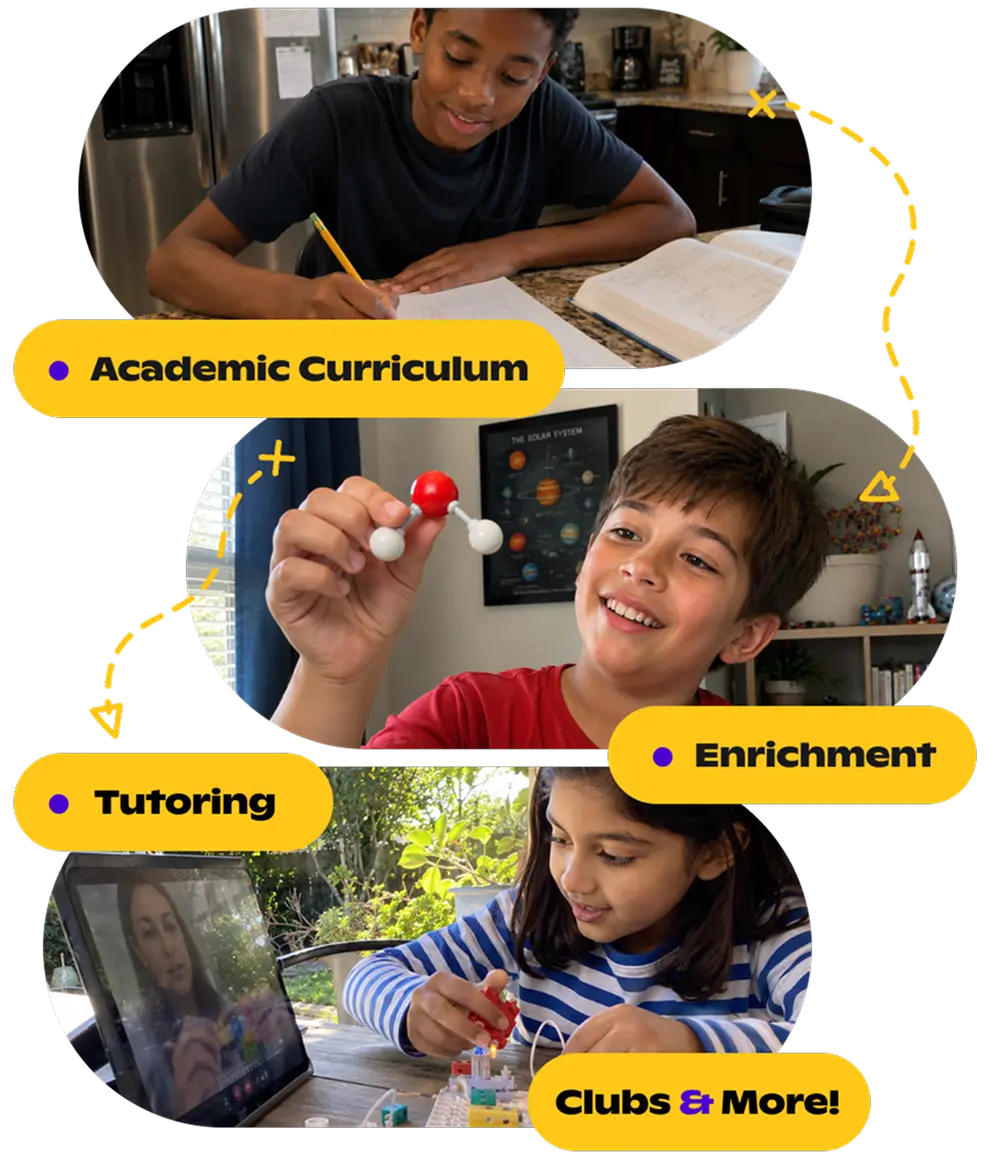
Discover thousands of live classes taught by expert teachers, across academics and enrichment.
Browse classesHand off one subject without dropping the year
The hand-off that helps most is the subject that creates the most parent-kid friction after work. For many families that is math or writing.
Options that do not require you to become a curriculum designer at midnight:
- A short live online class on a set weekday, so the teaching is not on you.
- A 1-to-1 tutor for 30 minutes, twice a week, while you take a work call.
- Independent work with an answer key you check once, not in real time.
Browse homeschool classes for a slot that already fits the workday you have, not the one you wish you had.
Watch for: resets that make the pile bigger
A reset fails when it becomes a shopping trip. Watch for these traps:
- Buying a new all-in-one program in January because winter break felt messy.
- Adding a 12-week class on top of the old stack instead of swapping.
- Promising your kid a "fun Friday" you then staff with four activities.
- Measuring the year only by pages finished, with no credit for the hours you already logged.
If you are stuck on records, progress, or "are we even doing this," how to assess homeschool progress is a calmer measuring stick than a guilt inventory.
A sample mid-year week for a working parent
This is a sketch for after the holidays, not a prescription. Swap days to match your job.
- Monday. Literacy and math before work. Live class or tutor for the hard subject while you work. No evening lesson.
- Tuesday. Independent reading plus one worksheet you already own. Outdoor time counts if your state allows it.
- Wednesday. Repeat Monday's live slot. Kitchen math or a documentary in the evening if anyone has energy. If not, stop.
- Thursday. Writing is scribed if motor load or writing anxiety is in the mix. Many kids can talk the paragraph while you type.
- Friday. Light review, library, or a co-op. Protect one afternoon that is not instructional.
If mornings are the only overlap you have, a small morning basket can hold read-alouds and check-ins so the rest of the day is not a scavenger hunt for school.
When the reset is not enough
Two weeks of a smaller stack should take the edge off. If you still cannot get out of bed for the homeschool part, or you feel unsafe with your own temper, that is bigger than a schedule tweak. Talk to a clinician. Homeschool community advice is not a substitute for care.
You can also ask for practical help: a spouse taking one subject, a drop in co-op hours, or pausing a volunteer role through spring. Mid-year changes are allowed. The year is not a contract with August-you.
FAQ
Is homeschool burnout the same as hating homeschool?
Often it is not. Many parents still want this path and are simply out of hours. Burnout is chronic overload. Dislike is a values question. You can feel both, and they need different next steps.
Can I pause a boxed curriculum mid-year?
Yes, if you keep whatever your state requires for records. Pause the extras. Keep a simple log of reading, math, and real-life learning so you are not reconstructing the year in May.
What if my kid is burned out too?
Shrink together. Drop overlapping extras, keep one shared interest, and treat rest as part of the week. If the signs are more about gifted intensity or school-style overload, start with the gifted-kid burnout guide linked above.
Does hiring a class mean I am not really homeschooling?
No. Plenty of homeschool years include tutors, co-ops, and live online classes. You are still the parent of record. You are allowed to not be the only teacher in the building.
Sources
[1] World Health Organization. "Burn-out an occupational phenomenon: International Classification of Diseases." May 28, 2019. https://www.who.int/news/item/28-05-2019-burn-out-an-occupational-phenomenon-international-classification-of-diseases
[2] American Psychological Association. "Why we're burned out and what to do about it, with Christina Maslach, PhD." https://www.apa.org/news/podcasts/speaking-of-psychology/burnout
[3] Mikolajczak, M., and Roskam, I. "A Theoretical and Clinical Framework for Parental Burnout: The Balance Between Risks and Resources (BR2)." Frontiers in Psychology, 2018. https://pmc.ncbi.nlm.nih.gov/articles/PMC6006266/



.svg)
.svg)