Homeschool room ideas: how to set up a learning space that actually works

<h2>You don't need a dedicated room to have a great homeschool space</h2>

Search "homeschool room ideas" and you'll find a lot of Pinterest-perfect dedicated classrooms with wall-to-wall bookshelves and a teacher's desk. Most homeschool families don't have that room to spare, and they don't need it. What actually moves the needle isn't square footage. It's whether materials have a defined home and whether the space signals "we're doing school now" when it's time to focus.

Research on classroom environments from the National Center for Education Statistics points to the same pattern seen in traditional classrooms: kids stay on-task longer when materials are organized and visually predictable, and they transition between activities more smoothly when the physical space cues the shift. You can build that at a kitchen table corner as easily as in a converted bedroom.

Dedicated room vs. shared space: how to decide

A dedicated room makes sense if:

  • You have more than two kids doing schoolwork simultaneously
  • You're teaching subjects that need to stay set up between sessions (art projects, science experiments, unfinished LEGO builds for a unit study)
  • A closed door helps a sensory-sensitive kid focus

A shared space works fine, and is often better, if:

  • You have one or two kids and value flexibility over separation
  • Your homeschool day moves between rooms anyway (reading on the couch, math at the table, science in the kitchen)
  • You want to avoid the "school room" feeling entirely and prefer to blend learning into normal family life

Neither option is more legitimate than the other. The families who struggle are usually the ones without a system, not the ones without a room.

Storage that's organized by subject, not by "stuff"

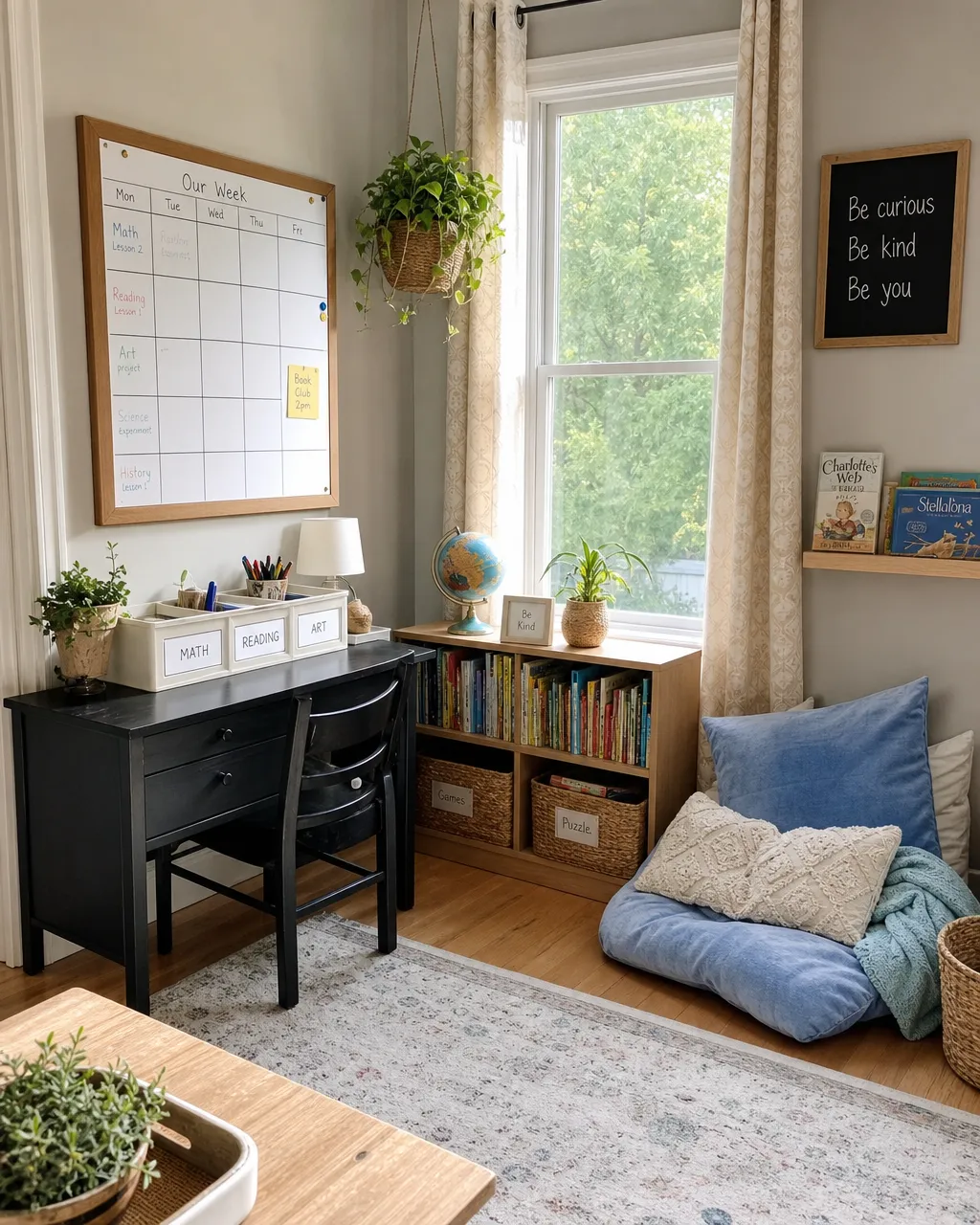
The single highest-leverage homeschool room upgrade is subject-based storage: one bin, shelf, or drawer per subject, clearly labeled, so a kid can grab what they need without asking. This does two things. It cuts down on the daily friction of finding materials, and it gives kids a visual sense of what today's subjects are.

A simple system:

  • Clear bins or magazine files, one per subject (math, reading, art, science)
  • A rolling cart if space is shared with another room function, so it can tuck away
  • A "current unit" tray or shelf, separate from long-term storage, for whatever's actively in use
  • A finished-work bin or wall for portfolio documentation, since most states require some form of progress record
$20 off your first class WITH promo code: blog
Let them lead.
Watch them grow.
This summer, give kids the power of choice. Live and self-paced classes with real teachers in the subjects they’re actually excited about.
Browse classes

Sensory-friendly design for neurodivergent learners

For kids who are easily overstimulated or under-stimulated, small design choices matter more than decor:

  • Reduce visual clutter on walls directly in a child's line of sight at their workspace. Save busy decor for areas outside the primary focus zone.
  • Add a defined quiet corner with floor cushions or a small tent for regulation breaks, separate from the main work area.
  • Use natural or warm lighting where possible; harsh overhead fluorescent lighting is a common overstimulation trigger.
  • Offer alternative seating, a wobble stool, floor cushion, or standing option, since forcing a single seated posture for a fidgety or sensory-seeking kid usually backfires.
  • Keep a noise-reducing option on hand (headphones or a white noise machine) for kids doing independent work near siblings.

Low-budget setups that still work

A functional homeschool space doesn't require a renovation:

  • A repurposed closet with a fold-down desk shelf for a compact 1:1 workspace
  • A tension rod and curtain to visually separate a "school corner" in a shared room without construction
  • Command hooks and a cork board for a rotating schedule, instead of built-in storage
  • A card table that folds flat when not in use, for families without room for a permanent desk
  • Library totes labeled by kid, so materials travel easily if the family homeschools on the go some days

Setting up for transitions, not just for looks

The biggest functional win of an organized space is reducing transition friction between subjects. A kid who has to hunt for the math workbook loses focus before the lesson even starts. A visible daily schedule (a whiteboard, a printed checklist, or a simple pocket chart) paired with subject bins means less parental narration and more independent movement from one task to the next.

If your family also uses live online classes as part of the day, keep the device setup in the same spot each time, angled so the workspace stays a learning zone and not a screen-first environment. Predictability in where and how a child logs on matters just as much as predictability in where they keep their pencils.

$20 off your first class with promo code: blog
Let them lead. 

Watch them grow.
Learn more
Related Classes

Related stories