Many homeschool curricula include some level of religious content, and it is common for subjects like history, science, and literature to include religious perspectives or references (Coalition for Responsible Home Education; NHERI). Because of this, some families are looking for a fully secular option and will need to review materials carefully or choose resources that are non-religious.
Some programs are clearly faith-based, while others are more subtle and include occasional religious references that may not align with your family. Learning how to recognize these differences makes it much easier to choose materials with confidence.
The good news is that there are many ways to build a strong, engaging homeschool experience without religious instruction. In this article, we will walk through what a secular homeschool curriculum is, how it works, and how to choose or build one that fits your family.
What Is a Secular Homeschool Curriculum?
A secular curriculum means that academic subjects are taught without religious instruction or faith-based explanations. Science is based on evidence and the scientific method; history is presented through multiple perspectives; and literature is chosen for its content and ideas rather than for religious messaging (National Academies of Sciences, Engineering, and Medicine).
It is important to note that secular does not mean a lack of values. Many secular homeschool families still emphasize critical thinking, ethics, responsibility, and respect. The difference is that these ideas are explored through discussion, real-world examples, and diverse perspectives rather than religious instruction (National Center for Education Statistics).
Understanding the differences between these terms can help you make clearer choices.
- A secular curriculum does not include religious teaching in academics
- A neutral or inclusive curriculum may avoid strong religious messaging but still include occasional references or perspectives.
- A faith-based curriculum teaches subjects through a religious lens and often integrates beliefs directly into lessons.
Knowing these differences can help you evaluate materials more confidently and choose those that align with your goals.
Main Approaches of Secular Homeschooling
There is no single way to homeschool secularly. Many families combine different approaches depending on their child’s needs and learning style.
- Structured curriculum approach: These programs outline what to teach and when to teach it. They often include textbooks, lesson plans, and assignments that follow a clear sequence. Families who prefer structure and clear direction often choose this option. Using a structured curriculum can reduce planning time and provide consistency across subjects.
- Eclectic homeschooling: This typically combines materials from different sources rather than relying on a single program. You might use a math curriculum, choose novels for reading, and complete hands-on science projects. This approach allows you to customize learning and adjust based on what works best for your child.
- Project-based or interest-led learning: In this approach, learning is organized around topics or projects rather than separate subjects. A learner might explore a topic like ecosystems through reading, writing, experiments, and discussion. This works well for students who are curious and benefit from deeper, connected learning.
- Online and class-based learning: Some families use online classes to support secular learning. These may include live or self-paced lessons in subjects like writing, science, or math. This approach can provide structure, outside instruction, and opportunities for interaction with other learners.
How Secular Homeschooling Typically Works
Once you decide to use a secular approach, the next question is how it actually looks day to day. Most families find that it comes down to planning, creating a workable routine, and choosing materials that fit their goals.
Lesson planning
Lesson planning in a secular homeschool can be as simple or as detailed as you want. Some families follow a structured plan, and others build their own by choosing topics, books, and activities for each subject. In both cases, the focus is on teaching academic content without adding a religious framework.
For example, a science lesson on ecosystems might include reading about food chains, watching a short video, and then observing plants and animals outside. The learning stays grounded in real-world concepts and evidence-based understanding (National Academies of Sciences, Engineering, and Medicine).
The key is to keep planning manageable. You do not need to map out every detail in advance.
Daily, weekly, or monthly routines
Secular homeschooling does not require a strict schedule, but having a consistent rhythm helps keep learning on track.
Some families prefer a daily routine where core subjects like math and language arts are completed each day, while science and history rotate throughout the week. Others use a more flexible weekly plan, focusing on completing specific subjects over several days rather than fitting everything into a single day.
For example, your child might work on math and writing in the morning, then alternate between science and history in the afternoon, depending on the day. Another day might include a longer project, a library visit, or outdoor learning instead of formal lessons.
Monthly planning can also be helpful for bigger goals, such as finishing a book, completing a science project, or covering a historical time period. The goal is not to follow a rigid schedule, but to create a routine that supports consistent progress while allowing flexibility.
Subjects Covered in Secular Homeschooling
Secular homeschooling covers the same core subjects as traditional education, but the content is presented without religious interpretation and often with more flexibility in how it is taught.
Reading and literature
Reading focuses on building comprehension, vocabulary, and critical thinking. Learners are often exposed to a wide range of books, including fiction, nonfiction, and diverse perspectives.
At home, this might include reading novels together, discussing themes, or exploring different genres rather than following a fixed reading list.
Writing and language arts
Writing often includes grammar, sentence structure, and the ability to express written ideas clearly. Spelling, vocabulary, and editing are often built into writing instruction rather than taught separately.
For example, a learner might write a short essay, then revise it for clarity and correct spelling with guidance.
Math
Math is typically taught in a structured way, focusing on concepts, problem-solving, and application. Secular math programs emphasize understanding rather than memorization alone.
A homeschool math lesson might include learning a concept, practicing problems, and applying it to real-life situations, such as budgeting or measurement.
Science
Science is taught using evidence-based concepts such as observation, experimentation, and the scientific method. Topics often include biology, chemistry, physics, and earth science.
At home, this might involve simple experiments, nature observation, or researching topics of interest. Resources like those from the Library of Congress can support deeper exploration through primary materials.
Social studies and history
History is typically presented using multiple perspectives and sources rather than a single narrative. Learners explore cultures, events, and systems without a religious framework guiding interpretation.
For example, a lesson might include reading about a historical event, examining primary sources, and discussing how different groups experienced it (Library of Congress).
Electives and real-world learning
Secular homeschooling often includes subjects like art, music, technology, and physical education, along with real-world experiences.
This might include coding, drawing, cooking, or exploring local museums and community events. These experiences help connect learning to everyday life.
How to Plan a Secular Homeschool Curriculum
Planning a secular homeschool curriculum does not require building everything from scratch. Most families follow a few clear steps and adjust over time.
Step 1: Decide on your overall approach
Start by choosing how structured or flexible you want your homeschool to be. You might prefer a full curriculum that outlines everything, or you may want to combine resources and build your own plan. Knowing your approach helps guide the rest of your decisions.
Step 2: Choose core subjects and priorities
Focus on the core areas first, such as math, reading, writing, science, and history. From there, you can add electives or interest-based learning. Deciding what matters most helps you avoid overloading your schedule.
Step 3: Select materials carefully
As you choose materials, look for content that aligns with a secular approach. This means checking how topics are presented, not just what is included. For example, a science program should focus on evidence-based explanations, while a history resource should present multiple viewpoints rather than a single interpretation.
Step 4: Build a simple routine
Create a routine that fits your family’s schedule and your child’s attention span. This might include completing core subjects in the morning and leaving afternoons open for projects, reading, or exploration. A simple structure makes it easier to stay consistent.
Step 5: Adjust as you go
No plan will be perfect from the start. Pay attention to what is working and what is not. If a resource feels too difficult or not engaging, change it. If your schedule feels too full, simplify it. Secular homeschooling allows you to adapt based on your child’s needs.
Popular Secular Homeschool Curricula
There are many ways to build a secular homeschool, whether you prefer structured programs, flexible resources, or a mix of both. The key is finding options that align with your goals and fit into your daily routine.
Outschool’s online curricula and classes
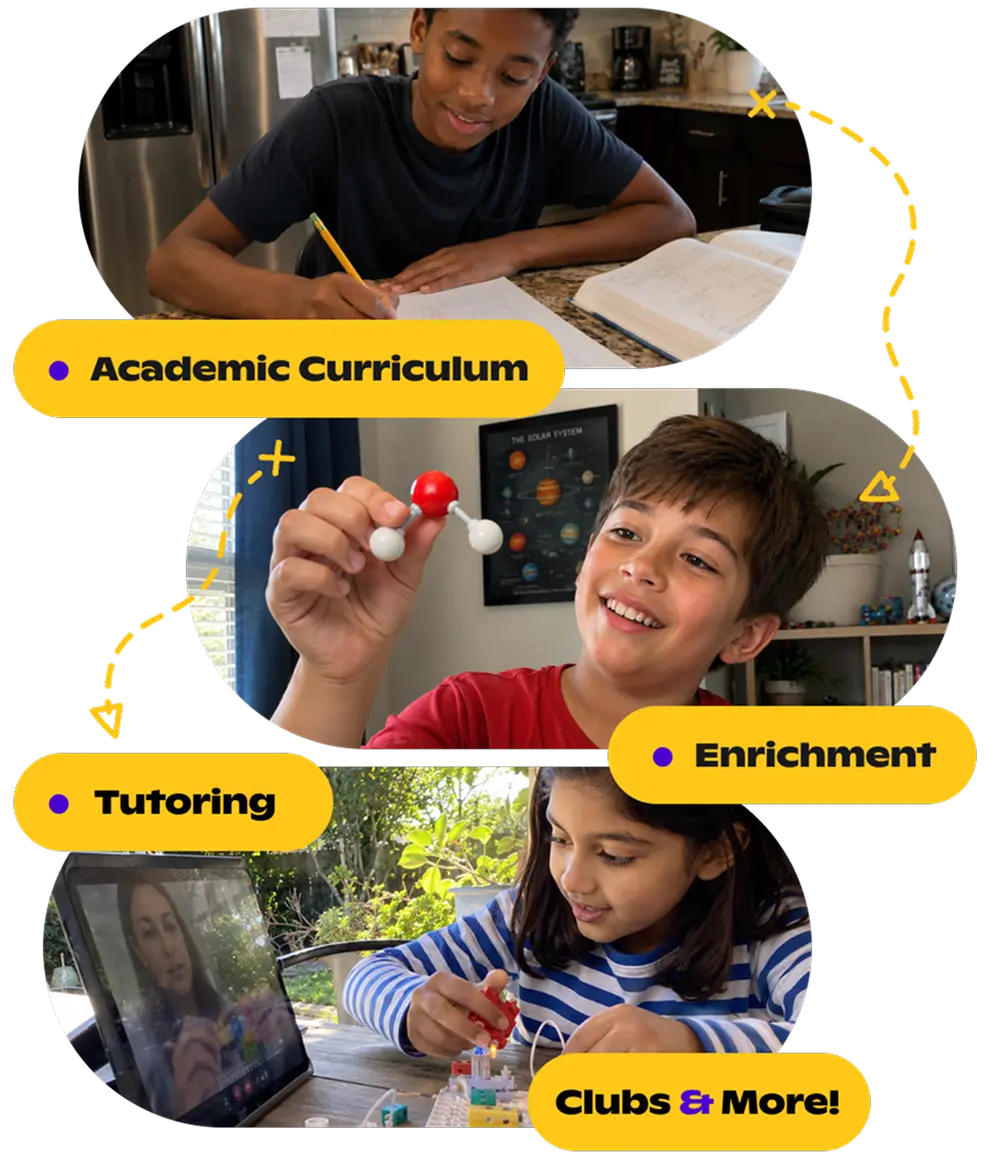
Outschool can be a key support for secular learning across subjects. Families can choose from online courses in math, science, writing, history, and more, all taught without religious framing.
One of the biggest advantages is flexibility. You can use Outschool to supplement your current curriculum or build your homeschool schedule around it. Classes often include small-group discussions, projects, and instructor feedback, which help learners stay engaged.
For example, a learner might take a writing class focused on structure and editing, a science course exploring real-world topics, or a history class examining events from multiple perspectives. These experiences allow students to learn in an interactive environment while staying aligned with a secular approach.
Structured secular curriculum programs
Some families prefer a complete curriculum that outlines lessons and progression across subjects. These programs typically include clear plans for what to teach and when, making it easier to stay organized.
This approach works well for parents who want a straightforward path and less day-to-day planning. It can also help ensure that all core subjects are covered consistently.
At home, this might look like following a daily lesson plan for math and language arts while using the curriculum’s guidance for science and history topics.
Build-your-own secular curriculum
Many homeschool families choose to create their own curriculum using a mix of books, online resources, and hands-on activities.
This approach allows you to tailor learning to your child’s interests and needs. For example, you might combine a math program with library books, documentaries, and projects for other subjects.
It also gives you the freedom to adjust quickly. If something is not working, you can replace it without needing to change an entire program.
Frequently Asked Questions: Secular Homeschool Curricula
Many parents have questions as they begin exploring secular homeschooling. These answers can help clarify common concerns.
How can I tell whether a program is fully secular or just lightly religious?
Look closely at how subjects are presented, not just the description. A fully secular program will teach subjects such as science and history without religious interpretation. If a program includes phrases that frame content through beliefs or regularly references religious ideas, it may not be fully secular (Coalition for Responsible Home Education).
How do I switch from a religious curriculum to a secular one midyear?
You do not need to wait for a new school year to make the change. Many families transition gradually by replacing one subject at a time, starting with areas like science or history. This allows you to adjust without feeling overwhelmed.
What are the pros and cons of piecing together your own secular curriculum?
Building your own curriculum gives you flexibility and allows you to tailor learning to your child. However, it can require more time and planning, especially at the beginning. Many families find a balance by using a structured program for some subjects and customizing others.
Building a Secular Homeschool That Works
A secular homeschool curriculum gives you the freedom to choose how your child learns and what perspectives shape their understanding of the world.
Whether you use a structured program, online classes, or a customized approach, the goal is the same: to create a learning environment that supports curiosity, critical thinking, and steady progress.
Sources
Coalition for Responsible Home Education. “Homeschooling: A Guide for Parents.” CRHE, https://responsiblehomeschooling.org.
Edutopia. “Project-Based Learning: A Teaching Method That Works.” George Lucas Educational Foundation, https://www.edutopia.org.
Library of Congress. “Teaching with Primary Sources.” Library of Congress, https://www.loc.gov/programs/teachers/getting-started-with-primary-sources/.
National Academies of Sciences, Engineering, and Medicine. How People Learn II: Learners, Contexts, and Cultures. National Academies Press, 2018, https://nap.nationalacademies.org/catalog/24783/how-people-learn-ii-learners-contexts-and-cultures.
National Center for Education Statistics. “The Nation’s Report Card.” NCES, U.S. Department of Education, https://www.nationsreportcard.gov.
National Home Education Research Institute. “Research Facts on Homeschooling.” NHERI, https://nheri.org/research-facts-on-homeschooling/.
Sempeles, Ellena, and Jiashan Cui. Parent and Family Involvement in Education: 2023 (NCES 2024-113). National Center for Education Statistics, U.S. Department of Education, Sept. 2024, nces.ed.gov/use-work/resource-library/report/first-look-ed-tab/parent-and-family-involvement-education-2023.



.svg)
.svg)