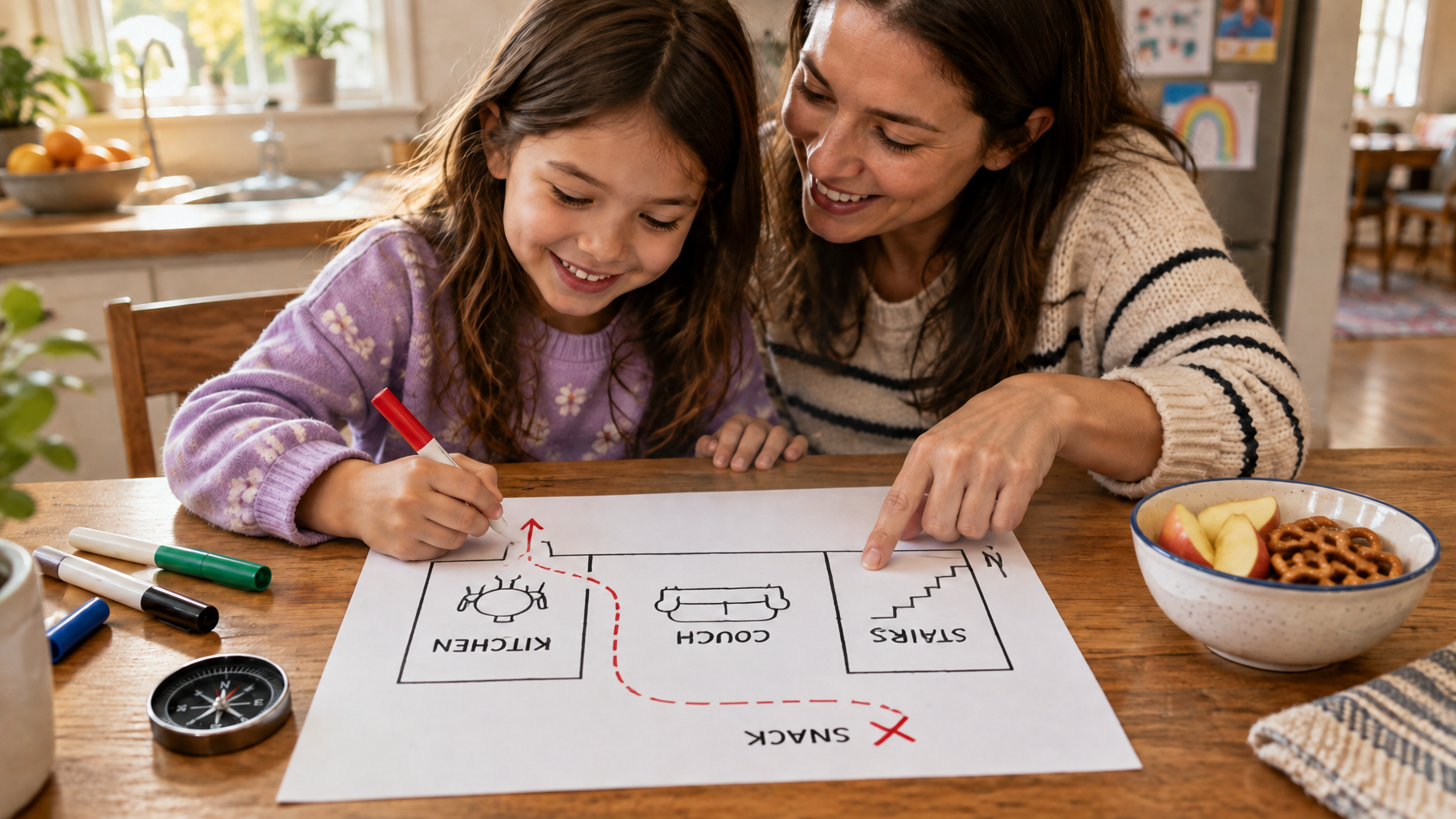
Your child sits down to study. Ten minutes later the pencil is a drumstick, the water bottle needs refilling, and somehow the dog needs checking on. If this is your evening, you are not doing anything wrong, and neither is your child.
Focus is not a character trait kids either have or lack. It is a set of skills that develop slowly, unevenly, and on a timeline most of us underestimate. Understanding what is happening in a distracted brain, and what genuinely helps, saves a lot of frustration on both sides of the desk.
Why focus is so hard for kids
The ability to sit with a task, ignore distractions, and hold a goal in mind runs through the prefrontal cortex, the part of the brain responsible for what researchers call executive function. It is one of the last brain systems to mature, and it is still developing well into the twenties [1].
So when a 7-year-old drifts off after a few minutes, that is roughly on schedule. Attention span grows with age, and expecting an elementary schooler to concentrate for a 40-minute stretch is like expecting them to reach a shelf they are still too short for. They will get there. Not tonight.
There is also a difference worth naming: a child who cannot focus and a child who will not. Genuine attention struggles look consistent across subjects and settings. Motivation gaps tend to be specific, the kid who cannot focus on math worksheets but disappears into a Lego build for an hour. Both are real, and they call for different responses. If the struggle shows up everywhere, and it is paired with other signs, it may be worth exploring further, and our guide on ADHD and homework is a good next stop.
Set up the environment before you set expectations
Where a child studies shapes how well they focus, often more than any pep talk. A few changes that move the needle:
- A consistent, dedicated spot
- A cleared surface
- The phone in another room
- Materials ready before the timer starts
- Steady light and a supportive seat
Notice that none of this is about willpower. You are lowering the number of decisions your child has to fight through to stay on task.
Work in short, timed blocks
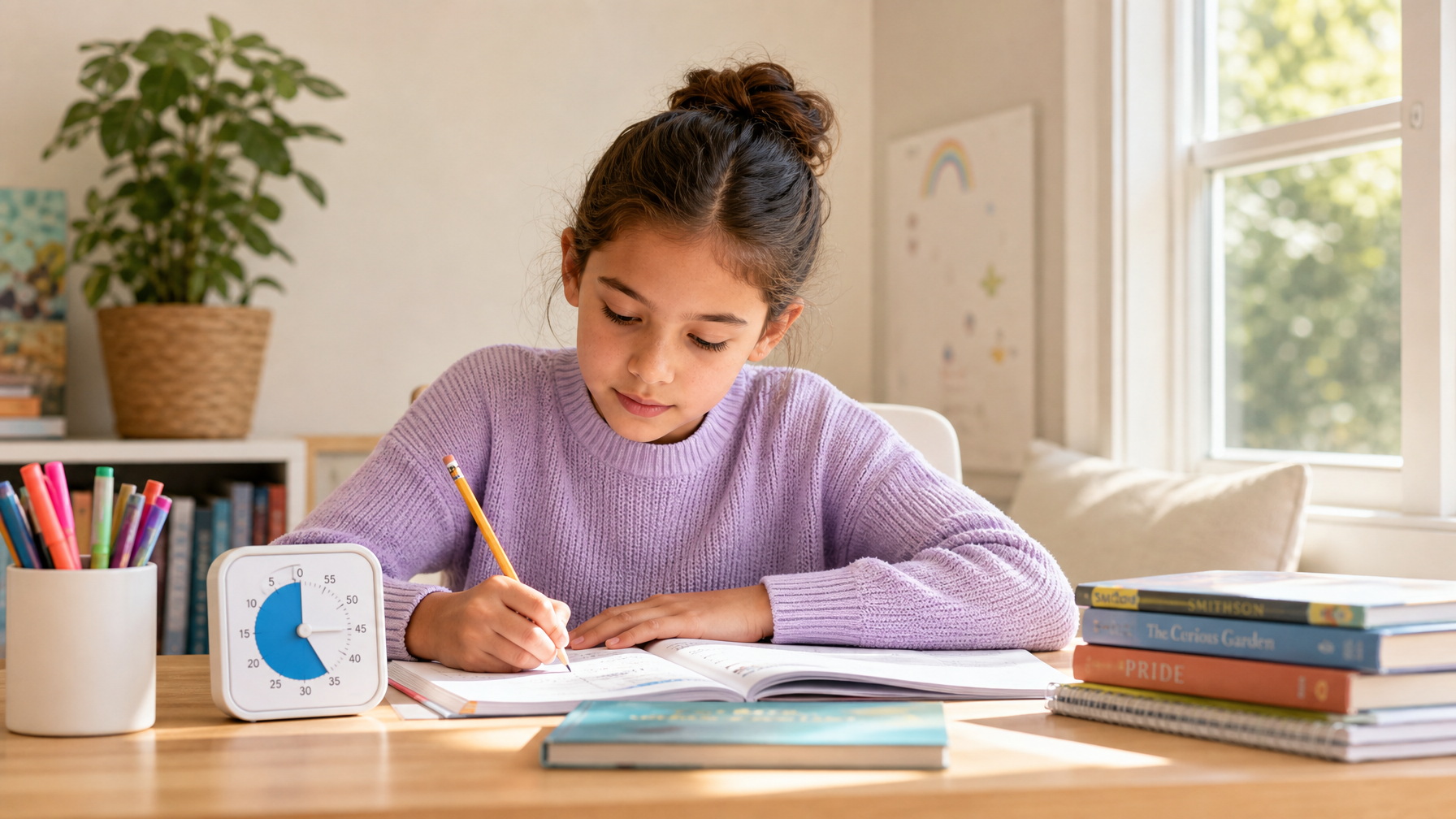
Long study sessions backfire. A better rhythm is a short focused block followed by a real break, then repeat. For younger kids that might be 10 minutes on, 5 off. For a middle schooler, 20 or 25 minutes on, 5 off.
A visual timer helps enormously here. When a child can see time shrinking, the abstract idea of "keep working" becomes concrete and finite. It also turns focus into a game against the clock rather than a fight against you. Building this into a predictable daily rhythm matters more than any single session, which is why we walk through the whole thing in our guide to a study routine that sticks.
$20 off your first class WITH promo code: blog
Build the Education your Kid Deserves
Discover thousands of live classes taught by expert teachers, across academics and enrichment.
Browse classesBuild in movement, not just breaks
Breaks are not lost time. For a distractible brain, they are part of the work. And the most useful breaks involve the body. In a study of school-age kids, a short bout of moderate physical activity improved attention and academic performance immediately afterward, with the effect especially pronounced for children who struggle most with focus [2].
So a break does not mean handing over a tablet. It means a lap around the yard, ten jumping jacks, carrying something heavy to another room. Movement resets attention in a way that scrolling does not. Screen breaks tend to make the next study block harder, not easier.
Match your approach to your child's age
Ages 5 to 7. Keep blocks tiny, 10 minutes at most, and stay nearby. At this age focus is fragile and external structure does the heavy lifting. A visual timer and a parent within arm's reach beat any lecture about concentration.
Ages 8 to 10. Start naming the strategies out loud so your child begins to own them. Introduce a simple checklist for what a study block includes. Let them set the timer themselves. This is the window where focus starts shifting from something you manage to something they manage.
Ages 11 to 13. Hand over more control. Let them plan which subject goes first and how long each block runs, then review how it went together. Middle schoolers focus better when the plan feels like theirs. Pair this with the estimation and planning skills in our time management for kids guide.
Ages 14 and up. By high school the goal is self-direction. Your job shifts to coaching, helping them notice what conditions produce their best work and troubleshoot when a system stops working. Our grade-by-grade guide to studying for a test goes deeper here.
Protect the after-school window
When focus falls apart most is right after school, when a child is already depleted. Diving straight into homework often guarantees a meltdown. A short decompression period, a snack, some movement, a little downtime, refills the tank before the real work starts. We lay out a full version of this in our after-school homework routine.
When a little structure from outside helps
Sometimes the missing ingredient is not another strategy from you. It is a different setting. A live class with a small group and a teacher keeping the pace can hold a child's attention in ways a kitchen table cannot, simply because the accountability comes from someone other than a parent. For some kids, a study-skills or executive-function class is the thing that makes the strategies finally click. You can browse study skills classes on Outschool to see what fits.
Frequently asked questions
How long should my child be able to focus? A rough rule is two to five minutes per year of age for a single sustained task, though interest, difficulty, and time of day all shift it. Expect less than you think, and build up gradually.
Is it focus or is it something more? If concentration struggles show up consistently across every subject and setting, and come with restlessness, impulsivity, or trouble following multi-step directions, it may be worth talking to your pediatrician. Our executive function activities guide can help in the meantime.
Does background music help or hurt? It depends on the child and the task. Quiet instrumental music can help some kids tune out a noisy house, while lyrics tend to compete with reading and writing. Test it and let the results decide.
What about rewards? Small, immediate acknowledgments for effort work better than big promised prizes. The goal is to help focus feel achievable, then let the sense of finishing become its own reward.
Focus is built, not summoned. Set up the environment, keep the blocks short, move the body, and adjust as your child grows. The nightly battle eases not because your child suddenly tries harder, but because the whole system finally fits how their brain actually works.
Sources
[1] Diamond, A. (2013). Executive Functions. Annual Review of Psychology. https://www.ncbi.nlm.nih.gov/pmc/articles/PMC4084861/
[2] Pontifex, M. B., et al. (2013). Exercise improves behavioral, neurocognitive, and scholastic performance in children with ADHD. The Journal of Pediatrics. https://www.ncbi.nlm.nih.gov/pmc/articles/PMC3556380/


.svg)
.svg)