The weekend version of a research paper
Most sixth through eighth graders hear "research paper" and picture a 20-page college thesis. That's not what this is. A middle school research paper runs 3 to 5 paragraphs, draws from 3 sources, and follows a predictable outline: question, evidence, argument, conclusion. The goal isn't to produce original scholarship. It's to practice finding information, evaluating it, and making a point with it.
If your kid can explain why their favorite video game is better than another one, they already understand the core skill. A research paper asks them to do it on paper, with receipts.
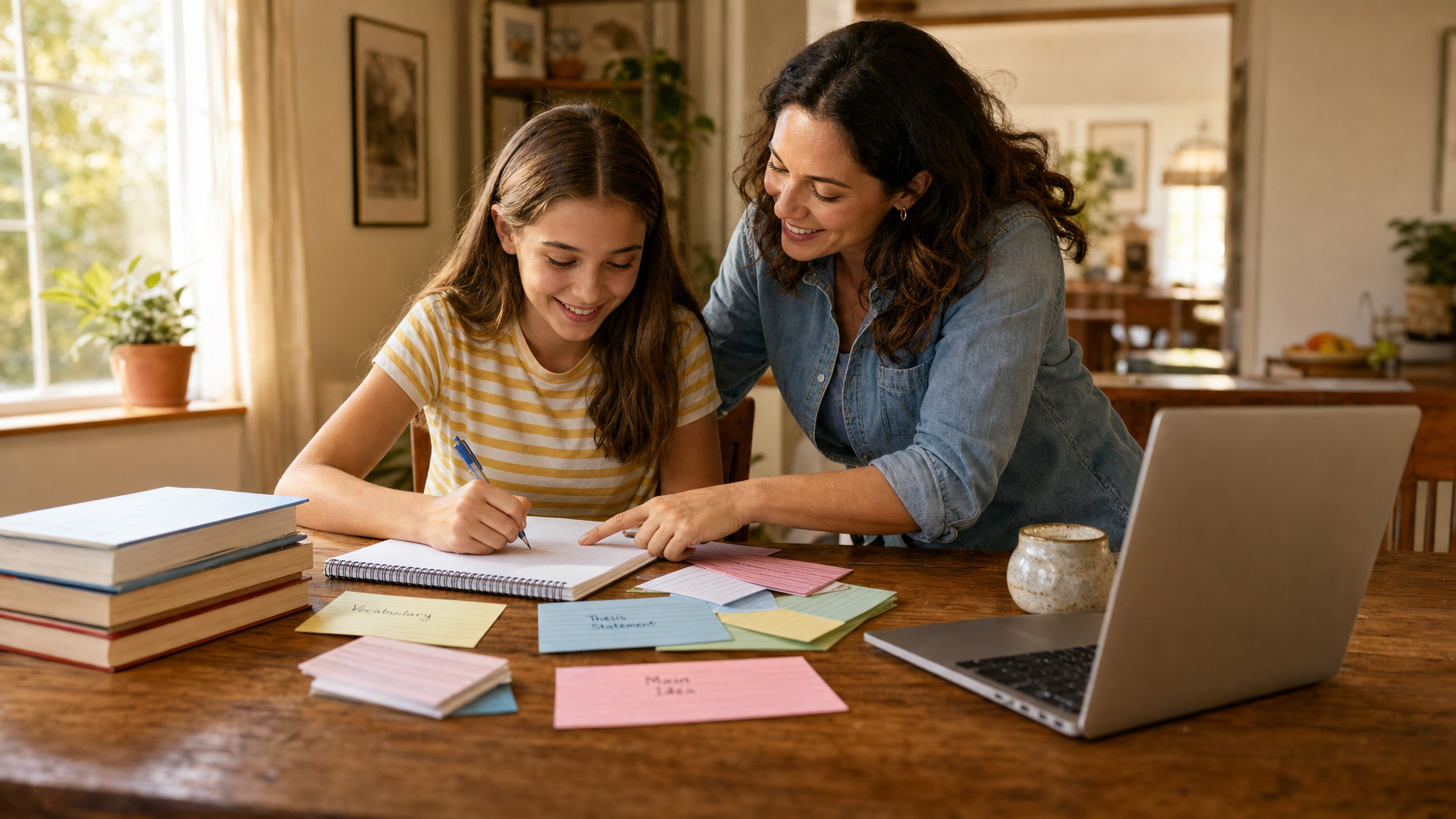
This checklist walks you through coaching a first research paper at home, from picking a topic through formatting the works cited page. You don't need to be a writing teacher. You need a weekend, a library card (or browser), and a willingness to sit through some productive frustration.
Before you start: what you'll need
- A notebook or blank document for brainstorming
- 3 source slots (we'll fill these in step 2)
- Access to a library database or kid-safe search engine
- A printer or the ability to highlight digitally
- The Purdue OWL MLA formatting guide bookmarked in a browser tab [1]
Step 1: pick a question, not a topic
"Volcanoes" isn't a research paper topic. "Why do some volcanoes erupt explosively while others don't?" is. The difference matters because a question gives your kid a built-in argument structure. Their paper will answer the question and defend the answer with evidence.
Help your kid brainstorm by listing 3 things they're curious about, then turning each one into a question that starts with "why," "how," or "should." If the question can be answered in one sentence with a Google search, it's too narrow. If it would take an entire book, it's too broad.
A good middle school research question lives in between: specific enough to answer in 3 to 5 paragraphs, open enough that the answer requires reading more than one source.
Step 2: find 3 sources (and learn why it matters)
Three sources is the standard minimum for a middle school paper, and it teaches an important principle: one source is a report, not research. Your kid needs to see the same topic from different angles before they can form their own position.
Where to find sources:
- Library databases: Most public libraries give card holders free access to databases like EBSCO or Gale. These are pre-vetted, which saves you from evaluating every result.
- Educational sites: National Geographic Kids, Smithsonian, NASA, PBS LearningMedia. These are written at a level most middle schoolers can read independently.
- Books: A relevant chapter from a nonfiction book counts as a source. It doesn't need to be the whole book.
Skip Wikipedia as a cited source (though it's useful for finding sources listed at the bottom of an article). Skip random blogs, opinion pieces, and anything without an author or publication date.
As your kid reads each source, have them write down 3 facts or quotes that relate to their question. This is the raw material for the paper.
Step 3: build the outline
This is where most kids stall, and where most parents can help the most. The outline is the skeleton. Once it exists, writing each section is filling in the bones.
A basic middle school research paper outline:
- Introduction (1 paragraph): State the question. Give one sentence of context. End with the thesis, the answer to the question.
- Body paragraph 1: First piece of evidence supporting the thesis. Name the source.
- Body paragraph 2: Second piece of evidence, different source. Connect it to the first point.
- Body paragraph 3 (optional): A counterpoint or a complication. "Some researchers argue..." followed by why the thesis still holds.
- Conclusion (1 paragraph): Restate the thesis in different words. Say why it matters. Do not introduce new evidence here.
Have your kid fill in each bullet with 2 to 3 sentences before they start writing the full draft. If they can't fill a section, they need to go back to their sources.
$20 off your first class WITH promo code: blog
Build the Education your Kid Deserves
Discover thousands of live classes taught by expert teachers, across academics and enrichment.
Browse classesStep 4: write the draft (the messy version is fine)
The first draft is not the final paper. Say this out loud to your kid because most middle schoolers don't believe it. The first draft is for getting ideas on the page in complete sentences. Grammar, word choice, and transitions get fixed later.
Two rules for the first draft:
- Every claim needs a source. If your kid writes "volcanoes near tectonic plate boundaries erupt more violently," the next sentence should name where they learned that.
- Every paragraph needs a first sentence that tells the reader what the paragraph is about. If you covered this with the outline, those bullet points become the first sentences.
Most sixth graders can draft a 5-paragraph paper in 60 to 90 minutes if the outline is solid. If it's taking longer than that, the outline probably has gaps.
Step 5: cite everything (and learn why plagiarism isn't about copying)
This is the step most parents skip or rush, and it's the one that matters most for building research skills that last through high school and beyond.
Plagiarism isn't "copying." It's using someone else's idea or words without saying where they came from. That distinction matters because even a paraphrased idea needs a citation. Your kid didn't discover that tectonic plates cause earthquakes. Someone else did the research, and the paper needs to say who.
For middle school, MLA format is standard. The Purdue OWL MLA formatting guide is the best free reference [1]. The basics:
- In-text citations: Put the author's last name and page number in parentheses at the end of the sentence. (Smith 42). If there's no author, use a shortened title.
- Works cited page: List every source alphabetically by author last name at the end of the paper. Each entry follows a specific format depending on whether it's a book, website, or article.
Walk through one citation together. Then let your kid do the next two on their own, checking the OWL guide as needed. The formatting is tedious, but it's learnable in one sitting.
Step 6: revise, then proofread (in that order)
Revising and proofreading are two different steps, and doing them in the wrong order wastes time.
Revise first: Read each paragraph and ask: does this support the thesis? Is the evidence clear? Does the paragraph connect to the one before it? Cut or move anything that doesn't belong. Add transitions where the reader would get lost.
Proofread second: Check spelling, punctuation, and formatting. Read the paper out loud. If a sentence sounds confusing when spoken, it's confusing on paper too.
If your kid is open to it, swap roles: you read their paper out loud while they listen. Hearing their own words in someone else's voice catches problems they'd miss reading silently.
The printable checklist
Pin this on the fridge or tape it to the desk:
- Research question written as a "why," "how," or "should" question
- 3 sources found (no Wikipedia, no unsigned blogs)
- 3 facts or quotes pulled from each source
- Outline completed with 2 to 3 sentences per section
- First draft written (messy is fine)
- Every claim has a source named
- In-text citations added in MLA format
- Works cited page formatted
- Revised for argument and flow
- Proofread for spelling and grammar
When to bring in outside support
Some kids take to research papers quickly. Others hit a wall at the outline stage or freeze during drafting. If your kid is struggling with organizing ideas or writing clear paragraphs, a few sessions with a writing teacher can build the foundation skills that make research papers manageable.
Outschool offers live writing classes where teachers coach kids through the research and drafting process in real time. For kids who find writing isolating, working with a teacher and a small group of peers can make the difference between dreading the assignment and finishing it.
If note-taking is the sticking point, start there. A kid who can take organized notes from a source is halfway to a research paper already.
Frequently asked questions
How long should a middle school research paper be?
Most teachers expect 3 to 5 paragraphs, or roughly 500 to 800 words. Some eighth grade assignments run longer. Check the rubric first.
Does my kid need to use MLA format?
MLA is the most common format for middle school humanities papers. Some science teachers prefer APA. When in doubt, ask the teacher or default to MLA.
What if my kid can't find enough sources?
Narrow the question. "How does climate change affect polar bears?" will return more usable sources than "what's happening to the environment?" A focused question makes finding relevant sources easier.
Is it okay to help my kid with the outline?
Yes. Coaching the outline is not the same as writing the paper. The outline is a thinking exercise, and thinking out loud with a parent is how most kids learn to organize ideas. Step back during drafting so the writing is theirs.
Sources
[1] "MLA General Format." Purdue Online Writing Lab, Purdue University. https://owl.purdue.edu/owl/research_and_citation/mla_style/mla_formatting_and_style_guide/mla_general_format.html


.svg)
.svg)