Somewhere around the second week of December, many parents hit the same wall. School is winding down, the kids are wound up, and another worksheet feels like the wrong answer. Christmas STEM activities give you a better one. They run on tape, cardboard, candy canes, and baking soda, and most of them take less than an hour.
These 10 activities are written for kids in kindergarten through fifth grade. Each one lists the grade fit, the materials, and the science, technology, engineering, or math idea behind it, so you can tell what your kids are learning while they build, measure, and fizz things across the counter. If you are also planning the full break, our winter break activities guide covers the screen-light schedule around them.
How to use this list
Pick two or three activities, not all ten. Kids get more out of a project when they have time to test it, change one thing, and test it again. That loop is the heart of engineering, and it is easy to skip when everyone is rushing to the next craft.
Keep a notebook on the table. Ask your kids to draw what they plan to build, write down what happened, and note one change for the next try. Younger kids can draw. Older kids can add numbers, like how far the sleigh traveled or how many seconds the candy cane took to dissolve.
If you are working with kids of different ages, give the older one the measuring job and the younger one the building job. Both are real STEM work, and nobody feels like the helper.
Build and engineer
1. Gumdrop and toothpick Christmas trees
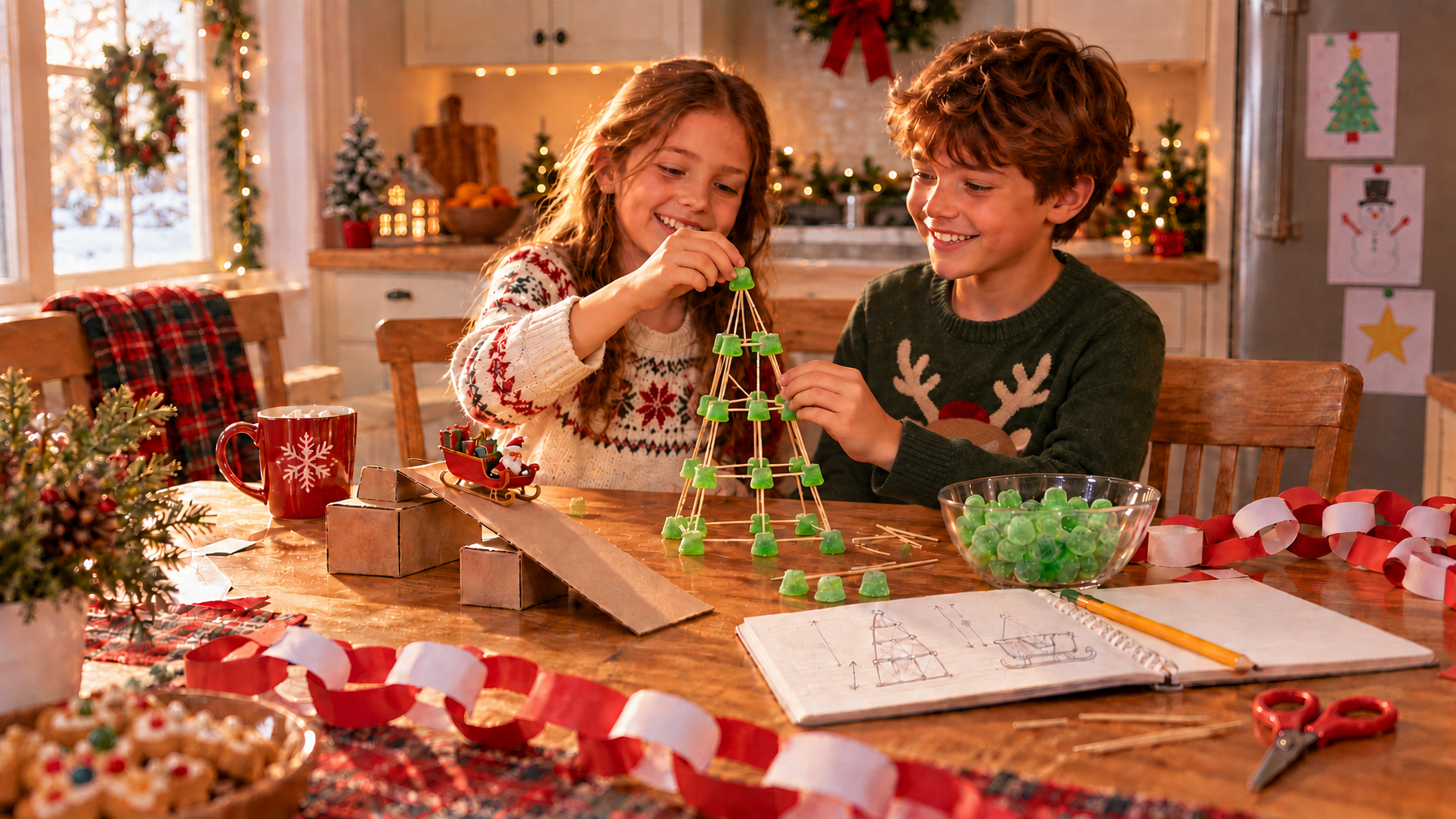
Best for: kindergarten through third grade. Materials: green gumdrops, toothpicks, a plate. Concept: structures and shapes.
Challenge your kids to build the tallest tree that can stand on its own for 10 seconds. Most kids start with squares, and their towers wobble. After a few collapses, many discover that triangles hold their shape better. Let them find that out on their own, then ask why they think it worked.
2. Santa's sleigh ramp
Best for: first through fourth grade. Materials: a sturdy piece of cardboard, a stack of books, a toy sleigh or small box, a tape measure. Concept: forces, slope, and fair tests.
Prop the cardboard on one book and release the sleigh. Measure how far it travels, then add a second book and try again. Kids can predict first, which makes the results more interesting. Older kids can test one more variable, like covering the ramp with wrapping paper or a dish towel to see how the surface changes the distance.
3. Reindeer zip line
Best for: second through fifth grade. Materials: string, a paper cup, a toy reindeer or a few cotton balls, tape, two chairs. Concept: gravity, friction, and design improvement.
Tie a length of string between two chairs, slightly higher on one end. Tape the cup to the string so it can slide, load it with the cargo, and let it go. Try moving the string to a steeper angle, or changing how much weight the cup carries. Ask your kids to rank which changes made the ride faster and which made it slower.
Kitchen science
4. Candy cane dissolving race
Best for: kindergarten through third grade. Materials: three candy canes, three clear cups, cold, warm, and hot tap water, a timer. Concept: dissolving and variables.
Place one candy cane in each cup of water at a different temperature, and have your kids predict which will dissolve first. Then watch and time them. Because only the temperature changes, this makes a clean first experiment in fair testing. Keep the hot water at a temperature an adult can safely handle, and let the adult pour it.
5. Fizzing Christmas tree cookie cutters
Best for: first through fifth grade. Materials: baking soda, white vinegar, food coloring, a baking tray, metal cookie cutters. Concept: chemical reactions.
Set cookie cutters on the tray and fill each one with a thin layer of baking soda. Mix a few drops of food coloring into the vinegar, then drop or squirt it over the baking soda and watch the shapes fizz. Younger kids enjoy the colors. Older kids can try different amounts of vinegar and compare how long the fizzing lasts.
6. Crystal candy canes
Best for: third through fifth grade, with an adult handling the borax. Materials: white pipe cleaners, borax, boiling water, a wide jar, a pencil, string. Concept: saturated solutions and crystal growth.
An adult dissolves borax in hot water until no more will dissolve. Kids twist pipe cleaners into candy cane shapes, hang them from a pencil across the jar, and let them sit overnight. By morning, crystals have grown on the pipe cleaner. Borax is not food, so keep it away from mouths and pets, and wash hands after handling it. Follow the safety directions on the box.
Circuits, code, and math
7. Light-up paper Christmas cards
Best for: third through fifth grade. Materials: cardstock, copper tape, a 3-volt coin battery, a small LED, a binder clip. Concept: simple circuits.
Have your kids draw a tree or star on the card, then run two strips of copper tape from the spot where the LED will sit to the spot where the battery will go. Tape the LED legs to the strips, one on each, and fold the card so the battery completes the circuit. If the light stays off, flip the LED around, since LEDs only work in one direction. Troubleshooting a dark card is the best part of this project. Coin batteries are a swallowing hazard, so have an adult handle them and put them away when you are done.
8. Bead code garlands
Best for: second through fifth grade. Materials: red and green beads, string, a sheet of paper for the code key. Concept: patterns and binary code.
Computers store information as two states, on and off. Let your kids pick two bead colors to stand for those states, write a short code key on paper, and thread a garland that spells out a word or their initials. Then swap garlands with a sibling and ask them to decode it. Younger kids can skip the key and focus on making and repeating patterns.
9. Snowflake symmetry cutting
Best for: kindergarten through fifth grade. Materials: round coffee filters or squares of paper, child-safe scissors. Concept: symmetry and geometry.
Fold the paper in half, then into a cone shape, and cut small shapes from the edges before unfolding. Ask your kids to predict what the pattern will look like, then check. Older kids can count the matching sections and compare them with a real snowflake, which has six sides. Younger kids can simply notice that both halves match.
10. Wrapping paper math
Best for: third through fifth grade. Materials: a box or two, wrapping paper, a ruler or tape measure, scissors. Concept: area, measurement, and estimation.
Before cutting, ask your kids to guess how much paper a box needs and mark it with a pencil. Then measure the box and work out the amount more carefully. Cut the paper and see how close each method came. The goal is to compare the guess with the math, so a miss is useful information.
Watch for
Some of these activities need an adult close by. Borax in the crystal candy canes, hot water in the dissolving race, coin batteries in the light-up cards, and scissors all call for supervision, and younger kids will often need you to handle those steps.
Many families also find that kids lose interest when the first try fails. A tower falling over is part of the project. Keep the notebook nearby and ask what they would change, and the second try often goes better than the first.
Candy does not have to be eaten. Some kids prefer to build with gumdrops and save the snacking for later, and that is fine. Check for allergies before you set out shared food.
FAQ
How many activities should we do? Two or three is plenty for a week. Kids learn more from repeating and improving one project than from rushing through all ten.
Do we need special supplies? Most of the list uses things many families already have, such as cardboard, string, baking soda, and vinegar. Copper tape, LEDs, and borax are the main exceptions, and they only show up in two activities.
What if my kids are different ages? Give the older child the measuring and recording job, and the younger child the building job. Both count as real STEM work. Our guide to teaching critical thinking through everyday activities has more ways to ask the questions that make these projects stick.
Is this STEM or STEAM? Several of these projects, including the snowflakes and the cards, include art. If you are curious about the difference, we break it down in STEAM vs STEM: How to decide for homeschooling.
What about younger kids? Kindergarteners can do the gumdrop trees, the candy cane race, and the snowflakes. Our STEM activities for kindergarten guide has more options.
Keep the learning going
If your kids love building and testing, a live class can take it further with a teacher and other kids who like the same things. Browse Outschool's elementary STEM classes and find one that fits your family.