Why most science fair projects miss the point
The baking soda volcano has been a science fair staple for decades, and there's a reason it keeps showing up: it's dramatic, it's easy, and it takes about 20 minutes. The problem is that it doesn't teach the scientific method. There's no real question being tested, no variable being controlled, no data being collected. It's a demonstration, not an experiment.
That distinction matters more than most parents realize. Research on project-based learning shows that when kids design experiments with genuine questions, they develop stronger critical thinking and retain concepts longer than through traditional instruction alone [1]. The scientific method is not a worksheet to fill out before the poster board goes up. It's a thinking framework: observe something, ask a question, form a prediction, test it, measure what happens, figure out what it means.
The projects below are organized by grade band and built around that framework. Each one starts with a real question a kid might ask, requires an actual variable to test, and produces data worth analyzing. They also use materials you probably already have at home.
A quick look at the scientific method (the version kids can use)
Before diving into projects, here's the version of the scientific method that works for kids at home:
- Observe something interesting. Notice a pattern, a difference, or something that makes you curious.
- Ask a question. Turn that observation into something you can test: "Does...?" or "What happens when...?"
- Do some background research. Find out what's already known about your topic. Books, websites, or asking a parent all count.
- Form a hypothesis. Make a specific prediction: "I think [this] will happen because [reason]."
- Design and run an experiment. Change one variable, keep everything else the same, and observe what happens.
- Collect and record data. Write down numbers, sketch what you see, take photos, or fill in a data table.
- Analyze your results. Look at the data. Did it match your prediction? If not, why? What patterns do you notice?
- Share what you found. Explain your question, your process, and your conclusions to someone else, whether that's a poster board, a notebook page, or just telling the family at dinner.
Younger kids won't use all these steps formally, and that's fine. A kindergartner predicting which toy boat will float and then testing it in the bathtub is doing real science. The formality scales up with age; the thinking stays the same.
Kindergarten through second grade (ages 5 to 8)
At this stage, the goal is curiosity and observation. Kids are natural experimenters. Your job is to help them slow down enough to notice what's happening and talk about why.
Which paper towel brand holds the most water?
Method connection: controlled variable testing, measurement
Cut equal-sized squares from three different paper towel brands. Dip each one into a bowl of water for exactly 10 seconds, then hold it over a measuring cup and squeeze. Measure how much water comes out. Repeat three times per brand (this introduces the concept of multiple trials without calling it that). Kids can draw a simple bar graph with colored pencils.
Do seeds grow faster in light or dark?
Method connection: hypothesis, observation over time, journaling
Plant identical bean seeds in two cups of the same soil. Place one on a sunny windowsill and one in a dark closet. Water both the same amount on the same schedule. Have your kid predict which will sprout first, then check and sketch the cups daily for two weeks. This project teaches patience and the value of recording observations even when "nothing is happening yet."
Does the color of a surface affect how hot it gets in the sun?
Method connection: prediction, fair testing, thermometer reading
Tape sheets of white, black, red, and blue construction paper to a sunny surface outside. Place a thermometer on each sheet and check temperatures every 15 minutes for an hour. Kids predict which color will be hottest, then compare their prediction to what the thermometer says.
Third through fifth grade (ages 8 to 11)
This is where the method starts becoming more deliberate. Kids can identify variables, keep a simple data table, and start distinguishing between what they expected and what the data shows.
Does the type of liquid affect how fast a gummy bear grows?
Method connection: variables, measurement, data tables
Place identical gummy bears in cups of water, milk, vinegar, salt water, and juice. Measure the width and height of each bear before soaking and again after 12 hours, 24 hours, and 48 hours. This project is wildly popular with kids because it involves candy, but it also teaches osmosis at an accessible level. The vinegar bear's reaction usually surprises everyone.
Which bridge design holds the most weight?
Method connection: engineering design process, iterative testing
Using popsicle sticks and glue, build three bridge designs: a flat beam, a truss (triangles), and an arch. Span each across two stacks of books and load pennies or small weights onto the center until it collapses. Record the weight each bridge held. This project connects to the engineering design cycle and shows how structure affects strength.
Does music affect plant growth?
Method connection: long-term data collection, controlling for confounding variables
Set up three identical plants. Play classical music to one for 30 minutes a day, play rock music to another for 30 minutes, and keep the third in silence. Water and light conditions stay the same. Measure height weekly for a month. This project is great for teaching kids how tricky it is to control variables, since they'll have to think about volume, distance from the speaker, and whether the music disturbs anyone else in the house.
Sixth through eighth grade (ages 11 to 14)
Middle schoolers can handle more complex experimental design, including multiple trials, statistical thinking, and written analysis. This is also the age where kids start to care whether their project is "cool." Leaning into their interests helps.
Does phone screen color temperature affect how quickly you fall asleep?
Method connection: hypothesis based on prior research, self-reported data, bias awareness
Have the participant (your kid or a willing sibling) use a phone with warm-toned "night mode" for a week before bed, then switch to the standard blue-toned screen for a week. Track how long it takes to fall asleep each night. This project introduces the concept of self-reported data and its limitations, plus it connects to real sleep research your kid can cite.
Which natural substance is the best ant repellent?
Method connection: controlled experiment, replication, ethical considerations
Set up small food sources outdoors and create barriers with cinnamon, vinegar, peppermint oil, and chalk. Observe which barriers ants cross and which they avoid. Repeat at the same time of day for three days. This project naturally introduces the idea of replication and also prompts a useful conversation about ethical treatment of animals in experiments (the ants aren't harmed, just redirected).
Does the angle of a solar panel affect how much energy it produces?
Method connection: quantitative measurement, graphing, real-world application
Use a small solar panel kit (available for under $15) and a multimeter. Position the panel at 0, 15, 30, 45, 60, and 90 degrees relative to the ground and measure the voltage output at each angle. Test at the same time of day and record sun conditions. Graph the results. This connects directly to STEM concepts kids hear about in the news but rarely get to test themselves.
Method vs. display checklist
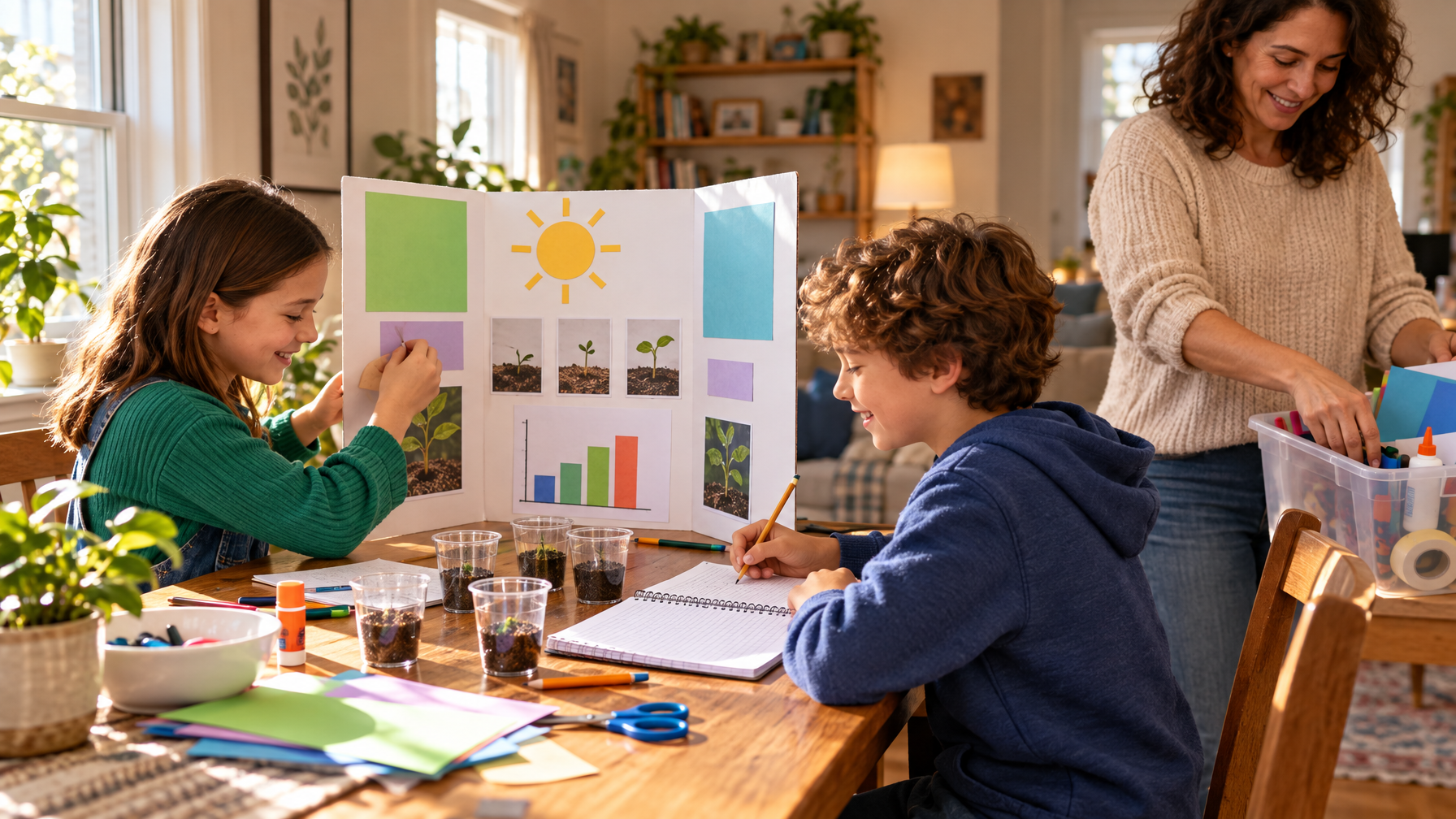
Use this before you buy a trifold. An experimental project changes one thing and writes numbers. A display project explains how something works. Fairs that score method want the first kind.
- Can your kid say the question in one sentence that starts with Does or What happens when?
- Is there only one thing you change?
- Is there a data table with at least three trials?
- Can a stranger find question, table, and meaning on the board in 10 seconds?
Board layout: left for question and guess, center for photo plus table, right for what stayed the same and what it means. For the step-by-step loop, use scientific method for kids (draft until published).
Ninth through twelfth grade (ages 14 to 18)
High schoolers doing science fair projects are often competing at regional or state level, which means the rigor matters. But even if your kid is doing this for a homeschool portfolio or transcript documentation, these projects build the kind of analytical thinking that transfers to college coursework.
Does soil pH affect the germination rate of different seed varieties?
Method connection: experimental design with multiple variables, statistical analysis
Adjust soil pH in separate containers using vinegar (acidic), baking soda (basic), and untreated soil (control). Plant identical quantities of three seed types (radish, lettuce, basil work well) in each condition. Track germination percentage and growth rate over three weeks. This project produces enough data points for a real statistical comparison and connects to agricultural science.
How does water salinity affect the buoyancy of different materials?
Method connection: density calculations, graphing, connecting results to existing physics principles
Prepare water solutions at five salinity levels (0%, 5%, 10%, 15%, 20%). Test how various small objects (cork, plastic, aluminum, rubber) behave in each solution. Calculate density for each solution and plot buoyancy against salinity. This project lets kids connect their experimental data to established physics, which is the kind of reasoning college admissions reviewers notice on a transcript.
Does ambient noise level affect short-term memory recall?
Method connection: human subjects protocol, controlling for bias, sample size considerations
Test participants on a word list recall task under three conditions: silence, moderate background noise (coffee shop ambiance), and loud noise (construction sounds). Use the same word list length and exposure time across all conditions. This project introduces human subjects methodology, including informed consent and the need for enough participants to draw meaningful conclusions.
How to guide your kid through the method without doing it for them
The most common science fair mistake isn't choosing the wrong project. It's a parent who takes over. The board looks polished, the data is perfectly organized, and the kid can't explain what they did or why.
Here's how to stay in the guide role:
- Ask questions instead of giving answers. When your kid gets stuck, resist the urge to explain. Try: "What do you think would happen if...?" or "How could we figure that out?" The goal is to keep them in the driver's seat, even when the route gets bumpy.
- Let the hypothesis be wrong. A "failed" experiment is not a failed project. If the results don't match the prediction, that's a finding worth reporting. Help your kid frame it: "My hypothesis was X. The data showed Y. Here's why I think that happened." Judges love honest analysis more than tidy results.
- Be the materials manager, not the project manager. Your job is to make sure the supplies are available, the timeline is realistic, and the kitchen table is free on experiment night. Their job is everything else: choosing the question, designing the test, recording the data, building the display.
- Help them practice explaining it. Ask your kid to walk you through their project as if you know nothing about it. If they can't explain their hypothesis, method, and conclusions in plain language, they don't fully understand them yet. This rehearsal is more valuable than any poster board decoration.
- Handle the frustration, not the problem. When the data is messy, the plant dies, or the experiment doesn't work on the first try, your kid needs someone to say "that's part of science" before jumping in to fix it. Sit with the frustration for a minute. Then ask: "What could we try differently?"
Turning a science fair project into something bigger
A good science fair project doesn't have to end when the fair does. Some ways to extend the learning:
- Enter a competition. Most state science fairs accept homeschool entries through regional affiliates. The Society for Science runs the Regeneron International Science and Engineering Fair (ISEF) pipeline, and Broadcom MASTERS targets middle schoolers. Check your state's science fair organization for entry details.
- Turn it into a portfolio piece. Write up the full experiment as a lab report: introduction, methods, results, discussion, and sources. This format mirrors what colleges expect and gives your kid practice with formal scientific writing. It also makes strong homeschool record-keeping documentation.
- Run a follow-up experiment. The best projects raise new questions. If the ant repellent experiment showed that cinnamon worked best, the next question is whether concentration matters, or whether it works on different ant species. Iterating on a project teaches kids how real research works.
- Share it with an audience. Present the project at a co-op meeting, a library science night, or to extended family over video call. Public speaking practice reinforces the learning and builds communication skills that transfer far beyond science.
- Connect it to a class. Outschool's live science classes cover topics from chemistry to environmental science. A kid who just ran a soil pH experiment might be ready for a deeper dive into plant biology or ecology with a teacher who can push their thinking further.
Common mistakes (and how to avoid them)
- Choosing a demonstration instead of an experiment. A volcano, a tornado in a bottle, a density column: these are cool to watch, but they don't test a question. If there's no variable being changed and no data being collected, it's a demonstration. Judges and portfolio reviewers can tell the difference. The fix: make sure you can fill in this sentence: "I changed [variable] to see how it affected [outcome]."
- Skipping multiple trials. Running an experiment once proves nothing. The paper towel that held the most water on one try might have had a fold that trapped extra liquid. Three trials minimum. Five is better. This is where kids learn that one data point is an anecdote, not evidence.
- Making the poster the priority. A display board with perfect lettering, printed photos, and color-coded sections looks impressive, but if the kid can't explain the experiment without reading from the board, the project is hollow. Spend 80% of the time on the experiment and 20% on the display, not the reverse.
- Picking a topic that's too broad. "How does pollution affect the ocean?" is a research paper topic, not a science fair experiment. Narrow it: "Does the concentration of salt in water affect how quickly a piece of seaweed decomposes?" Specific questions produce testable experiments.
- Confusing correlation with causation. This comes up naturally in middle and high school projects. If plants grew taller in the room with music, was it the music or the fact that someone entered the room twice a day to turn on the speaker? Help your kid think about confounding variables, even if they don't use that term yet.
Frequently asked questions
What age should kids start doing science fair projects?
Kids as young as five can do simplified versions. A kindergartner predicting which objects will sink or float and then testing them is using the scientific method. The formality increases with age, but the core thinking starts early.
Does my homeschooler need to enter a formal science fair?
No. Many homeschool families use science fair projects as a portfolio piece or a way to document hands-on learning for their records. If your kid does want to compete, most regional fairs accept homeschool entries. Check your state's science fair affiliate for registration details.
How long should a science fair project take?
Plan for two to four weeks of active work for most projects. That includes choosing the topic, designing the experiment, running multiple trials, analyzing data, and building the display. Plant-based or long-observation projects may need six weeks or more.
What if my kid wants to do a project I don't know anything about?
That's a feature, not a problem. You don't need to be a subject expert. Your role is to help them find reliable sources, ask clarifying questions, and keep the timeline on track. For topics that go deeper than you're comfortable with, Outschool's science classes and 1:1 tutoring can connect your kid with a teacher who knows the content.
Can my kid use the internet for research?
Researching the topic is part of the scientific method (step 2: background research). Teach your kid to evaluate sources, distinguish between a blog post and a peer-reviewed study, and cite what they find. Science Buddies (sciencebuddies.org) is a strong free starting point for project ideas and research guidance.
The real point of a science fair project
The ribbon is nice. The poster looks great on the wall. But the real value of a science fair project is the thinking it builds. A kid who learns to ask a testable question, control variables, interpret data honestly (even when it doesn't match their prediction), and communicate what they found is practicing skills that transfer to every subject and every stage of learning that follows.
If your kid is excited about science and wants to go deeper with a teacher who can push their thinking, browse Outschool's live science classes to find a format and topic that fits.
Sources
[1] Chen, C.H., & Yang, Y.C. "Revisiting the effects of project-based learning on students' academic achievement." Educational Research Review, 2019. https://pmc.ncbi.nlm.nih.gov/articles/PMC10411581/


.svg)
.svg)