If traditional school has turned into a daily battle, rushing, reminders, unfinished work, and a child who feels constantly behind, you’re not alone, and homeschooling can offer a fresh start.
But finding a homeschool curriculum for ADHD might feel just as overwhelming. How much structure is helpful? What actually keeps kids engaged? And how do you plan a day that works with (not against) challenges like focus, executive function, transitions, and motivation?
In this guide, you’ll learn how homeschooling can support ADHD learners, practical techniques that make lessons more manageable, the core topics most families cover, and step-by-step ways to build a flexible plan you can realistically stick with without constant frustration.
How Homeschooling a Child with ADHD Works
Homeschooling doesn’t “fix” ADHD, but it can change the learning environment, so your child’s strengths have more room to show up. Instead of trying to fit into a one-size-fits-all classroom pace, you can adjust lessons, routines, and expectations to match how your child actually focuses, moves, and absorbs information.
Understanding how ADHD affects learning and what kinds of supports tend to help can make it much easier to choose materials and build a plan that feels doable.
How ADHD can impact learning
ADHD is commonly associated with patterns of inattention, hyperactivity, and/or impulsivity that can interfere with daily life, including school. In learning terms, that can look like starting work but not finishing, losing track of multi-step directions, rushing through tasks, or melting down during transitions.
Many kids also struggle with organization and time management, which are skills that fall under the category of “executive function,” the brain’s self-management system. In a busy classroom with lots of noise, movement, and schedule changes, these challenges can pile up and make even capable students feel like they’re constantly catching up.
How homeschooling may help
Homeschooling can help because it lets you reduce the “wrong kind” of distractions and build in supports that are hard to individualize in a group setting. For example, you can shorten lesson blocks, add frequent movement breaks, and teach organizational skills in small, repeatable steps. These are all approaches that align with school-based strategies shown to support students with ADHD, such as behavior supports and organizational training.
You can also slow down for tough skills, speed up when your child is engaged, and choose formats that match their learning style, like hands-on, audio, video, or project-based. Over time, this kind of personalization can reduce daily friction and help your child experience more “I can do this” moments.
Techniques Used in Homeschooling a Student with ADHD
The best homeschool curriculum for ADHD usually isn’t about finding a “magic” program. It’s about how you use the materials that are available.
The techniques below can make almost any curriculum feel more flexible, more engaging, and less stressful by supporting attention, executive function, and smooth transitions. .
Use short work blocks and planned breaks
Many kids with ADHD do better with 10–20 minutes of focused work, followed by a quick movement or sensory break.
Building breaks into the plan (instead of waiting for a meltdown) can make it easier to restart and keep the day moving.
Break assignments into smaller steps
Instead of “write a paragraph,” try “pick a topic” first. Then move on to “say your first sentence out loud,” and then add “write one sentence,” checking each step off as you go.
This sort of “chunking” reduces overwhelm and helps with task initiation, one of the hardest parts for many students with ADHD..
Externalize routines with visual schedules and checklists
When kids have to hold the whole plan in their heads, they burn a lot of energy before learning even starts.
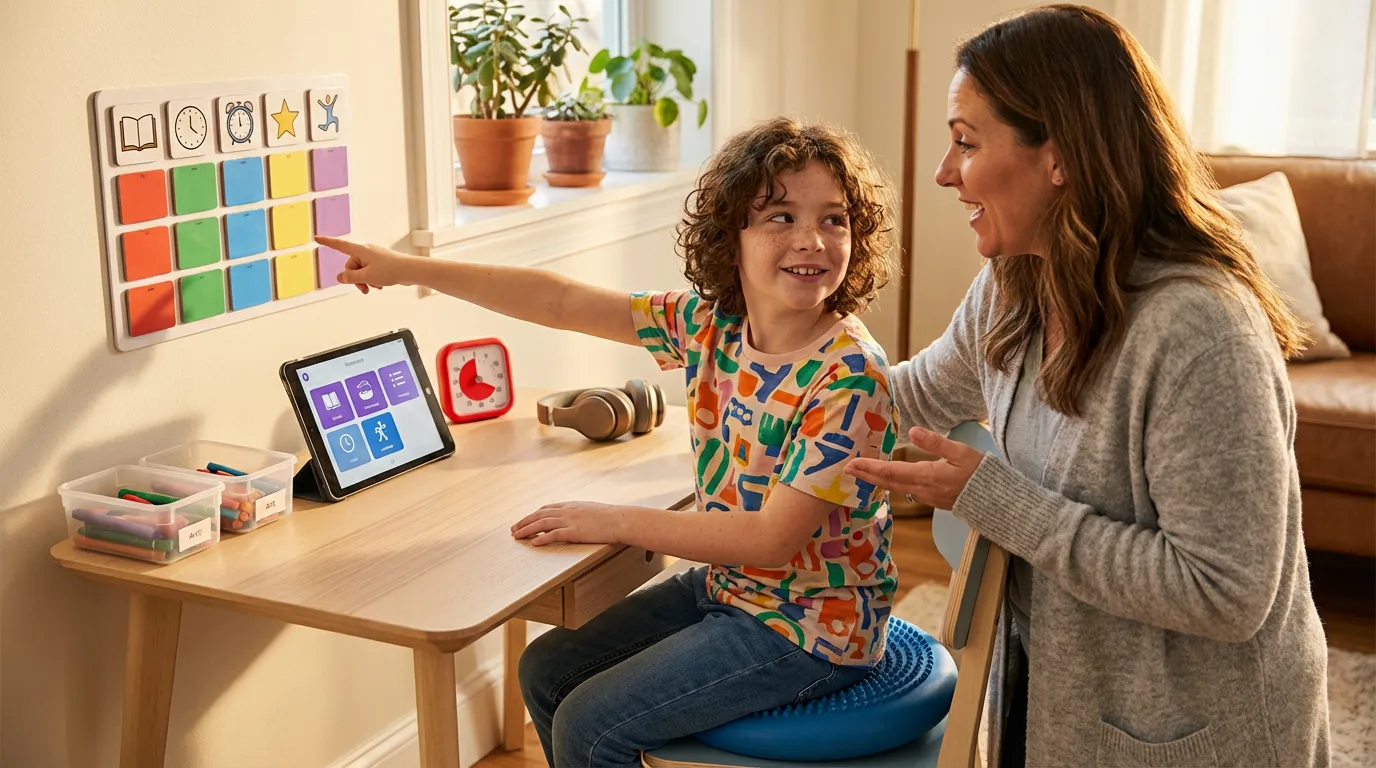
Posting a simple daily agenda (morning work, movement, reading, lunch) and using a short checklist for independent tasks supports organization and follow-through.
Set up a low-distraction workspace
A quieter space can make it easier to start and finish work, especially for reading, writing, and anything that requires sustained attention. If your child gets “stuck,” a planned location change (kitchen table → porch → floor with clipboard) can reset focus without turning it into a power struggle.
Give directions one step at a time
Multi-step directions are easy to lose, especially during transitions. Try saying (and writing) just the next step, then have your child repeat it back, and then do one together before they work independently (Morin).
Offer limited choices to boost buy-in
Choice helps motivation, but too many options can be overwhelming. Two good choices are a sweet spot: “Do you want to do math on paper or on the whiteboard?” “Do you want to read on the couch or in the tent?” The goal is to keep the learning target the same while giving your child some control.
Use quick feedback and specific praise
Kids with ADHD often get a lot of correction but not much noticing of what’s going right. Aim for immediate, specific feedback. ”You started right away” or “You fixed that mistake without getting upset” makes the feedback easy to understand. Also, consider a simple reward system for effort and follow-through.
Let your child show learning in different formats
If writing is the bottleneck, your child can demonstrate learning in a different way: say it out loud, dictate, build a model, record a short video explanation, or draw and label a diagram.
This keeps the focus on the skill you’re teaching, like comprehension or scientific thinking, while you steadily build weaker skills in smaller doses.
Topics Typically Covered in a Homeschool Curriculum for a Student with ADHD
Most homeschool curricula cover the same core subjects you'd see in school, but the big difference is that you can teach them in shorter bursts with more hands-on options and other supports that make follow-through easier. Below are common topics families include, plus a few ADHD-friendly angles to consider as you choose materials and activities.
Reading (phonics and comprehension)
Look for reading instruction that's explicit and engaging, especially for younger learners who need phonics practice, and add variety for comprehension with audiobooks, read-alouds, graphic novels, or short passages.
If sustained silent reading is hard, it's okay to build stamina gradually and use alternatives, like listening while following along, partner reading, or narration.
Writing (handwriting, spelling, and composition)
Writing can be a triple load: idea generation, organization, and the physical act of writing all rolled into one assignment.
Consider curricula that teach planning (brainstorm → outline → draft) in small steps, and use supports like dictation, speech-to-text, or scribing so your child can show what they know while skills build over time.
Math (number sense, fluency, and problem-solving)
Math often goes better using short practice sessions, clear visuals, and plenty of "do it with me" examples before independent work.
Hands-on tools, like counters, number lines, and fraction tiles, and real-life math found in cooking, budgeting, and games, can be life-savers because they improve focus and reduce frustration, especially when word problems feel overwhelming.
Science (hands-on exploration and curiosity)
Science is a great place to focus on interest-based learning. Simple experiments, nature studies, and project-based units can keep attention high while still building core skills like observing, recording results, and explaining cause and effect.
Social studies (history, geography, and civics)
Many kids with ADHD learn history best through stories, timelines, videos, and field trips rather than long readings. Map work, short narration prompts, and hands-on projects, like models, posters, and skits, help turn "information" into something memorable.
Executive function and study skills (planning, organization, follow-through)
This isn't always listed as a "subject," but it's often the difference between a plan that works and one that collapses by Tuesday. Building routines, practicing checklists, learning how to break tasks into steps, and reviewing what's coming next can make every other subject smoother.
Movement and physical education
Movement isn't an extra; it can be a crucial tool for focus. Daily walks, sports, yoga, dance, obstacle courses, or short strength circuits can support attention and self-regulation, and they often make it easier to settle back into seatwork afterward.
Social-emotional learning (feelings, coping skills, and communication)
Kids with ADHD may need explicit practice in tolerating frustration, flexible thinking, and repairing relationships after conflict. You can build this in with short lessons, role-play, mindfulness exercises, and plenty of coaching language ("What's your plan?" "What do you need right now?") during real-life moments.
How to Plan a Homeschool Curriculum for a Student with ADHD
A workable plan is usually simpler than it sounds: start with your child's needs, pick only a few priorities, and build structure in a way you can actually maintain. These steps can help you create a homeschool curriculum for ADHD that's flexible, engaging, and realistic… without reinventing the wheel.
Step 1: Start with your child's needs
Before you buy anything, write down what's hardest right now. Is it task initiation? Transitions? Sitting still? Written work? Regulating emotions? Then think about what helps. Movement? Novelty? Visuals? Hands-on work?
This quick "learner profile" will guide how much structure you probably need and what formats are most likely to work consistently.
Step 2: Choose 2–3 goals for the next 6–8 weeks
ADHD planning goes off the rails when the plan tries to fix everything at once. Pick a few high-impact targets, like consistent reading practice, math confidence, or finishing work without daily battles.
You can treat everything else as "maintenance" for now. When those goals feel steadier, you can add more.
Step 3: Build a simple daily rhythm
Instead of scheduling every minute, create a repeatable order of events. For example, you might start most days with movement, move to reading, break for a snack, shift to math, then have outside time.
Predictability reduces the mental load of "what's next" and can make transitions smoother, especially if you use a visual schedule or checklist.
Step 4: Pick materials that match the problem areas
If writing output is the problem, you don't necessarily need a "better" writing curriculum. Instead, you may just need lighter handwriting demands, more modeling, or a way to dictate. If attention is the problem, you may need shorter lessons, more interaction, or hands-on practice. Start by solving the biggest friction point first so your child feels success early on in the learning process.
Step 5: Plan support strategies
Consider writing the "supports" into your plans so you're not improvising all day. For many learners, that includes short work blocks with planned breaks, breaking assignments into smaller steps, and using immediate, specific feedback.
These strategies can make the same curriculum feel far more manageable.
Step 6: Start small, review weekly, and adjust without guilt
Run your plan for one week, then do a quick check-in: What got done easily? What caused a bottleneck? What time of day went best? Make one or two changes at a time, like shorter lessons, a different order, more movement, or fewer pages.
A flexible plan that you can sustain will beat a "perfect" plan that burns everyone out.
Popular Homeschool Curricula for Students with ADHD
You might be tempted to think that meeting the unique learning needs of your child with ADHD is beyond your capacity, especially if you aren't an education professional yourself. But take comfort in knowing that there are lots of resources available that will make the whole process feel a lot more doable.
Outschool's online curricula and classes
Outschool offers a wide variety of live, online, ADHD-friendly group classes for kids and teens. Parents appreciate that the classes are taught by vetted professionals who are passionate about kids and their subject matter, and kids love the engaging, "fun" lessons.
An added benefit is the real-time interaction kids get with the teacher and other students in the class.
Public libraries (books, audiobooks, and research help)
Your public library can act like a "curriculum buffet," especially if your child learns best through interest-led reading. Ask a librarian for age-appropriate book lists on the topics you're covering, and use audiobooks to support comprehension when sitting to read is tough.
Many libraries also offer free homeschool days, clubs, and research databases, but be aware that a considerable amount of preparation may be needed to translate these materials into usable lesson plans.
Museums and virtual field trips
Field trips, in-person or virtual, are especially ADHD-friendly because they turn learning into something physical, visual, and memorable.
Try choosing one theme per week, like space, weather, ancient Egypt, or oceans. Then pair a short video tour with a simple "show what you learned" task, like drawing a diagram, building a model, or recording a 60-second summary.
Smithsonian and NASA educator resources
When you want strong content without extra planning, use free lesson collections from major institutions. The Smithsonian Learning Lab curates inquiry-based collections that you can browse by topic and grade, and NASA has classroom activities and STEM lessons that pair well with hands-on projects at home.
These resources won't take care of all your instructional needs, but they can go a long way in helping prepare for science lessons..
PBS LearningMedia
For kids who focus better with visual input, PBS LearningMedia offers free classroom-ready videos, interactives, and lesson materials searchable by grade and subject. It's a good way to keep lessons short while still covering standards-based topics.
Parks, nature centers, and community programs
If sitting still is the biggest obstacle, build learning around movement. Junior Ranger programs, guided nature walks, local recreation classes, and community clubs can cover science, PE, and social-emotional skills in a way that feels less like "school" and more like life.
Simple planning tools
Sometimes the "curriculum" that matters most is the system that helps your child start and finish their work. A one-page daily checklist, a simple visual schedule, and a timer for short work blocks can reduce decision fatigue and make transitions smoother.
You can create these in a notes app, on a whiteboard, or on paper, whatever your child will actually use.
Frequently Asked Questions: Homeschool Curricula for a Student with ADHD
Homeschooling with ADHD tends to come with a few repeat questions, especially about workload, overwhelm, and whether you're "qualified" to do this. Here are practical, parent-friendly answers to the most common concerns, with ideas you can adapt to your child's needs.
How much school should a child with ADHD do each day at home?
There's no one "right" number of hours. What matters more is whether your child is making steady progress and your routine is sustainable. Keep in mind that while a traditional school day generally lasts 6-7 hours, homeschooling takes less time because it's more efficient. Without the need to wait for everyone in class to finish a task, manage classroom behavior, and repeat instructions, a homeschool day might involve 3-4 hours of focused learning.
Also, many ADHD learners do best with shorter learning blocks, clear expectations, and planned breaks.
How do I know if a homeschool curriculum is too overwhelming for my child?
A curriculum may be too much if you're seeing consistent signs, like frequent shutdowns or tears, constant arguing to start work, your child guessing or rushing just to be done, a sudden drop in confidence ("I'm stupid"), or you spending most of the day managing behavior instead of learning.
When that happens, don't assume your child "can't" do the subject. It's more likely that the fit needs adjusting. Try reducing the amount of work, breaking tasks into smaller steps, and adding planned movement breaks and quick feedback.
Can you homeschool a child with ADHD successfully without special training?
Yes! You don't need special training to homeschool well. You just need a willingness to observe, adjust, and ask for support when needed. If you're concerned about learning disabilities, severe anxiety, or major behavioral challenges that are escalating, it can help to talk with your child's pediatrician and/or seek an evaluation or additional services. Homeschooling doesn't mean you have to do everything alone.
Making It Happen
Choosing a homeschool curriculum for your child with ADHD isn't as hard as it might seem at first. By using the guidance provided here, you'll be able to select curriculum materials that align with your educational philosophy and your child's individual needs. Remember to start small, watch out for what helps, and adjust as you learn what works for your family. You'll find that before long, the educational success you've always wanted for your child is a reality for both of you.
Sources
American Library Association. "Homeschooling and Libraries." American Library Association, www.ala.org.
Centers for Disease Control and Prevention. "ADHD in the Classroom: Helping Children Succeed in School." CDC, 22 Oct. 2024, www.cdc.gov/adhd/treatment/classroom.html.
Jacobson, Rae. "School Success Kit for Kids With ADHD." Child Mind Institute, 9 Dec. 2025, https://childmind.org/article/school-success-kit-for-kids-with-adhd/.
Morin, Amanda. "Classroom Accommodations for ADHD." Understood, 12 Mar. 2026, www.understood.org/en/articles/classroom-accommodations-for-adhd.
NASA STEM Engagement. NASA STEM Engagement, National Aeronautics and Space Administration, www.nasa.gov/stem/.
Outschool. "ADHD-Friendly Online Classes for Kids & Teens. Outschool. https://outschool.com/online-classes/popular/adhd-brain.
PBS LearningMedia. PBS LearningMedia, Public Broadcasting Service, www.pbslearningmedia.org/.
Smithsonian Learning Lab. Smithsonian Learning Lab, Smithsonian Institution, www.learninglab.si.edu.


.svg)
.svg)