Choosing a homeschool curriculum might seem a little scary at first. Perhaps you’re brand new to the concept altogether, or maybe you’ve given homeschooling a try but found your previous efforts didn’t hit the mark. It’s easy to feel overwhelmed by curriculum styles, grade levels, prices, formats, and strong opinions you find online.
But don’t let any of that get in your way! Choosing the “best homeschool curriculum” for you and your child doesn’t have to be an arduous task. A curriculum is simply the plan and materials you use to teach, and you have the freedom to build it in a way that matches your child’s learning style and your family’s real life.
In this guide, you’ll learn what a homeschool curriculum is, the most common curriculum approaches, and how to compare options so you can choose something your kid will learn from and you can stick with.
What Is a Homeschool Curriculum?
A homeschool curriculum is the roadmap for your home education: what you teach, the order you teach it in, and the resources you use to make learning happen. That roadmap might be an all-in-one program that includes lesson plans, student books, and assessments, or it might be a mix of materials you choose subject by subject, like one math program, a reading list, science experiments, and field trips.
Either way, a curriculum helps you cover core skills consistently while leaving room for your child’s pace and interests. It can also make planning and record-keeping easier, which matters because homeschooling rules and documentation expectations vary by state (American Psychological Association).
Main Types of Homeschool Curricula
The main types of homeschool curricula available differ based on educational philosophy or delivery method. It helps to understand the differences between them so you can determine which will work best for your child.
Classical education
Classical education is a content-rich approach that emphasizes reading, writing, discussion, and building knowledge over time. Many classical plans organize learning around the traditional “trivium” of grammar, logic, and rhetoric (Fulton Brown).
It focuses on foundational skills and memorization in the early years, then moves into logic, analysis, and more formal writing as students get older. Cultural literacy is also a primary goal. Families who like clear structure, a long-term plan, and lots of classic literature may find this approach a good fit.
“Living books”
Originally developed by Charlotte Mason, this approach relies on “living books,” which are well-written books by authors who are passionate about the topics instead of dry textbooks.
This curriculum also features short, focused lessons with narration as a key learning strategy, which involves a child telling back what they learned in their own words (Smith). Many families add nature study, art, music, and life skills/character work. It tends to work well for kids who learn best through stories and conversation, and for parents who want a gentle rhythm without constant worksheets.
Montessori-inspired
Montessori-inspired homeschooling emphasizes independence, hands-on learning, and mastering skills through purposeful repetition.
Younger children often work with concrete materials, like counting beads or movable letters, before moving to more abstract paper-and-pencil work. This approach can be a good match for families who like calm routines, practical life skills, and letting children work at their own pace with guidance (UConn Library).
Unit studies
Unit studies organize multiple subjects around one theme or topic. For example, a topic might be oceans, ancient Egypt, or the solar system. A single unit might combine reading, writing, science activities, art, and even math practice tied to the theme.
This approach can be especially helpful if you’re teaching multiple ages, if your child is motivated by hands-on projects, or if you want learning to feel more connected than “separate subjects.”
Interest-based learning
Also known as “unschooling,” this approach helps kids learn through real life, curiosity, and projects based on their own interests rather than following a preset scope and sequence. In practice, many families blend interest-led learning with intentional skill-building, especially for reading and math, so that kids keep progressing while still having lots of choice.
If you’re considering this style, it helps to think ahead about how you’ll document learning and make sure you’re meeting any legal requirements where you live (American Psychological Association). A fantastic resource is Outschool’s information on homeschool laws in each state (Outschool).
All-in-one boxed set
An all-in-one boxed set is a complete, ready-to-use curriculum package for a specific grade or age range. It typically includes the student materials plus a teacher guide with daily lessons, a recommended schedule, and built-in review or assessments. Many families like boxed sets because they reduce decision fatigue and planning time.
The trade-off is that they can be less flexible, so it helps to check how easy it is to adjust the pace, skip busywork, or swap out subjects if something isn’t a good fit. Also, comprehensive packages usually come with a price tag to match.
Online or virtual programs
Online and virtual programs range from self-paced courses to live, teacher-led classes. Depending on the program, lessons may include videos, interactive practice, auto-graded quizzes, or parent dashboards that track progress.
This format can reduce your planning load and support independent learners. While self-paced videos can become passive for learners, live virtual classes provide opportunities for kids to interact with a teacher and peers in real time, and you can find classical, living books, and Montessori-based options available.
Eclectic
A mix-and-match approach to homeschooling means you choose different resources for different subjects instead of committing to one complete program. For example, you might use a structured math curriculum, a phonics program, library books for history, and unit studies for science.
The upside is flexibility because you can tailor each subject to your child. The challenge is keeping it organized, so many families pick just one “spine” (often math and language arts) and keep the rest lighter and more interest-driven.
How Using a Homeschool Curriculum Typically Works
Even within the same curriculum style, most homeschoolers follow a similar workflow: you choose your materials, decide what school looks like for your family, teach in small, consistent chunks, and adjust as you learn what works.
The key is to build a system that's structured enough to keep you moving forward but flexible enough to handle real life.
Lesson planning
Some curricula are fully "open-and-go," with daily lesson plans that tell you exactly what to do next. Others give you a scope and sequence of what to cover over the year and expect you to flesh it out yourself.
Either way, lesson planning usually involves:
- Preparing: Skimming the teacher's guide and gathering supplies, like books, printables, lab materials, and manipulatives.
- Deciding on the pace: Do one lesson per day, remain with a lesson until mastery, or implement a modified schedule for younger kids.
- Choosing what to do together versus independently: Read-alouds, discussions, and practice work.
- Planning how to check for understanding: Review days, quizzes, writing samples, projects, and informal conversations.
Daily, weekly, or monthly routines
Homeschool schedules can be surprisingly simple. Some families do a short "school block" each weekday; others use a four-day week, loop scheduling (rotating subjects), or a year-round calendar with frequent breaks. What matters most is consistency and a routine your child can predict, since predictable routines can support kids' learning and adjustment over time (Seattle Children's).
A common pattern is to focus on core skills, like reading/writing and math, on most days, then rotate science, history, and electives across the week. Many parents also plan one weekly "reset time," where they review what has been completed, preview the next week, and file any work samples or notes they need for records.
Subjects Typically Covered in a Homeschool Curriculum
When families plan a homeschool year, they often start with a handful of core skill areas and then add electives based on a child's age and interests. Rather than trying to do every topic every year, many parents focus on steady progress and revisit subjects over time as kids are ready for more depth.
The list below can help you think through what you might want to include as you choose or build a curriculum.
- Language arts: This includes reading, phonics, writing, spelling, grammar, and literature. In the early grades, this often looks like phonics plus read-alouds. Later, it may include literary analysis, essays, and research writing.
- Math: This includes number sense, operations, and problem-solving. Depending on the curriculum, this may be mastery-based (staying on the topic until it's a solid skill) or spiral (reviewing continually) and can include manipulatives, worksheets, or online practice.
- Science: This includes life, earth/space, and physical science. Many homeschool plans add hands-on labs, nature study, kitchen science, or simple engineering projects to make the concepts concrete.
- Social studies: This includes history, geography, civics/government, and economics. In the elementary years, this may cover the local community and maps. In later grades, it often expands into world history, U.S. history, and civics.
- Art and music: This includes visual art, art appreciation, music fundamentals, and instruments/voice, and can take the form of weekly lessons, artist/composer studies, co-op experiences, or community classes.
- Physical education and health: This includes movement, fitness, nutrition, and safety. Some families count sports, martial arts, dance, hiking, or swimming lessons as P.E.
- Foreign language: This is often optional, usually for middle school and up. It can include conversational practice, apps, online tutors, or formal grammar-based study, depending on your goals.
- Technology, logic, and STEM electives: This includes subjects like coding, typing, robotics, logic, and statistics. These can be especially motivating for project-oriented learners and can start with simple, age-appropriate activities.
- Life skills and practical electives: These include cooking, budgeting, home economics, study skills, and career exploration. The skills involved are usually easy to integrate into real life and document.
- Social-emotional learning and character: This includes communication, empathy, coping skills, and values. Some curricula include this directly, while others build it through read-alouds, discussions, service projects, and family routines.
How to Choose the Best Homeschool Curriculum for Your Learner
Use these steps to narrow your options and find a program you can realistically stick with.
Step 1: Start with your goals and your child's needs
Before you compare programs, get clear on what "best" means for your family in 2025–26. Are you trying to catch up in reading, build confidence in math, add more writing, or simply create a calmer routine?
Think about your child's attention span, learning differences, motivation, and how they respond to structure. Would they prefer a scripted lesson versus an open-ended project? A simple way to start is to write down (1) your top 2–3 priorities, (2) the non-negotiables, like minimal prep, lots of reading aloud, or mastery math, and (3) the pain points you want to avoid, like busywork, long lessons, or too many moving parts. Those notes will make every subsequent step easier.
Step 2: Check your homeschool laws and reporting requirements
Before you buy anything, double-check the homeschool laws in each state. Requirements can include specific subjects, days/hours, attendance tracking, periodic assessments, portfolios, or an annual notice of intent.
This step prevents you from choosing a program that's hard to document later. If record-keeping feels intimidating, keep it basic: save a few work samples per subject each month, jot down the books your child has read, and keep a simple attendance or activity log. Many families also choose curricula with built-in placement tests, quizzes, or end-of-unit projects because those naturally create documentation.
Step 3: Choose your delivery method
The delivery method is the way your child encounters the material. An all-in-one curriculum can reduce decision fatigue because it tells you what to do each day, but it can be rigid and expensive.
A mix-and-match plan lets you choose the best fit for each subject but requires a good deal of preparation. Live, online group classes require the use of a computer but also provide social interaction. Also, be honest with yourself about how much will need to be parent-led versus independent, especially if you're teaching multiple kids or working from home.
Step 4: Pick an approach that fits your teaching style
A curriculum can be a great fit for your child on paper, but still fail if it clashes with how you prefer to teach. Some parents love scripted lessons and clear daily checklists. Others thrive with read-alouds, discussions, and flexible project work. Neither is better than the other; the goal is sustainability.
Use the curriculum "types" above as a shortcut: if you like structure and long-term sequencing, you may gravitate toward a classical approach or boxed sets. If you prefer literature, short lessons, and a gentle rhythm, living books may feel more natural to you. If you want big-picture themes and hands-on projects, unit studies might work well. Also, consider that online classes are available in all those iterations.
Step 5: Confirm grade level and placement
Homeschoolers don't have to buy materials strictly by age or grade. It's common for a child to be "ahead" in one subject and need more support in another. Before you commit, look for placement tests, sample lessons, or previews so you can see the reading level, pacing, and how much writing is expected (National Center on Intensive Intervention).
In the first couple of weeks, watch for common signs of mismatch, like constant frustration, unusually long lesson times, or work that feels like busywork. A good fit should feel appropriately challenging but still doable with steady effort.
Step 6: Look for support and flexibility
The best curriculum is one you can actually use without feeling stuck. Look for clear teacher guides, answer keys, and straightforward instructions.
If your child needs accommodations, check whether the program offers multiple levels, alternative assignments, or suggestions for struggling and advanced learners. Flexibility matters too: Can you slow down without "falling behind"? Can you speed up when something clicks? Can you skip repetitive practice or swap a reading list?
Step 7: Plan a 4–6 week "tryout," then adjust
Even strong curricula take a little time to settle into. Choose a reasonable trial window (usually about a month) and pay attention to how the days feel: Are lessons taking forever? Is your child retaining skills? Are you able to prepare and teach consistently? When something isn't working, adjust the smallest lever first: shorten lessons, reduce written work, add more practice, or change how you teach (for example, more oral work or more hands-on activities).
If a subject is still a constant battle after tweaks, that's a good sign to replace that individual piece without throwing out your whole homeschool plan.
Best Homeschool Curricula
There isn't one "best" homeschool curriculum for every family. Instead, the best option is the one that aligns with your child's needs, your teaching bandwidth, and the requirements where you live. Check out these popular options.
Outschool's online curricula and classes
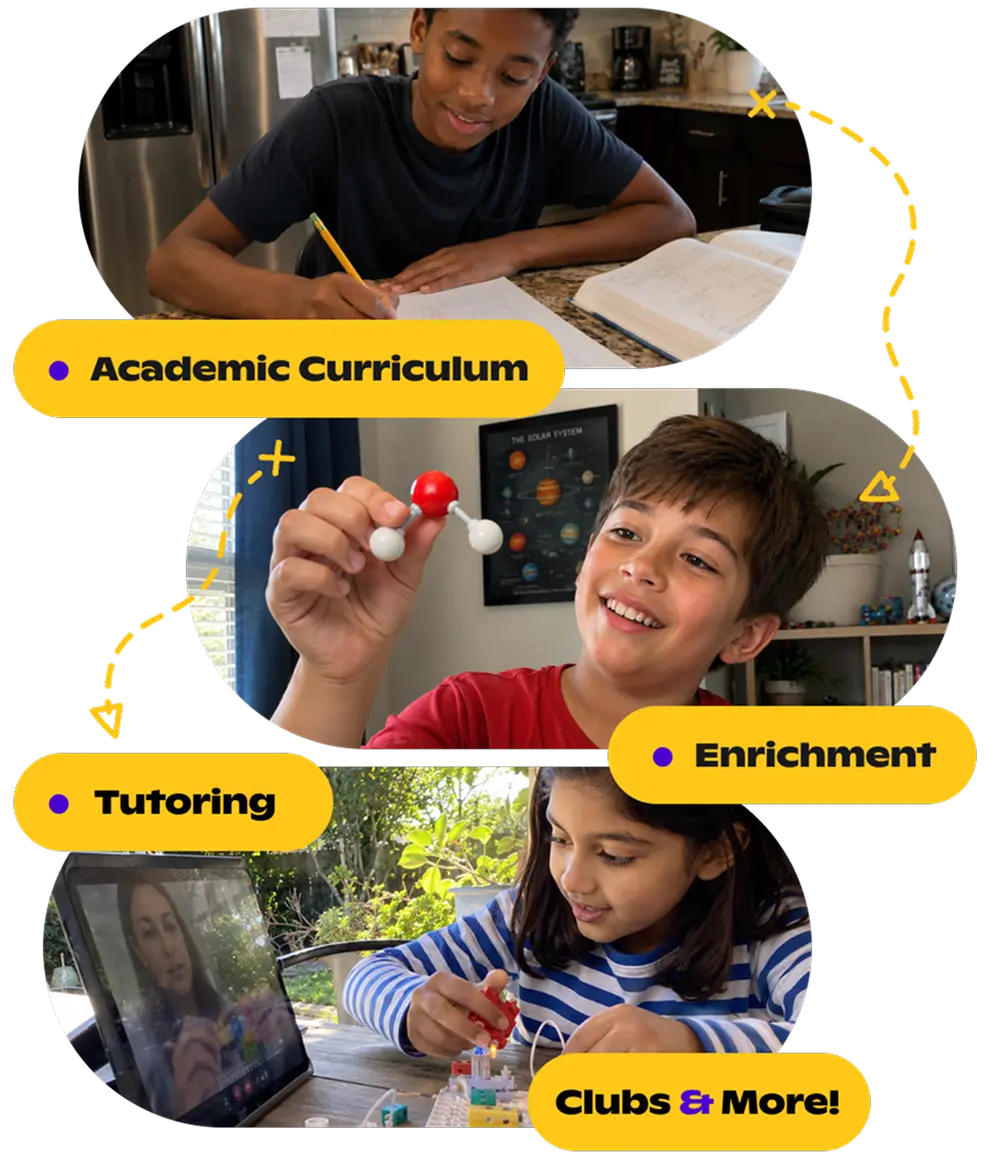
Outschool offers online classes on literally hundreds of topics. They can cover all parts of an entire academic year or last a few weeks, targeting a specific subject or set of skills. One-on-one tutoring is available, too.
Parents love the wide variety of courses available, the fact that they are taught by vetted professionals, and that their child is able to interact with others in real time. Kids love how engaging and fun the classes are.
Education research database
ERIC is a free, searchable database of education research sponsored by the U.S. Department of Education. If you want to dig deeper into a specific question, like phonics versus whole language, writing instruction, attention supports, or project-based learning, ERIC is a good place to find studies, reports, and literature reviews.
Try searches like "diagnostic assessment," "reading intervention elementary," or "writing instruction middle school." The research is excellent, but that doesn't necessarily translate into usable lesson plans for day-to-day instruction, so be prepared to come up with those yourself.
Your State Department of Education
Even if you don't plan to "teach to the state standards," they can be a practical checklist for scope, especially for language arts and math. While they can be useful for knowing what to cover, you're on your own for creating the lesson plans and learning activities that teach them.
Institute of Education Sciences
If you want research-backed guidance without marketing, IES and its What Works Clearinghouse review education studies and publish practice guides. These can be especially helpful when you're choosing approaches for reading instruction, math intervention, study skills, or learning supports.
You can compare what has evidence behind it before committing to a specific program. Again, the material is great, but it will take some work to apply what you learn there to real lessons.
Frequently Asked Questions: Homeschool Curricula
Homeschooling looks different in every household, so the "right" curriculum for your child may look a lot different from the one the kid down the street uses. These common questions can help you troubleshoot potential issues and feel confident moving forward.
What is the best homeschool curriculum for first-time homeschoolers?
For first-timers, the best one is generally simple to start, easy to maintain, and flexible enough to adjust after you learn what works.
If you're overwhelmed, start small: prioritize language arts and math, add one content subject, and build from there once your routine feels steady. If your state requires documentation, choose materials that naturally produce evidence of learning (work samples, quizzes, writing pieces, or projects) and keep a simple weekly log.
How can I tell whether a homeschool curriculum is too easy or too hard for my child?
Look for three signals: time, accuracy, and attitude. If lessons consistently take far longer than the curriculum suggests, your child is making frequent errors even with help, or frustration is high day after day, the level may be too difficult.
If your child finishes quickly with near-perfect accuracy and seems bored, it may be too easy. Before switching programs, try a short adjustment first: reduce the number of problems, add more guided practice, slow the pace, or use more hands-on methods. Placement tests and diagnostic assessments can also help you start at the right level, especially when your child is working above or below grade level in a subject, and you can find free options online.
Which homeschool curriculum features matter most to busy parents?
Busy parents usually benefit most from (1) clear daily lesson plans, (2) minimal prep and printing, (3) built-in review and answer keys, and (4) flexibility to shorten lessons without breaking the sequence.
A predictable routine can also reduce decision fatigue and make learning feel more manageable for both parent and child (Seattle Children's).
Do I need to buy an all-in-one curriculum?
No. An all-in-one curriculum may be convenient for some families because it reduces planning time and keeps subjects coordinated, but it's not required and can be quite expensive. If you are interested in the all-in-one approach because of time constraints or a lack of comfort teaching some subjects, you might consider live online classes, which provide many of the same benefits.
How much should a homeschool curriculum cost?
Costs vary widely because "curriculum" can mean anything from a free reading list to a full boxed program. If you're trying to keep costs down, start with your public library (read-alouds, audiobooks, reference books, and biographies), free teacher resources, and used curriculum swaps.
What if I'm homeschooling middle or high school? How do credits and transcripts work?
In middle and high school, it helps to think in terms of courses rather than "grade levels." Keep a brief course description (topics covered, major books, labs/projects), note how you evaluated work (tests, papers, projects), and save representative samples. Credit expectations and reporting rules vary by location, so confirm what your state requires and what your student's future school or college expects.
Even simple documentation, like a book list and a few writing samples per semester, can go a long way when you're building a transcript.
How do homeschoolers handle socialization?
Social time doesn't have to come from your curriculum. Many homeschoolers build community through co-ops, library programs, sports, faith communities, Scouts, 4-H, volunteering, and group classes. If your child enjoys online learning, live classes can also provide structured interaction with teachers and peers. The best plan is usually a mix of consistent weekly activities plus occasional field trips or special events.
Real Life, Real Learning
Choosing a homeschool curriculum is less about finding a "perfect" program and more about building a plan you can use consistently. Start with your child's needs, choose a manageable format, and give yourself permission to adjust after a short trial period. With steady routines, the right level of challenge, and resources you trust, you can create a homeschool program that supports real learning and works for real life.
Sources
American Psychological Association. "4 Important Considerations for Homeschooling." American Psychological Association, https://www.apa.org/topics/schools-classrooms/homeschooling-considerations.
Fulton Brown, Rachel. The Arts of Language in the Middle Ages: The Trivium. Department of History, The University of Chicago, Spring 2025, https://home.uchicago.edu/~rfulton/Trivium.pdf.
National Center for Education Statistics. "Homeschooled Children and Reasons for Homeschooling." The Condition of Education, U.S. Department of Education, Institute of Education Sciences, May 2025, https://nces.ed.gov/programs/coe/indicator/tgk/homeschooled-children.
Seattle Children's. "Kids Thrive on Structure and Routines." Seattle Children's, https://www.seattlechildrens.org/health-safety/parenting/kids-thrive-routines/.



.svg)
.svg)