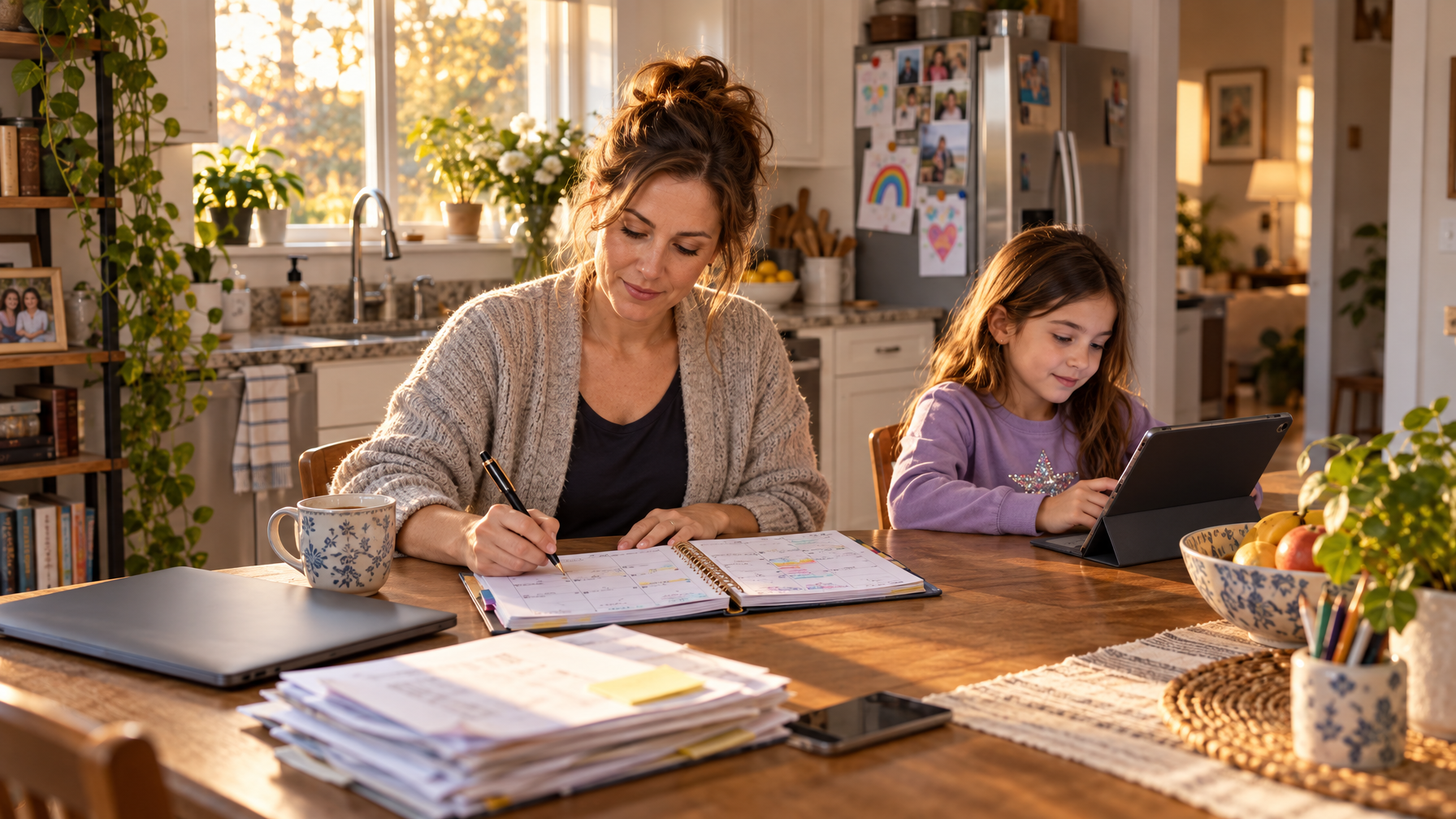
6:47am, and the coffee isn't ready yet
The house is half-awake. Your 8-year-old is building something out of couch cushions. Your 5-year-old is asking for a snack for the third time. You have a 9am meeting, a math lesson to get through before lunch, and the vague feeling that you're already behind.
This is where the morning basket changes the shape of your day.
A morning basket isn't a curriculum. It's 20 to 30 minutes of shared learning that happens before individual work begins: a read-aloud, a poem, a map puzzle, maybe a short skill page. Everyone together, no screens, low pressure. By the time it's over, your kids have settled into learning mode and you've had a structured start that didn't require a single login.
The concept comes from Charlotte Mason's philosophy, which treats short, focused lessons and "living books" as the foundation of a child's education. But you don't need to follow Mason's method to borrow the morning basket. It works for eclectic homeschoolers, classical families, and parents who just need a reliable opening routine.
What goes in the basket
Literally: a basket, a bin, a tote bag, whatever sits on your table. Inside it, keep the materials you'll use every morning. Rotate them every few weeks to keep things fresh.
A good starter basket for a work-from-home parent:
- One read-aloud book. A chapter book you're working through together, 1 to 2 chapters per day. This is the anchor. Pick something you enjoy reading too, because you'll be reading it out loud for weeks.
- One poem. A printed poem or a poetry anthology propped open to the day's page. Read it once, talk about one thing you noticed, move on. This takes 2 minutes.
- One map or geography prompt. A blank map to label, a globe to spin (find the country from yesterday's read-aloud), or a geography question card. Another 2 to 3 minutes.
- One skill page (optional). A copywork passage, a handwriting page, a logic puzzle, or a short math review. Something your kid can do independently while you sip your coffee.
Total time: 20 to 30 minutes. That's the whole basket.
7:15am: what this looks like with a meeting at 9
Here's the part that matters for parents who work from home: the morning basket is done before your workday starts. It's not competing with your calendar. It's replacing the chaotic first 30 minutes where everyone wanders and nobody's learning.
7:15: Sit down together. Open the read-aloud. Read 1 chapter (10 to 15 minutes). Your kids are eating breakfast. That's fine.
7:30: Read the poem. Ask one question: "What did you picture?" or "What word stood out?" Don't turn it into an assignment. (2 minutes.)
7:32: Pull out the map. "Find the country from chapter 3" or "What ocean is between here and England?" Your 8-year-old does this while your 5-year-old colors the map. (3 minutes.)
7:35: Hand over the skill page. Your 8-year-old works on a copywork passage. Your 5-year-old practices letter formation. You're refilling your coffee. (5 to 10 minutes.)
7:45: Basket done. Individual work starts (math workbook, phonics, whatever your curriculum covers). You have 75 minutes before your meeting.

$20 off your first class WITH promo code: blog
Build the Education your Kid Deserves
Discover thousands of live classes taught by expert teachers, across academics and enrichment.
Browse classesWhy routines work: the executive function connection
There's a reason the morning basket works even on days when your kid woke up grumpy and resistant. Predictable routines reduce the demand on executive functions, the mental skills that handle planning, task-switching, and impulse control [1].
When your kid knows what's coming (read-aloud, poem, map, skill page, in that order, every morning), they don't have to spend mental energy figuring out what to do next. That energy goes toward the learning instead. Adele Diamond's research on executive functions shows that routines and structure are especially important for younger kids whose EF skills are still developing [1].
For work-from-home parents, this has a practical payoff: a kid who's been through a predictable morning basket transitions to independent work more smoothly than one who started the day with "go find something to read."
Adapting for different ages
If you're homeschooling multiple kids, the morning basket is one of the few things that works across age gaps without modification.
Ages 3 to 5: They listen to the read-aloud and poem, color during map time, and do a simple tracing or matching page during skill time. They won't engage with everything, and that's normal. Exposure counts.
Ages 6 to 9: Full participation. They can narrate the read-aloud chapter back to you, answer the map question, and do copywork or a logic puzzle independently.
Ages 10 to 13: The read-aloud still works (even older kids benefit from hearing complex language read aloud). Swap the skill page for a journal prompt or a discussion question they answer in writing. The poem can become a short analysis: what literary device is the poet using?
What to read: starter suggestions
The read-aloud book drives the basket, so choose one that holds your attention too. A few family-tested options:
- For younger kids (ages 5 to 8): Owl at Home by Arnold Lobel. Short chapters, gentle humor, one chapter per day.
- For middle readers (ages 8 to 11): My Side of the Mountain by Jean Craighead George. Survival, nature, independence. Pairs well with nature study unit work.
- For older kids (ages 11 and up): The Hobbit by J.R.R. Tolkien. Maps built right into the book. Geography practically teaches itself.
For poetry, start with a general anthology like A Child's Garden of Verses by Robert Louis Stevenson for younger kids, or Poetry 180 edited by Billy Collins for older ones. One poem per day, no analysis required unless your kid wants to talk about it.
After the basket: where live classes fit
The morning basket handles the communal, relationship-building part of your homeschool day. What comes after is individual skill work, and that's where live classes can carry the load.
A common rhythm for work-from-home parents:
- 7:15 to 7:45: Morning basket (together, parent-led)
- 7:45 to 9:00: Independent math and reading practice
- 9:00 to 12:00: Parent works; kid attends 1 to 2 live Outschool classes
- Afternoon: Free play, projects, or co-op meetup
The basket gives your kid a strong reading foundation and a sense of connection with you. The live class gives them a teacher, a peer group, and depth on subjects you don't have time to teach yourself.
Frequently asked questions
Do I have to use a physical basket?
No. The "basket" is just a container for your materials so you're not scrambling every morning. A shelf, a drawer, a tote bag, a clipboard with the day's pages clipped to it. The container doesn't matter. Having everything in one place does.
What if my kid resists the morning basket?
Start with just the read-aloud and food. Read during breakfast for a week without asking for any response. Once the routine feels normal, add the poem. Then the map. Build it in layers, not all at once.
How often should I rotate the basket contents?
Swap the read-aloud book when you finish it (every 2 to 4 weeks). Swap the poem anthology or map set monthly. The skill page can change weekly. Don't overthink this. If something's working, keep it.
Is a morning basket enough for a full homeschool day?
No. The basket covers 20 to 30 minutes of shared time, plus whatever the skill page adds. You still need dedicated time for math, reading/phonics (for younger kids), and whatever subjects your state requires. The basket is the opening routine, not the whole curriculum.
Sources
[1] Diamond, Adele. "Executive Functions." Annual Review of Psychology, vol. 64, 2013, pp. 135-168. https://pmc.ncbi.nlm.nih.gov/articles/PMC4084861/



.svg)
.svg)