Why music belongs in your homeschool curriculum
Music is one of those subjects that homeschool families tend to handle informally: a playlist in the car, a piano gathering dust in the living room, a kid who hums constantly but has never had a lesson. Informal exposure matters, but it is not the same as music education.
Research shows that structured music training strengthens executive function, verbal intelligence, and working memory in kids, even with short-term instruction. [1] Those are the same cognitive skills that support reading, math, and self-regulation. Music is not a nice-to-have elective. It is a subject that makes other subjects easier.
The challenge for homeschool families is figuring out what "music curriculum" looks like when you do not have a band room, a choir director, or a budget for private lessons. This guide compares the most widely used homeschool music programs by approach, cost, and age range, so you can find the right fit for your family without overspending or overcomplicating your schedule.
Types of music curricula: what the main approaches look like
Before comparing specific programs, it helps to understand the main categories. Most homeschool music curricula fall into one of these buckets:
Music appreciation
These programs focus on listening, composer studies, genre exploration, and cultural context. Kids learn to identify instruments, recognize musical forms, and connect music to history and geography. Strong for families who want music education without instrument commitment. Programs: SQUILT, Music in Our Homeschool, The Good and the Beautiful Music.
Instrument-based
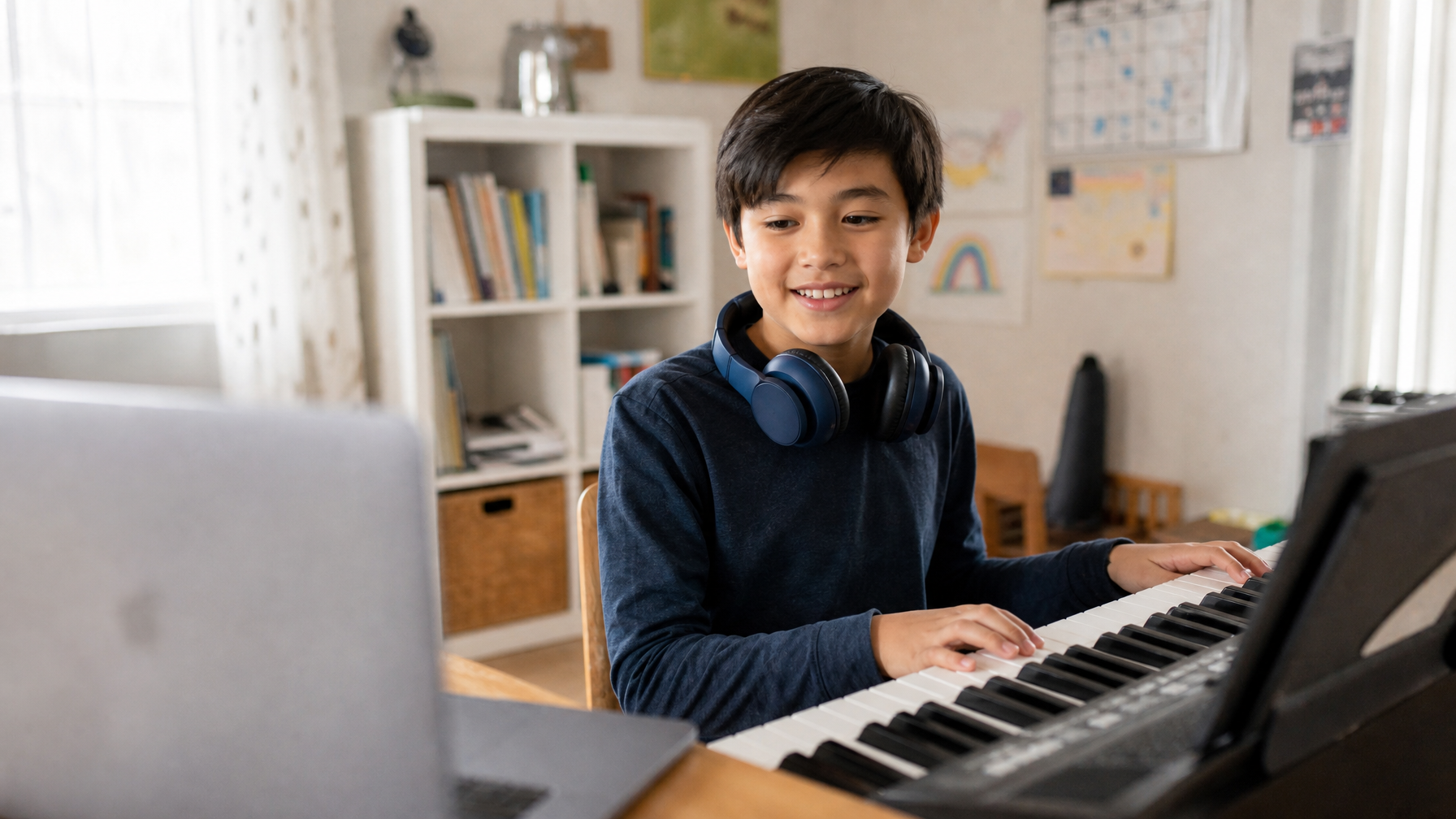
These programs teach kids to play a specific instrument through structured lessons, practice routines, and progressive skill building. They range from app-based (Simply Piano, Hoffman Academy) to live instruction (Outschool, local teachers). Best for families ready to invest in an instrument and consistent practice time.
Theory and composition
These programs teach how music works: reading notation, understanding rhythm and meter, chord structure, and eventually composition. Some are standalone; others are woven into instrument or appreciation programs. Older kids who want to compose, produce, or pursue music seriously need this foundation.
Hybrid and lifestyle-based
Many families combine approaches: a music appreciation program for the core curriculum, piano lessons for skill building, and concert attendance or music documentaries for cultural exposure. This mix-and-match approach is the most common in experienced homeschool families.
7 programs compared: what each one does well and what to watch for
1. SQUILT (Super Quiet UnInterrupted Listening Time)
Approach: Guided music appreciation through active listening exercises.
Age range: Ages 4 and up (tiered by level).
Cost: ~$15-$20 per unit; annual membership ~$97.
What it does well: Teaches kids to listen with intention. Each lesson centers on a single piece of music, and kids document what they hear: instruments, tempo changes, dynamics, mood. The curriculum builds genuine listening skills that transfer to other subjects. Zero instrument requirement, zero musical background needed from the parent.
Watch for: This is a listening and analysis program, not a performance program. If your kid wants to play an instrument, SQUILT will not get them there. It works best as one piece of a broader music education rather than the whole thing.
Best for: Families who want a structured, low-prep music appreciation program that builds real analytical listening skills.
2. Prodigies Music
Approach: Color-coded video music lessons with deskbells and play-along activities.
Age range: Ages 2-12.
Cost: ~$15/month or ~$149/year; starter bell set ~$30-$50.
What it does well: Makes abstract music concepts concrete for young kids through color coding. Kids play along with video lessons using color-matched bells, and the system gradually introduces pitch, rhythm, melody, and basic theory. Very high engagement for kids under 8. The video-based format means parents do not need musical training to facilitate lessons.
Watch for: The color-coding system is a bridge to standard notation, not a replacement for it. Kids who stay in Prodigies too long without transitioning to traditional notation may have a harder time reading sheet music later. The upper age limit (12) means you will need a different program for middle and high school.
Best for: Families with young kids (ages 3-8) who want a hands-on, screen-based introduction to music fundamentals.
3. The Good and the Beautiful Music
Approach: Free music appreciation curriculum organized by composer and era.
Age range: All ages (family-style).
Cost: Free (digital downloads).
What it does well: Covers composer biographies, listening exercises, and basic music concepts at zero cost. Each unit focuses on a single composer with guided listening, narration, and discussion questions. The open-and-go format requires almost no prep. Hard to beat the price for families on a tight budget.
Watch for: Includes a religious worldview that will not fit every family. The program covers appreciation only, with no instrument instruction, theory depth, or performance component. For a secular alternative, look at SQUILT or Music in Our Homeschool.
Best for: Budget-conscious families who want a simple, structured introduction to classical music and composers.
4. Hoffman Academy
Approach: Free video piano and music theory lessons.
Age range: Ages 5 and up (beginner through intermediate).
Cost: Free (video lessons); premium membership ~$18/month for practice tools and sheet music.
What it does well: Mr. Hoffman's teaching style is warm, clear, and paced for kids. The free video library covers piano technique, music reading, rhythm, and basic theory in a logical sequence. Each lesson builds on the last, so kids can work through the curriculum independently. One of the best free piano resources available.
Watch for: Without the premium tools, practice reinforcement is limited. The videos teach concepts well, but a video cannot hear your kid play or correct hand position. Kids who need real-time feedback will eventually need a live teacher alongside Hoffman.
Best for: Families who want a free, self-paced piano and theory foundation before committing to paid lessons.
5. Simply Piano
Approach: App-based piano learning with real-time feedback via device microphone.
Age range: Ages 6 and up.
Cost: ~$18/month or ~$170/year.
What it does well: The app listens to your kid play through the device microphone and gives instant feedback on accuracy. Gamified progression keeps kids motivated, and the two learning paths (Soloist for classical/theory, Chords for pop/rock accompaniment) let kids follow their interests. Short daily sessions (10-15 minutes) fit easily into a homeschool schedule. Works with acoustic or digital keyboards.
Watch for: The microphone-based feedback catches wrong notes but cannot correct posture, hand position, or technique. Over time, bad habits can develop without a teacher noticing. The gamification can also become the point rather than the music. Not designed for kids who need intensive or advanced instruction.
Best for: Kids who are self-motivated and want a low-pressure, app-based way to learn piano at their own pace.
6. Music in Our Homeschool
Approach: Comprehensive music appreciation and theory curriculum with lesson plans, printables, and listening guides.
Age range: PreK through high school.
Cost: ~$10/month or ~$70/year (membership); individual courses ~$15-$30.
What it does well: The widest age range of any music appreciation program. Courses cover everything from preschool rhythm games to high school music history for fine arts credit. The "I Heart" series (I Heart Classical Music, I Heart Hymns, I Heart American Music) provides focused, short-term deep dives. Printable worksheets and listening maps make it easy to document music study for portfolio or transcript purposes.
Watch for: Some courses include a Christian perspective, though it is lighter than The Good and the Beautiful. The platform has a lot of content, and navigating to the right course for your kid's level takes some upfront research. No instrument instruction included.
Best for: Families who want a full-spectrum music appreciation curriculum that spans PreK through high school, with documentation for transcripts.
7. Live music classes on Outschool
Approach: Live, teacher-led music classes across instruments, voice, theory, composition, and appreciation.
Age range: Ages 3-18.
Cost: Per-class pricing, typically $10-$25 per session. No subscription or annual commitment.
What it does well: A live teacher can do what no app or video can: hear your kid play in real time, correct technique, adjust the lesson when something is not clicking, and build a relationship that keeps kids showing up. Outschool's music classes cover piano, guitar, ukulele, voice, music theory, composition, and music appreciation. Small group classes average 3-4 kids, which means real interaction and feedback.
Outschool also offers 1:1 music lessons for kids who need focused instruction on a specific instrument or are preparing for auditions, recitals, or fine arts credit requirements.
Watch for: Outschool is not a sequenced, packaged music curriculum. You choose individual classes and teachers rather than following a preset scope and sequence. If you want a full year-long plan, pair Outschool lessons with an appreciation program like SQUILT or Music in Our Homeschool for structure.
Best for: Families who want live instruction with real-time feedback, need to fill specific gaps (instrument lessons, theory, composition), or want to add a human element to a self-paced curriculum. Also strong for ESA families, since Outschool is an approved provider on Odyssey, ClassWallet, and Step Up for Students.
How to match a program to your kid
The comparison above covers what each program does. This section is about which one fits your specific situation.
By age and stage
Preschool and kindergarten (ages 3-5): Focus on rhythm, movement, and playful sound exploration. Prodigies is the standout here. Singing, clapping games, and simple percussion instruments build a foundation for everything that comes later. Formal lessons are not necessary at this age.
Early elementary (first through third grade): This is when kids can start connecting music concepts to specific skills. Beginner piano (Hoffman Academy or Simply Piano) or ukulele lessons give them something concrete to practice. Pair with SQUILT or The Good and the Beautiful for listening and appreciation.
Upper elementary (fourth through fifth grade): Kids have the attention span and fine motor skills for more structured instrument practice. This is a strong time to start guitar, piano, or voice lessons with a live teacher. Music theory starts to make sense at this age, especially if connected to an instrument they are already playing.
Middle school (sixth through eighth grade): Music education becomes more reflective and skill-based. Kids can study music history, explore digital composition tools like Chrome Music Lab (free, from Google), and work toward performance goals. If your kid is interested in music but not in performing, lyric analysis, songwriting, and audio production are strong alternatives. This is also when music can start counting toward fine arts credit on a transcript.
High school: Music study becomes intentional and potentially credit-bearing. Students may work toward a recital, build a composition portfolio, prepare for AP Music Theory, or pursue college audition prep. Music in Our Homeschool offers high-school-level appreciation courses. For performance-level instruction, live 1:1 lessons (Outschool or a local teacher) are hard to replace.
By interest and learning style
The listener (loves music, does not want to perform): SQUILT or Music in Our Homeschool. These programs build genuine musical understanding without requiring a kid to pick up an instrument. Pair with concert attendance (live or virtual) and music documentaries for a rich appreciation-based program.
The self-starter (wants to learn independently): Hoffman Academy (piano, free) or Simply Piano (app-based, gamified). Both work well for kids who are motivated to practice on their own and prefer learning at their own pace.
The performer (wants feedback and stage time): Live Outschool music classes, especially 1:1 instrument lessons. A teacher who can hear them play, correct technique, and set performance goals makes a real difference for kids who want to get good, not just learn the basics.
The creator (wants to compose and produce): Start with music theory classes, then add digital audio tools (GarageBand, BandLab, Soundtrap). Outschool offers composition classes that teach songwriting, arranging, and production alongside theory.
Can I use ESA funds for music curriculum?
Yes, in most states with active ESA programs. How it works depends on the program type:
- Outschool: Approved on Odyssey (Texas, Utah), ClassWallet (Arizona, Idaho, Alabama), and Step Up for Students (Florida). Per-class pricing makes it easy to allocate funds for weekly music lessons alongside other subjects.
- Instrument purchases: Many ESA programs cover musical instruments as approved educational materials. Check your state's vendor list or approved expense categories.
- Digital subscriptions (Simply Piano, Prodigies, Music in Our Homeschool): May qualify as approved educational technology in some states, but not all digital tools are pre-approved. Verify with your state program.
- Free programs (The Good and the Beautiful Music, Hoffman Academy free tier): Nothing to reimburse.
For a full breakdown by state, see our ESA approved expenses guide.
Do homeschoolers need music credits?
It depends on your state. Some states include fine arts (which includes music) in their graduation requirements or recommended coursework. Others leave it entirely to the parent's discretion. The National Core Arts Standards for music outline grade-level benchmarks if you want a reference point for what to cover at each stage. Review your state's homeschool laws for specifics on requirements.
Even when not required, music education is worth including for its documented cognitive benefits: stronger executive function, improved verbal memory, and better self-regulation. [1] For high school transcripts, a year of music appreciation, theory, or instrument study typically qualifies as a fine arts credit. Document it with a course description, hours log, and any performance or project evidence.
What a weekly music routine can look like
You do not need a dedicated music room or a conservatory schedule. Music develops naturally with consistency, and the best routines weave it into the day rather than treating it as a separate block. Here is what a realistic weekly routine looks like for most homeschool families:
- Daily (10-20 minutes): Instrument practice or a short music lesson from your core program. Consistency matters more than length, especially for younger kids.
- Daily (background): A curated playlist during meals, car rides, or quiet work time. Rotate genres, eras, and cultures. Talk about what you hear.
- 2-3 times per week (15-20 minutes): A guided listening exercise (SQUILT lesson) or a music appreciation unit (composer study, genre deep dive).
- 1 time per week: A live Outschool music class, whether that is instrument lessons, theory, or a music appreciation discussion group.
- Monthly: Attend a live concert, watch a music documentary, or have your kid perform for the family. The performance does not need to be polished. It needs to be practiced.
Keep instruments out and accessible so kids can pick them up spontaneously. A ukulele on the couch gets played more often than a guitar in a case in the closet. Music can also become a tool for emotional regulation: when learning gets frustrating, press play and move.
Frequently asked questions
What is the best homeschool music curriculum for beginners?
For young beginners (ages 3-7), Prodigies is the most engaging starting point. The color-coded bells and video lessons make abstract concepts tangible. For older beginners who want to learn piano specifically, Hoffman Academy's free video series is the strongest self-paced option. If you want a teacher guiding the process from the start, a weekly live lesson on Outschool gives your kid real-time feedback that videos and apps cannot.
Do I need to play an instrument to teach music at home?
No. Most homeschool music programs are designed for parents with zero musical background. SQUILT, Prodigies, The Good and the Beautiful, and Music in Our Homeschool all provide the listening guides, lesson plans, and teaching scripts you need to facilitate without performing. If your kid wants instrument instruction and you cannot teach it, a live teacher (Outschool or local) fills that gap.
Does music appreciation count as a music credit?
Yes. A structured music appreciation program with documented hours, course descriptions, and assessment (listening journals, composer reports, essay responses) qualifies as a fine arts credit for homeschool transcripts in most states. Music in Our Homeschool specifically offers high school courses designed for transcript documentation.
Do concerts count as music instruction?
Yes. Live performances, virtual concerts, and post-concert discussions all count as music education. Have your kid take notes on what they heard: instruments, dynamics, mood, and anything that surprised them. If you are tracking hours for a transcript or portfolio, log the concert plus discussion time.
Do private music lessons count as music instruction?
Yes, private lessons incorporate performance skills, technique, theory, and often music history. They are one of the easiest forms of music education to document for credit: log the weekly lesson time, practice time, and any recital or performance participation.
Can I combine free and paid programs?
Yes, and most experienced homeschool families do. A common setup: Hoffman Academy (free) for piano basics, SQUILT ($97/year) for listening and appreciation, and one weekly Outschool class for live instruction and performance feedback. Total cost: under $50/month for a well-rounded music education.
What instruments are easiest to start with at home?
Ukulele and piano (or keyboard) are the two most common starting instruments for homeschoolers. Ukuleles are inexpensive ($30-$60 for a quality starter), portable, and have only four strings. Keyboards do not need tuning, come at a range of price points ($50-$300 for a good starter), and transfer directly to piano lessons. Voice is also an instrument, and it is free.
Is Simply Piano worth it for homeschoolers?
It is a solid supplement for self-motivated kids who want to practice piano independently. The real-time feedback via microphone catches wrong notes, and the gamified progression keeps kids coming back. But it cannot correct hand position, posture, or technique, which means bad habits can develop without a teacher noticing. Think of it as a practice tool alongside occasional live instruction, not a standalone replacement for lessons.
Sources
[1] Moreno, S., et al. "Short-Term Music Training Enhances Verbal Intelligence and Executive Function." Psychological Science, vol. 22, no. 11, 2011, pp. 1425-1433. https://pmc.ncbi.nlm.nih.gov/articles/PMC3449320/


.svg)
.svg)