Teaching math to a kindergartner at home can feel overwhelming at first. Where do you start? How much is enough? What if your child isn't ready for numbers yet, or already races ahead of whatever you put in front of them?
The good news: kindergarten math is actually one of the most flexible and forgiving stages of elementary school learning. Children this age are natural mathematicians. They sort, count, compare, and pattern-hunt all day long before you ever open a workbook. A good kindergarten math curriculum for homeschoolers builds on that instinct rather than fighting it.
This guide walks through what kindergarten math actually covers, how to pick the right curriculum approach for your child, and how to keep things moving when one method stops working.
What kindergarten math covers
A solid kindergarten math curriculum for elementary school students touches six core areas. You don't need to cover them in order, and most children revisit each one multiple times throughout the year.
1. Counting and number sense
Kindergartners work toward counting reliably to 100, first by ones and later by tens. They also practice counting objects (one-to-one correspondence), recognizing that the last number counted tells you "how many," and understanding that numbers represent actual quantities, not just words in a sequence.
Number sense is the single most important foundation to build at this stage. One of the clearest signs a child has developed it is when they can recognize that their answer simply doesn't make sense — a self-monitoring ability that compounds year over year. Build it through hands-on exploration: comparing and contrasting quantities, understanding what a number is and what it isn't, and interacting with math in as many varied, concrete ways as possible. The more children can engage with math in real contexts, the more it becomes part of how they think.
Explore kindergarten counting and numbers classes if you want live practice to reinforce this at home.
2. Number recognition and writing
Children learn to recognize written numerals 0 to 20 and write them independently. This includes understanding that "5" and ●●●●● represent the same quantity, a concept that takes more practice than it looks.
3. Comparing numbers
Kindergartners compare groups of objects and numerals using language like greater than, less than, and equal to. They begin to order numbers on a simple number line.
4. Addition and subtraction within 10
This is the big milestone most parents think of first. Kindergartners develop basic kindergarten addition and kindergarten subtraction skills, adding and subtracting within 5, then within 10. They use physical objects, drawings, and eventually equations. Fluency within 5 is the end-of-year target for most kindergartners.
5. Geometry and shapes
Kindergarten geometry focuses on flat (two-dimensional) shapes: circles, squares, triangles, rectangles, and hexagons. Children also begin to recognize that some shapes are three-dimensional, or solid, and learn to distinguish 2D from 3D shapes by describing their attributes. Common Core standards at this level center on that distinction rather than requiring kindergartners to formally name all solid shapes. Recognizing and naming solids like cubes, cones, cylinders, and spheres is a skill that develops across kindergarten and into first grade, so give it time and don't rush it. Kids explore shapes by building, sorting, and finding them in the real world. Kindergarten geometry classes on Outschool can make this hands-on exploration feel like play.
6. Measurement and data
Kindergartners compare objects by length, weight, and capacity using language like longer, heavier, and holds more. In practice, this looks like laying two sticks side by side to decide which is longer, filling two containers with water to see which holds more, or holding two blocks and guessing which is heavier. Formal tools like rulers and scales come later; this stage is about building the language and intuition that standard measurement will build on. Kindergartners also sort and classify objects by one or more attributes (color, shape, size) and count how many fall into each category.
How much time should kindergarten math take?
For most homeschooling families, 20 to 30 minutes of focused math per day is plenty at the kindergarten level. This can look like 10 minutes with manipulatives, 10 minutes of a math game, and a few minutes of oral review, or it might be a single 25-minute lesson if your child is engaged.
The key is consistency over intensity. Short daily practice builds stronger number sense than a long session once a week.
Choosing a kindergarten math curriculum approach
Play-based learning is learning. At the kindergarten level, that's not a philosophy preference — it's developmental reality. The early years of math are about exploration, hands-on engagement, and helping your child discover what kind of mathematician they are. Learning styles vary greatly, and when a concept isn't clicking, it usually means the child hasn't encountered it in the way they need to see it yet. The approaches that honor that reality tend to produce better outcomes than programs that push pencil-and-paper work too early. Think about how your child learns best, including whether they are a hands-on, visual, auditory, or social learner, before committing to a curriculum format.
Manipulatives-based curricula
Programs like Math-U-See, RightStart Mathematics, and Miquon Math center on physical objects, including blocks, rods, tiles, and abacuses, to build number sense before moving to abstract symbols. This is the most developmentally appropriate starting point for most kindergartners.
Best for: Visual and kinesthetic learners. Children who light up when working with physical objects and struggle when pushed to abstract symbols too early.
Watch for: These programs require more parent involvement and materials. Budget time to prepare lessons and gather supplies.
Game-based and play-based approaches
Rather than a formal curriculum, some families build kindergarten math entirely around games, puzzles, and everyday activities: cooking, measuring, counting collections, and playing board games. This approach aligns naturally with how kindergartners learn best and is especially effective for active children who resist sitting down.
Some educators build entire teaching philosophies around this idea. Instructors who design classes around engagement-first, game-based learning, including math that lives inside familiar contexts like building, trading cards, and collaborative play, often find that kindergartners internalize number concepts faster when the stakes feel low and the fun feels real. On Outschool, Create N Learn brings exactly this approach to their math sessions: playful, skill-building, and designed with every kind of learner in mind.
Best for: Active, curious children who resist sitting down. Families comfortable with a looser structure.
Watch for: It's easy to accidentally skip areas, especially subtraction and number writing, with a fully play-based approach. A simple tracking checklist keeps you on track.
Singapore Math
Primary Mathematics (and its homeschool edition) uses a concrete-pictorial-abstract sequence: children first work with real objects, then pictures, then symbols. It's known for building strong problem-solving skills and deep number sense.
Best for: Children who are ready for a bit more challenge and parents comfortable with a less scripted approach.
Watch for: Singapore Math moves faster than some US-based programs. Many families supplement with extra manipulatives practice in the first few months.
Charlotte Mason-inspired math
Charlotte Mason advocates use real-life math (measuring ingredients, counting coins, telling time) alongside a minimal spine like Mathematical Reasoning or Ray's Arithmetic. The emphasis is on understanding over drill.
Best for: Families already using a Charlotte Mason approach in other subjects. Children who respond well to living books and real-world contexts.
Workbook-based curricula
Programs like Saxon Math K, Horizons Math, and Abeka provide structured, sequential lessons with clear instructions for the parent. Each lesson builds on the last, and the workbooks include plenty of repetition.
Best for: Families who want clear structure and measurable daily progress. Children who like routine and do well with pencil-and-paper tasks.
Watch for: Workbooks at the kindergarten level can feel tedious for five-year-olds who aren't ready to sit and write for extended periods. If your child resists or shuts down, try moving to manipulatives or games first and returning to workbook practice later in the year when fine motor skills and attention spans are stronger.
End-of-kindergarten math milestones
One of the most practical things a homeschool parent can do is keep a simple running checklist of where their child stands. Below are the core skills most kindergartners are working toward by the end of the year, aligned with Common Core standards. Use this as a guide, not a report card. Children develop at different rates, and a few unchecked items in June is not a cause for concern.
- Counts to 100 by ones, then by tens
- Counts forward starting from any given number (not only from 1)
- Writes numerals 0 to 20
- Counts a set of up to 20 objects and states how many there are
- Compares two groups of objects or two written numbers using "greater than," "less than," or "equal to"
- Adds and subtracts within 5 with confidence (using objects, drawings, or mental math)
- Solves simple addition and subtraction word problems within 10
- Understands that teen numbers (11 to 19) are made of a ten and some additional ones
- Correctly names flat shapes: circle, square, triangle, rectangle, hexagon
- Distinguishes flat (2D) shapes from solid (3D) shapes
- Compares two objects by length, weight, or capacity and uses comparative language correctly
- Sorts objects into groups by an attribute (color, shape, size) and counts each group
If your kindergartner is solid on the top six items, they are in strong shape for first grade math. The bottom six are important but develop more gradually across kindergarten and into first grade.
What to look for in a kindergarten math curriculum
Whatever approach you choose, the best kindergarten math curriculum for homeschoolers will:
- Build number sense before pushing into operations
- Include both conceptual understanding and procedural fluency
- Stay hands-on for at least part of each lesson
- Give your child time to talk through their thinking, not just write answers
- Spiral back to concepts so children revisit and reinforce them over time
Strong number sense is the single biggest predictor of math success in later elementary school years. When a child genuinely understands place value and quantity, they develop the ability to recognize when their own answer doesn't make sense — a self-monitoring skill that compounds from kindergarten through algebra. Build it through hands-on exploration, comparing and contrasting, and as many real-world interactions with math as possible. Curriculum choices that rush to memorization before building this foundation often create gaps that are harder to fix in second or third grade.
Teaching kindergarten math at home: practical tips
Start with what your child already knows
Before opening any curriculum, spend a week observing what math your child does naturally. Can they count their toys? Do they notice when portions are unequal? Can they sort blocks by color or size? Starting from their current level, not the first page of the curriculum, saves weeks of frustration.
Use real objects before worksheets
Kindergartners are concrete thinkers. Math doesn't have to feel like school — it can be woven into everyday life. Counting dried beans, grouping socks, and measuring the dog with a piece of string builds far more number sense than a page of number lines. Children have to see a concept in the physical world before they can work through it mentally. The more exposure and interaction children have with math in real contexts, the more prepared they are. Introduce worksheets after a concept is solid in 3D.
Play skip counting games in the car
Counting by twos, fives, and tens is a kindergarten standard that most children find genuinely fun to practice as a game. Use it during car rides, waiting in line, or walking to the mailbox. You can also find skip counting classes on Outschool to add some variety.
Keep a simple running checklist
Kindergarten math standards are public and searchable. A one-page checklist of the six skill areas above, updated as your child demonstrates mastery, lets you see gaps early and document progress easily. The milestone list in this article is a good starting point.
Don't panic about writing
Many kindergartners struggle to write numerals neatly and consistently. This is a fine motor issue, not a math issue. Let them show you answers with objects or verbally while the handwriting catches up.
When your child needs a different approach
Signs that your current kindergarten math curriculum isn't working:
- Consistent tears or meltdowns before or during math time
- Resistance that doesn't improve after a few weeks
- Forgetting concepts that seemed solid the week before
- No transfer: can do worksheets but can't apply the same skill to real objects or games
A checked-out learner is not the same as a resistant one. When a kindergartner goes quiet and disengages, it can signal overwhelm, confusion they can't yet articulate (sometimes they don't know what they don't know), or simply boredom. Before concluding that a curriculum isn't working, change it up, have a conversation, and invite more buy-in. Ask them: how do they want to learn? What are they wondering about? Their answers often point directly to the entry point you've been looking for.
These aren't signs that your child is bad at math. They're signs that the delivery method isn't matching how they need to learn. Try switching from workbooks to games, or from games to more structure, before concluding there's a deeper problem.
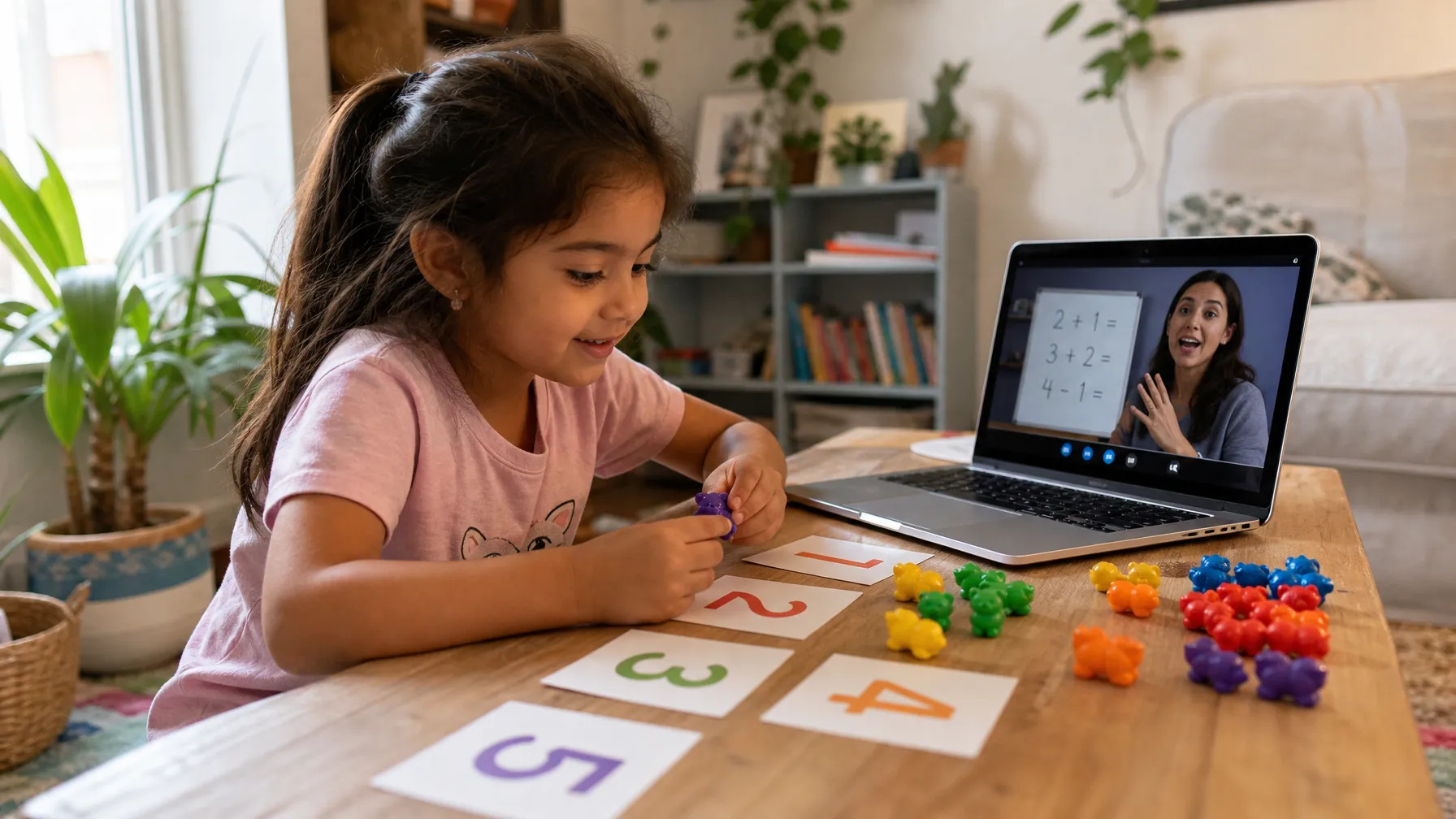
Some families find that a weekly live class fills the gap. A teacher who can ask questions in real time, respond to a child's specific confusion, and make the lesson feel different from "home practice" often unlocks progress that solo curriculum work couldn't. Educators who focus on giving students the actual tools, including worked examples, pattern recognition, and targeted practice, before moving on can make a meaningful difference for children who need to understand the why, not just the procedure. Mind over Math on Outschool operates from exactly this philosophy, offering group classes and tutoring designed to build the foundational understanding kindergartners need before math gets harder in first grade.
How Outschool fits into your kindergarten math homeschool
Outschool isn't a replacement for your core curriculum. It's the live, interactive layer that most homeschool programs can't offer on their own.
Browse kindergarten math classes to find:
- One-time enrichment classes that turn a tricky concept (like subtraction) into a game
- Short courses that run 4 to 8 weeks and follow your child's current curriculum topic
- Small group tutoring for children who need more individualized attention
- Math clubs that keep kindergartners engaged with numbers outside of formal lesson time
You can also browse early math classes for options that span the pre-K to early elementary school range, useful if your kindergartner is working ahead or behind grade level.
Classes run live on a flexible schedule, so they fit around your homeschool day rather than replacing it. Most kindergarten math sessions run 25 to 30 minutes, exactly the right length for this age group.
Putting it all together
A kindergarten math curriculum for homeschoolers doesn't have to be expensive, complicated, or perfectly planned. The children who build the strongest math foundation at this age are usually the ones who had consistent, low-pressure practice: daily exposure to numbers through games, conversations, manipulatives, and a little bit of structured work.
Pick one approach that fits your family, give it a genuine 6 to 8 week run, and adjust from there. The most important thing is that your kindergartner leaves the year believing they are good at math, because that belief will carry them through every year of elementary school that follows.
Explore Pre-K and kindergarten math classes on Outschool to find a live session that fits your schedule and your child's current level.



.svg)
.svg)