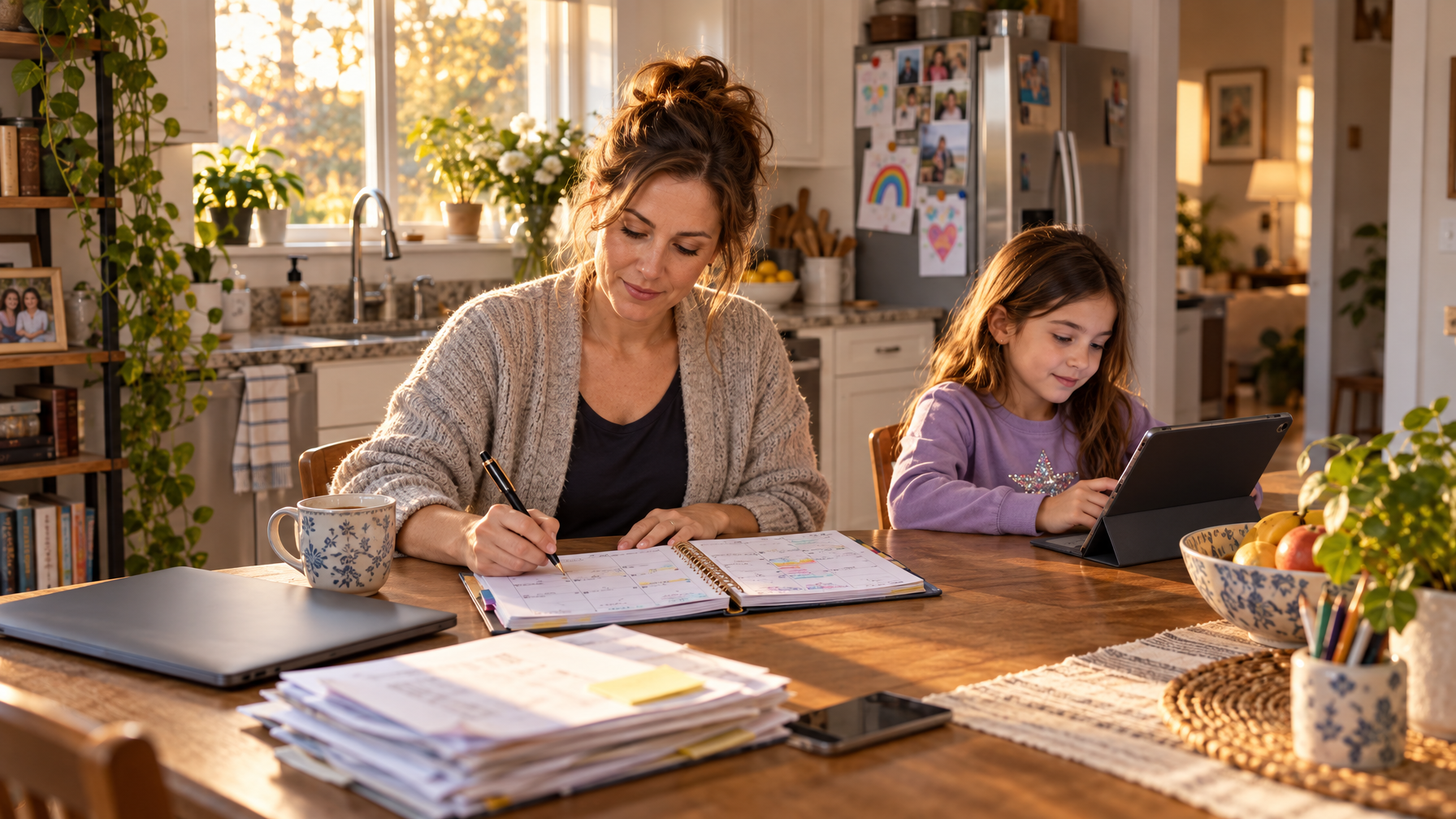
Your kid is five or six or seven, and you're staring at two tabs: the local school's enrollment form and a search for "online elementary school." Maybe public school didn't work last year. Maybe your family moves a lot. Maybe your kid learns at a pace that doesn't match the classroom clock. Whatever brought you here, you're not alone, and the options are wider than most parents realize.
This guide breaks down the three main types of online elementary school, what each one looks like day to day, and how to figure out which one fits your family.
What "online elementary school" means (it's not one thing)
The phrase "online elementary school" covers at least three very different models, and mixing them up is the fastest way to choose the wrong one.
Virtual public schools
These are tuition-free, state-run programs (K12/Stride, Connections Academy, state-specific options like Florida Virtual School). Your kid is enrolled as a public school student, follows state standards, takes standardized tests, and receives a report card. The school sets the schedule and curriculum. Parents serve as "learning coaches" but don't choose what or how to teach.
This works well for families who want structure and accountability without a physical building, or who need a tuition-free option with a clear transcript path.
Watch for: Virtual public schools are not homeschooling. In most states, enrolling in one means you're no longer legally a homeschooler, which affects flexibility, curriculum choice, and sometimes ESA eligibility. The daily time commitment can rival in-person school, with 4 to 6 hours of assigned work plus live sessions.
Online private schools
These are accredited private schools that operate entirely online (Laurel Springs, Seton Home Study, Calvert, Bina School). Tuition averages $3,000 to $12,000 per year, though some programs, particularly those with small cohorts or specialized approaches, charge well above $15,000. Not every online private school mirrors a traditional classroom. Some are built around project-based learning or Montessori methods, and others are designed specifically for kids with autism, ADHD, or giftedness, with curricula and pacing adapted to those learning profiles. Class sizes are typically smaller than virtual public schools, and many offer more schedule flexibility.
This works well for families who want an accredited diploma track with more personalized attention, who have a kid whose learning needs call for a specialized environment, or who plan to transfer credits to a brick-and-mortar school later.
Watch for: Cost is the obvious barrier, though some ESA programs cover private school tuition. The level of "live" instruction varies widely. Some are mostly self-paced with occasional check-ins; others run daily live classes.
Homeschool with live online classes
This is the approach where the parent remains the primary educator, choosing curriculum and setting the pace, but uses live online classes for subjects that benefit from a teacher and peer interaction. Platforms like Outschool offer thousands of live, small-group classes across every elementary subject, from phonics and math to art and coding.
This works well for families who want full control over what and when their kid learns, but don't want to teach every subject solo.
Watch for: This model requires the parent to do more planning and coordination than the other two. There's no single transcript or report card unless you build one. That freedom is the point for most families who choose it, but it does take more upfront work.
What a typical day looks like in each model
The daily experience varies so much between models that comparing them side by side is worth the space.
Virtual public school (example: K-2 student): Log in by 8:30am for a live morning meeting. Two to three live lessons (math, ELA, science or social studies) spread across the morning. Afternoon is "offline work time" with assigned worksheets, reading, and projects. Total screen time: 3 to 5 hours. Total work time: 5 to 6 hours.
Online private school (example: K-2 student): Schedule depends on the school. Some run 2 to 3 live classes per day; others assign weekly modules with one live check-in. Total screen time: 1 to 4 hours. Total work time: 3 to 5 hours.
Homeschool with live classes (example: K-2 student): Morning might start with a 45-minute live math class on Outschool, followed by 30 minutes of independent reading, then a nature walk or hands-on science project. Afternoons are free. Total screen time: 1 to 2 hours of live class. Total work time: 2 to 3 hours (because young kids learn faster one-on-one).
How to choose: five questions that clarify fast
Rather than comparing features in a spreadsheet, these five questions tend to sort families into the right model quickly.
1. Do you need a tuition-free option?
If yes, virtual public school is the only fully free path. Homeschooling with live classes can be affordable, especially if your state offers an ESA that covers online classes, but it's not zero-cost.
2. Do you want to choose the curriculum?
If yes, homeschooling is the only model where you're in full control. Both virtual public and online private schools assign the curriculum.
3. Does your kid need a flexible schedule?
Homeschooling offers the most flexibility. Online private schools are in the middle. Virtual public schools are the most structured.
4. Is an accredited transcript important to you right now?
For elementary grades, this matters less than most parents think. Accreditation becomes more relevant in high school for college applications. At the elementary level, what matters is that your kid is learning and progressing.
5. How much do you want to be involved in daily instruction?
Virtual public school: you supervise but don't teach. Online private school: similar. Homeschool with live classes: you plan and coordinate, but teachers handle subjects you choose to outsource.
What the research says about young kids learning online
Parents worry about screen time for elementary-aged kids, and that concern is legitimate. But the research draws a sharp line between passive screen use and interactive, instructor-led learning.
A 2024 meta-analysis published in Educational Research Review found that synchronous online instruction (live classes with a teacher and peers) produced learning outcomes comparable to in-person instruction for elementary students, while asynchronous, self-paced programs showed weaker results for kids under 10 [1]. The key variable wasn't the screen itself. It was whether a real person was on the other side of it.
This finding matters for model selection. Programs that rely heavily on recorded lessons and independent worksheets tend to struggle with younger kids who need real-time feedback and social interaction. Programs built around live, small-group instruction perform better.
Socialization: the question every parent asks
"But what about friends?" Every parent considering online elementary school asks this, and it's worth addressing directly.
Kids in virtual public schools typically have some peer interaction through live class sessions, but it's structured and limited compared to a physical classroom. Recess doesn't happen on Zoom.
Kids in online private schools get similar live-session interaction, plus some schools organize virtual clubs or in-person meetups in certain cities.
Homeschooled kids using live online classes often have the richest social lives, paradoxically, because their parents intentionally build it. Homeschool co-ops, park days, sports leagues, Scouts, community classes, and live online classes with recurring peer groups all fill the social calendar. On Outschool, many kids take the same weekly class for months, building real friendships with classmates across the country.
The honest answer: socialization requires effort in every model. No version of online elementary school delivers a built-in friend group the way a neighborhood school does. But the friendships kids build through intentional connection, whether online or in person, can be just as meaningful.
ESA funds and online elementary school
If your state offers an education savings account, your options expand. ESA funds can cover:
- Online private school tuition in most ESA states
- Live online classes on platforms like Outschool (approved in Arizona, Florida, Texas, Utah, Alabama, and other ESA states via ClassWallet, Odyssey, or direct reimbursement)
- Curriculum materials, tutoring, and educational technology
Virtual public schools are already tuition-free, so ESA funds don't come into play there. For a full breakdown of what your state's ESA covers, check our ESA guide.
When online elementary school doesn't work (and what to try instead)
Online learning isn't the right fit for every kid or every family. Here are the most common reasons it doesn't work, and what to do about each one.
Your kid can't sit still for screen time. This is normal for kids under 8. Try shorter live sessions (30 to 45 minutes), pair them with hands-on offline activities, and look for classes that incorporate movement. Outschool classes for younger kids are designed with short attention spans in mind.
You don't have a reliable internet connection. Some virtual public schools loan devices and hotspots. If connectivity is spotty, a curriculum-based homeschool approach with occasional live classes may work better than a fully online program.
Your kid misses being around other kids all day. Consider a hybrid approach: homeschool with live online classes for academics, plus in-person activities (co-ops, sports, art classes) for socialization.
You're overwhelmed by the planning. If you want online learning but can't handle the coordination, a virtual public school or online private school handles the planning for you. You trade flexibility for structure, which is a valid trade.
FAQ
Is online elementary school legal?
Yes. Virtual public schools are state-authorized. Online private schools are accredited. Homeschooling is legal in all 50 states, though requirements vary by state.
Can my kid switch back to in-person school later?
Yes. Virtual public school credits transfer like any other public school credits. Online private school credits transfer if the school is accredited. Homeschooled kids re-enter public school based on age and, in some states, placement testing.
How many hours a day does online elementary school take?
Virtual public school: 5 to 6 hours. Online private school: 3 to 5 hours. Homeschool with live classes: 2 to 3 hours for K-2, 3 to 4 hours for third through fifth grade. Elementary-aged kids learn efficiently in small groups and one-on-one settings, so less time doesn't mean less learning.
What about special education services?
Virtual public schools must provide IEP and 504 accommodations, just like brick-and-mortar schools. Online private schools vary. Homeschooling families can access private evaluations and therapies, sometimes covered by ESA funds, and supplement with specialized online tutoring.
Is online school harder for kindergartners and first graders?
It depends on the format. Long stretches of independent screen work are tough for five and six year olds. Short, interactive live classes with a skilled teacher work well. The key is matching the format to the developmental stage: brief sessions, lots of hands-on activities between, and a patient adult nearby.
Sources
[1] Means, B., et al. "Online and blended learning outcomes: a meta-analysis revisited." Educational Research Review, 2024.


.svg)
.svg)