Some families pull out of a driveway with a full curriculum loaded on a tablet and a color-coded schedule pinned to the dashboard. Others leave with a library card, a journal, and the loose plan of following whatever the road puts in front of them.
Both of those are roadschooling. And both can work.
Roadschooling is homeschooling while traveling, whether that means full-time RV life, a summer-long road trip, a gap year abroad, or anything in between. It's a growing subset of the broader homeschool and unschooling movement, and families approach it in wildly different ways. Some follow a structured curriculum on the road. Others lean fully into experience-based, interest-led learning. Most land somewhere in between, and that middle ground shifts week to week depending on where they are and what their kids are drawn to.
This guide covers the practical side of making it work: the legal requirements, how to think about structure (or the deliberate lack of it), what to do about subjects that are hard to teach from a camper, and how to keep some thread of continuity when your zip code changes every few days.
Roadschooling vs. worldschooling vs. unschooling: what's the difference?
These terms overlap, and families use them loosely. Here's a rough map:
- Roadschooling usually refers to homeschooling while traveling domestically, often by RV, van, or car. Some families use it for any travel-based learning.
- Worldschooling implies international travel, though the philosophy is similar: the world is the classroom. Worldschooling families tend to emphasize cultural immersion and language learning.
- Unschooling is a philosophy, not a location. It centers on child-led, interest-driven learning with no preset curriculum. Unschooling can happen on the road or at a kitchen table.
A roadschooling family might follow a structured math curriculum every morning and then spend the afternoon exploring tide pools. Another might skip the curriculum entirely and let a week at the Grand Canyon become the science, geography, art, and writing lesson all at once. Neither approach is more "legitimate" than the other. In a survey of 75 grown unschoolers, researchers Peter Gray and Gina Riley found that the vast majority reported no significant disadvantage from their non-traditional education and described benefits including self-direction, intrinsic motivation, and strong problem-solving skills [1].
The legal side: which state's homeschool laws apply?
This is the question every roadschooling family hits first, and the answer is simpler than it seems: you follow the homeschool laws of your domicile state, the state where you maintain legal residency (driver's license, voter registration, mailing address).
You do not need to register as a homeschooler in every state you drive through. States regulate residents, not visitors.
That said, domicile state matters. Some states have minimal requirements (Texas, for example, requires no notification and no testing), while others ask for annual assessments, attendance records, or a letter of intent. If your domicile state has strict requirements, some traveling families choose to establish residency in a state with lighter regulations before hitting the road. That's a legal decision worth discussing with your family, and the HSLDA state law directory is a good starting point for comparing requirements.
A few practical domicile tips for roadschooling families:
- Keep a mailing address. A mail-forwarding service or a family member's address works. You'll need it for state compliance, vehicle registration, and insurance.
- Document as you go. Even if your state doesn't require a portfolio, keep a running log of what your kids are learning. Photos, journal entries, reading lists, and project notes make this easy and also become a family archive you'll value later.
- Know your state's attendance calendar. Some states define a school year (for example, 180 days or a certain number of hours). If your state counts hours, it helps to know roughly how much learning time you're logging, whether structured lessons or experiential days.
The structured approach: curriculum on the road
Plenty of roadschooling families want (or need) structure. Maybe your kid is working toward grade-level benchmarks. Maybe you're planning to re-enroll in a brick-and-mortar school after a year on the road. Maybe structure just fits your family better.
Structured roadschooling typically looks like this:
- A core curriculum for math and language arts, done in morning blocks before the day's travel or exploration begins. Many families use digital or workbook-based programs that don't require heavy materials.
- Location-based enrichment for science, social studies, and the arts. A week near Yellowstone becomes geology. A stop in Gettysburg becomes history. A rainy day in the RV becomes a deep dive into whatever book your kid can't put down.
- Online classes for subjects that benefit from a teacher. Math at certain levels, foreign languages, writing with peer feedback, and lab sciences are hard to replicate from a van. Live online classes give traveling kids two things that are hard to find on the road: a consistent teacher who knows their work, and a group of peers who show up at the same time every week. That consistency becomes an anchor when everything else is in motion.
The biggest practical challenge is WiFi. Families solve this in a few ways: satellite internet, cellular hotspots with data plans sized for video calls, library and coffee shop stops built into the weekly rhythm, or downloading lessons and assignments in advance for offline work.
The interest-led approach: unschooling on the road
For families who lean toward unschooling, roadschooling can feel like the most natural expression of the philosophy. The world is right outside the door, literally changing every day.
Interest-led roadschooling doesn't mean "no learning." It means the learning follows the child's curiosity rather than a predetermined scope and sequence. That might look like:
- A 9-year-old who gets fascinated by bridge engineering after crossing one in West Virginia and spends the next two weeks sketching bridge designs in a journal, looking up truss types, and building models from craft sticks. They visit a museum that allows them to turn those sketches into a scale model.
- A 12-year-old who starts tracking fuel costs, campsite fees, and meal budgets for the family trip and ends up doing more real-world math than any workbook would cover.
- A 7-year-old who collects rocks at every stop and, over time, builds a catalog that includes where each one was found, what type it is, and how it formed.
The parents' role in this approach isn't to direct the learning but to notice what sparks interest and create conditions for it to deepen. That might mean driving an extra hour to visit a dam after the bridge conversation, or keeping a shelf stocked with field guides, or finding a live science class that connects to something a kid is already excited about.
Some families in this camp still use online classes selectively, not as curriculum but as a way to go deeper on a topic a kid has chosen. A kid who's obsessed with marine biology might take a live ocean science class while the family is parked near the coast. A kid who loves writing might join a creative writing workshop to get feedback from someone other than mom or dad.
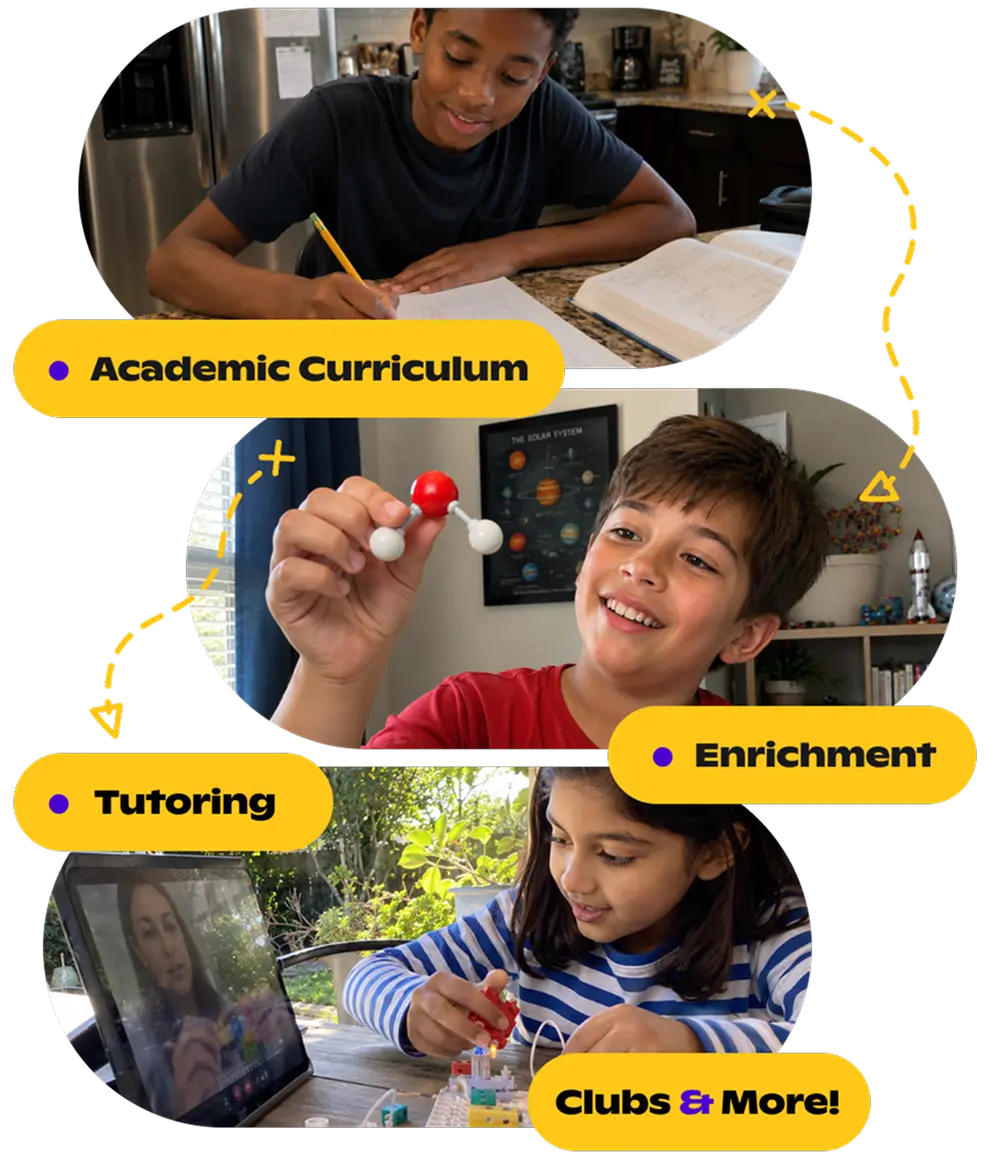
$20 off your first class WITH promo code: blog
Build the Education your Kid Deserves
Discover thousands of live classes taught by expert teachers, across academics and enrichment.
Browse classesThe middle ground (where most families land)
In practice, very few roadschooling families are purely structured or purely interest-led. Most blend both approaches, and the blend shifts based on the season, the kid's age, and the terrain.
A common pattern:
- Math stays structured. It's sequential, and gaps compound. Most families keep some kind of daily math practice going, even if everything else is flexible.
- Reading is constant but unstructured. Kids read what they want: library books picked up in every town, audiobooks on long drives, graphic novels, and field guides. Volume matters more than a reading list.
- Writing happens organically. Journals, postcards to grandparents, blog posts about the trip, scrapbook captions, nature logs. It doesn't look like a writing curriculum, but a kid who writes daily is practicing writing.
- Science, history, and social studies are location-driven. This is where roadschooling has a genuine advantage over classroom learning. Standing inside a cave and understanding how it formed is a different kind of learning than reading about it. Standing in a former president's home while you learn about all they accomplished and how their life progressed brings history to life.
This blended approach works especially well when families pair it with one or two weekly online classes to cover the subjects that are hardest to teach experientially. Building a curriculum for the road doesn't have to mean replicating a traditional school day. It can mean choosing the one or two subjects where consistent instruction matters most and letting the road handle the rest.
Socialization on the road
The socialization question comes up for every homeschool family, but it hits differently for roadschoolers because the peer group is always changing. Kids might make a friend at a campground and then drive away three days later.
Families handle this in a few ways:
- Online classes and clubs. A weekly class gives kids a stable group of peers who they see regularly, regardless of where the family is parked. For roadschooling kids, this can be the one social constant in a life that's otherwise in motion.
- Homeschool co-ops and meetups. Full-time traveling families sometimes plan routes around regional homeschool meetups or park in an area long enough for kids to join a local co-op temporarily. Families can also add sports the same way. Do you want to play soccer? Find a local recreation center and stay for 6 weeks.
- Travel communities. Organizations like Fulltime Families and Worldschoolers connect traveling families so kids can meet peers who share their lifestyle.
- Slow travel. Some families build in longer stays (2 to 4 weeks) in one place, specifically so kids can form deeper connections at a park, a local library program, or a community center.
ESA funds and roadschooling
If your domicile state has an education savings account (ESA) program, your funds travel with you. ESA eligibility is based on residency, not physical location, so a family domiciled in Arizona can use Arizona ESA funds to book online classes from a campground in Montana.
This is one of the practical advantages of pairing roadschooling with online learning. Live classes on Outschool are an approved expense in most ESA programs, and they're accessible anywhere you have an internet connection. Families in states like Arizona, Florida, Utah, West Virginia, and Texas can use their funds to fill gaps in the subjects that are hardest to roadschool, like math instruction, foreign languages, or 1:1 tutoring for a kid who needs extra support.
Getting started: a checklist for families considering roadschooling
Whether you're planning a full-time RV year or a 6-week summer road trip, here's a starting framework:
- Check your domicile state's homeschool laws. File any required paperwork (letter of intent, notification) before you leave. If you're not yet homeschooling, read our guide to switching from traditional school to homeschooling.
- Decide where you fall on the structure spectrum. Full curriculum? Interest-led? Somewhere in the middle? There's no wrong answer, but knowing your starting point helps you pack the right materials (or not).
- Solve for WiFi. If online classes, digital curriculum, or remote work are part of your plan, research cellular coverage for your route and invest in a reliable hotspot.
- Choose 1 to 2 anchor subjects. Even the most interest-led families usually find it helpful to keep one or two subjects (often math and reading) on a consistent rhythm. That could be as simple as 10 minutes of reading time every day.
- Set up a documentation habit. Photos, journals, a shared family blog, a simple spreadsheet. Pick whatever works, and make it part of the routine from day one. You'll need it for compliance, and you'll want it for memories.
- Build in connection points. Sign up for a weekly online class, join a traveling families group, or plan your route to overlap with homeschool meetups. Peer connection on the road takes more intention than it does at home.
- Give yourself a grace period. The first 2 to 3 weeks are an adjustment. Routines won't stick immediately. Kids might resist or might thrive right away. Either response is normal and every family has gone through the growing pains!
FAQ
Is roadschooling legal?
Yes. Roadschooling is a form of homeschooling, which is legal in all 50 U.S. states. You follow the homeschool laws of your domicile state (the state where you maintain legal residency), not the states you travel through.
Do I need a curriculum to roadschool?
It depends on your state's requirements and your family's philosophy. Some states require you to cover specific subjects or use an approved curriculum. Others have no curriculum mandate. And plenty of roadschooling families take an unschooling or interest-led approach that doesn't follow a packaged curriculum at all.
How do roadschooling kids take tests or meet grade-level requirements?
If your domicile state requires annual assessments, you can typically schedule them during a visit home or find an approved testing center in another state. Some families also use online proctored assessments. Check your state's specific rules for acceptable testing formats.
What about kids who need to transition back to traditional school?
If you know your kid will re-enroll in a brick-and-mortar school, keeping records of what they've covered helps smooth the transition. A portfolio of work, a log of subjects and hours, and any standardized test scores will give the receiving school a clear picture of where your child stands.
Can I use ESA funds while roadschooling?
Yes, if your domicile state offers an ESA program. Eligibility is tied to your state of residency, not your physical location. You can use ESA funds to book online classes, purchase curriculum materials, or pay for tutoring from anywhere.
How do roadschooling families handle socialization?
Through a mix of online classes, traveling family communities, homeschool co-op meetups along the route, and intentional slow-travel stops where kids can form deeper local connections. Many families say the social skills their kids develop from meeting new people constantly, adapting to new environments, and interacting with people of all ages, are one of the biggest benefits of the lifestyle.
Sources
[1] Gray, P. and Riley, G. (2015). "Grown unschoolers' evaluations of their unschooling experiences: Report I on a survey of 75 unschooled adults." Other Education: The Journal of Educational Alternatives, 4(2), 8-32. https://academicworks.cuny.edu/cgi/viewcontent.cgi?article=1514&context=hc_pubs


.svg)
.svg)