Most kids study the wrong way. Not because they're lazy, but because the strategies that feel productive — highlighting, re-reading, copying notes again — are among the least effective techniques in the research literature. This guide covers what actually works, organized by grade level so the recommendations are practical for where your child is right now.
The research: two techniques that actually work
In 2013, a team of cognitive scientists reviewed 10 common study techniques and rated each for effectiveness. Only two received "high utility" ratings: retrieval practice and distributed (spaced) practice. [1]
Retrieval practice means actively recalling information rather than re-reading it. Flashcards done correctly, practice tests, and the "close the book and explain it" method are all forms of retrieval practice. The act of struggling to retrieve information strengthens the memory trace in a way that passive review doesn't. [2]
Distributed (spaced) practice means spreading study sessions across multiple days. A 20-minute session on day one, 15 minutes on day four, and a 10-minute review the night before will outperform two hours crammed the night before the test.
Why kids default to low-utility strategies
Highlighting and re-reading feel productive because the content seems familiar afterward. Researchers call this the "illusion of knowing": content that's been re-read feels learned even when it can't be recalled without the text in front of you. [2] Retrieval practice feels harder in the moment. That difficulty is the mechanism — not a sign the method isn't working.
Grades third through fifth (ages 8–11)
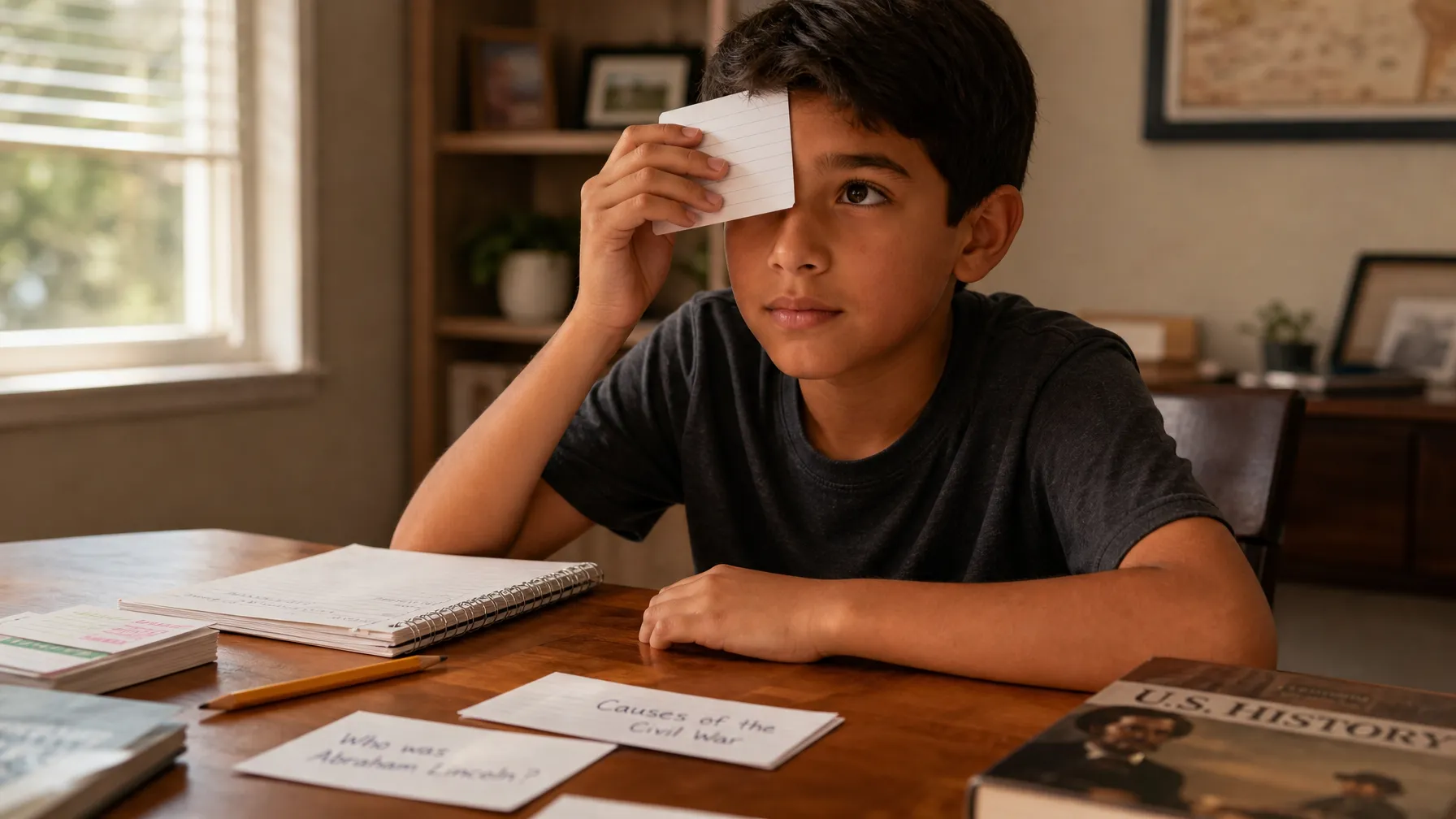
Flashcards done right: Cover the answer. Attempt to recall it out loud before flipping. Kids who flip immediately get almost none of the benefit. Put hard cards in a "not yet" pile and repeat until it's empty.
Teach it back: After studying a concept, close the book and explain it aloud — to you, to a sibling, to a stuffed animal. Gaps in the explanation reveal gaps in understanding.
Three-night spread: Even for a Friday test, start Tuesday. Tuesday: 10 minutes on flashcards. Wednesday: 10 minutes. Thursday: review only the hard cards. Stop there.
Grades sixth through eighth (ages 11–14)
Practice tests: If a teacher provides review sheets, use them as primary study tools. Answer every question without notes first. Grade the attempt. Review only what was wrong.
Cornell notes with retrieval column: Cover the right-side notes column. Use left-side cue questions to try recalling content aloud.
Interleaving subjects: Rather than 45 minutes on math then 45 minutes on history, alternate in shorter blocks — 20 minutes each. Interleaving feels harder and produces better retention. [1]
The spacing schedule: For a test in two weeks, study on days 1, 4, 9, and 13. For a one-week window, study on days 1, 3, 5, and 7.
$20 off your first class WITH promo code: blog
Build the Education your Kid Deserves
Discover thousands of live classes taught by expert teachers, across academics and enrichment.
Browse classesHigh school (ages 14–18)
Backward planning from the test date: On the day a test is announced, block study sessions starting at least one week out. Four sessions of 25 minutes each, spread across the week, will outperform three hours the night before.
Self-quizzing with increasing difficulty: Start with basic recall, move to application, then synthesis. This mirrors how higher-level exams are written.
Pre-retrieval before re-reading: Before reviewing notes, write down everything you can recall from the last session without looking. This retrieval step improves retention from the review that follows. [2]
Study groups built around quizzing: The most effective study groups quiz each other. Groups that just "go over the material" together produce weaker results.
Cramming the night before a big exam increases anxiety and disrupts sleep — both of which hurt performance more than the cramming helps. [1]
A simple study schedule any family can use
- Day 7: First review. Read notes actively, stopping to recall main points before moving on.
- Day 5: Flashcard or practice-question session. 20 minutes.
- Day 3: Practice test or teach-it-back. Identify what's still shaky.
- Day 1 (night before): Review only the shaky material from day 3. 15 to 20 minutes. Stop there.
If your child needs more support, Outschool's tutoring and study skills classes work one-on-one on techniques that match their grade level and learning style.
Frequently asked questions
What if my child has to study the night before? Focus entirely on retrieval practice. Use flashcards or practice questions for 30 to 45 minutes. Skip re-reading entirely.
Are some kids just bad test-takers? Most kids who say this are using low-utility study strategies. Address strategy first. If test anxiety is the real issue, see our guide on test anxiety in kids.
Sources
[1] Dunlosky, J. et al. "Improving Students' Learning with Effective Learning Techniques." Psychological Science in the Public Interest 14, no. 1 (2013): 4–58.
[2] Bjork, R. A. "Memory and metamemory considerations in the training of human beings." MIT Press, 1994.


.svg)
.svg)