Thank you! Your submission has been received!
Oops! Something went wrong while submitting the form.
Every detail of your class listing—from your cover image to your summary—plays an important role in helping families discover your class and feel confident enrolling.
In this guide, we’ll break down the key components of a high-performing Outschool class listing and share practical, actionable tips to improve your visibility, engagement, and enrollments.
Topics covered include:
Whether you’re launching your first class or improving an existing one, this guide can help you align your listing with how families search, discover, and enroll on Outschool.
Families don’t all begin their journey in the same place, but they all end up in the same one: your class listing.
Some families first encounter Outschool outside of the website. They might search Google for a specific learning need, see an ad on social media, or receive a recommendation from another parent. In many of these cases, they land directly on a specific class page.
Others begin on Outschool.com. They browse categories, use the search bar, or explore personalized recommendations to find options that fit their child.
No matter where the journey starts, every path leads to your class listing. That page must immediately communicate who the class is for, what learners will gain, and why families can trust you.
Many families first encounter Outschool – and individual classes – outside of Outschool.com.
When families search for specific learning needs online (for example, “online phonics tutor”) search engines often return relevant Outschool pages.
Search engines may direct families to:
Outschool also promotes classes through:
In many cases— especially with Class Listing Ads — Outschool Ads are a direct reflection of the details on your class page.
Families also discover classes through parent recommendations, shared links, and online communities. These visitors often arrive with limited context about Outschool.
💡 Key Takeaway: No matter how families find you, your class page must quickly communicate who the class is for, the outcomes learners will gain, and why you’re a trusted choice. You can also bring more traffic to your class listing by sharing with your own social network or homeschool groups you might be part of.
Once families are on Outschool, search helps them quickly find classes that best match what they’re looking for based on their query, selected filters, and past behavior.
When a family searches, the following components can be taken into consideration:
This is why two people can see slightly different results for similar searches.
💡Key takeaway: Search results are personalized. There is no single universal results page — only results tailored to a family’s request and context.
Before ranking begins, Outschool creates a pool of eligible classes. If a class fails any check, it won’t appear.
Classes must:
If there’s no meaningful match, the class is excluded from the pool.
Note: Match is forgiving: it’s case-insensitive, accounts for synonyms and spelling variations, stems related words, and uses flexible logic (e.g., mathematics tutor = math tutor).
💡Key takeaway: Include the keywords families are most likely to search for directly in your class title and summary, and make sure your subject and age range settings are accurate, because filters are hard requirements for appearing in search results.
Once Outschool has the relevant list of classes, our search algorithm determines which eligible classes should appear first.
Ranking balances three goals:
Those predictions are combined into a single score, with a higher score = higher placement.
Models are retrained regularly using recent search behavior so results stay aligned with what families respond to today.
We also provide a small boost to newly published classes so new listings have an opportunity to gain visibility. For classes without sufficient enrollment data, we estimate long-term value using performance patterns from similar classes on the marketplace.
💡Key takeaway: Ranking rewards alignment and performance over time. When your class clearly matches what families are searching for — and consistently converts interest into enrollment — it is positioned to perform well.
Parents are usually deciding whether a class is for them in under a minute. They’re trying to answer three questions, in order:
💡Key Takeaway: Families enroll when they quickly see fit, feel trust, and understand expectations. A strong listing answers these three questions clearly and confidently.
Now that you understand how families find classes and how search works, let’s break down the individual elements of your listing.
Each component plays a specific role in either:
A high-performing listing aligns all three.
Your title affects both search matching and click-through rate. It should clearly communicate what the class is about and what outcomes learners will achieve.
Outcome + Topic + Format (optional) + Audience (optional)
🎯 Ask Yourself: Does your title align with what you’d expect families to search for?
💡 Key Takeaway: Clear, searchable titles improve both visibility and clicks.
Your cover image is a key driver of clicks. It appears across all search and discovery surfaces (Search results, Browse pages, Paid ads, Category pages, etc). Families decide in seconds whether to click. Your image should communicate what the class is and feel trustworthy.
.webp)


🎯 Ask yourself: Would a parent understand this class in 2 seconds?
💡 Key Takeaway: Your image earns the click. If it’s unclear or untrustworthy, families won’t move forward. For technical requirements and more design tips, see Image Guidelines for Teachers.
Your short summary is your 1-2 sentence elevator pitch to families in search.
A strong summary answers:
“In this [format] class, learners will [outcome]. Ideal for [audience], using [approach] so learners can [benefit].”
“In this interactive ongoing course, students will master topics on a weekly basis found in the 8th grade common core math curriculum. This is a full year course (with holiday breaks), with practice and feedback.”
🎯 Ask yourself: Would a parent feel more confident after reading this?
💡 Key Takeaway: Your summary turns curiosity into serious consideration. For additional tips on positioning your class effectively for families, see Crafting a Class Listing That Stands Out and Attracts Learners.
Your description converts interest into enrollment. Parents are looking for clarity and reassurance. They want to know exactly what to expect.
A strong description includes:
Example: Chemistry – Full Year Curriculum High School Course With Labs
🎯 Ask yourself: Would a parent feel fully confident enrolling after reading this?
💡Key Takeaway: Clarity reduces hesitation. Specifics drive enrollment. Reviewing Sample Class Listings for New Teachers can help you see how successful educators structure their descriptions.
Availability is one of the most overlooked performance drivers.
If your class doesn’t have an upcoming, bookable option in the family’s selected time window, it may not appear in search at all.
Note: Please ensure you are available and prepared to teach any new section you create. Avoid scheduling overlapping sections solely for visibility, and do not transfer families between sections without their consent.
🎯 Ask yourself: Do I have availability posted within the next few weeks?
💡 Key Takeaway: Even the strongest listing can’t perform if it isn’t eligible to appear. Consistent, upcoming availability is essential for visibility — and visibility is the first step toward enrollment.
Reputation builds trust and trust drives enrollment. Enrollment history and ratings influence how your class listing(s) perform in search ranking.
🎯 Ask yourself: Am I creating strong first impressions in my earliest sessions?
💡 Key Takeaway: Trust drives enrollment. Enrollment strengthens visibility over time.
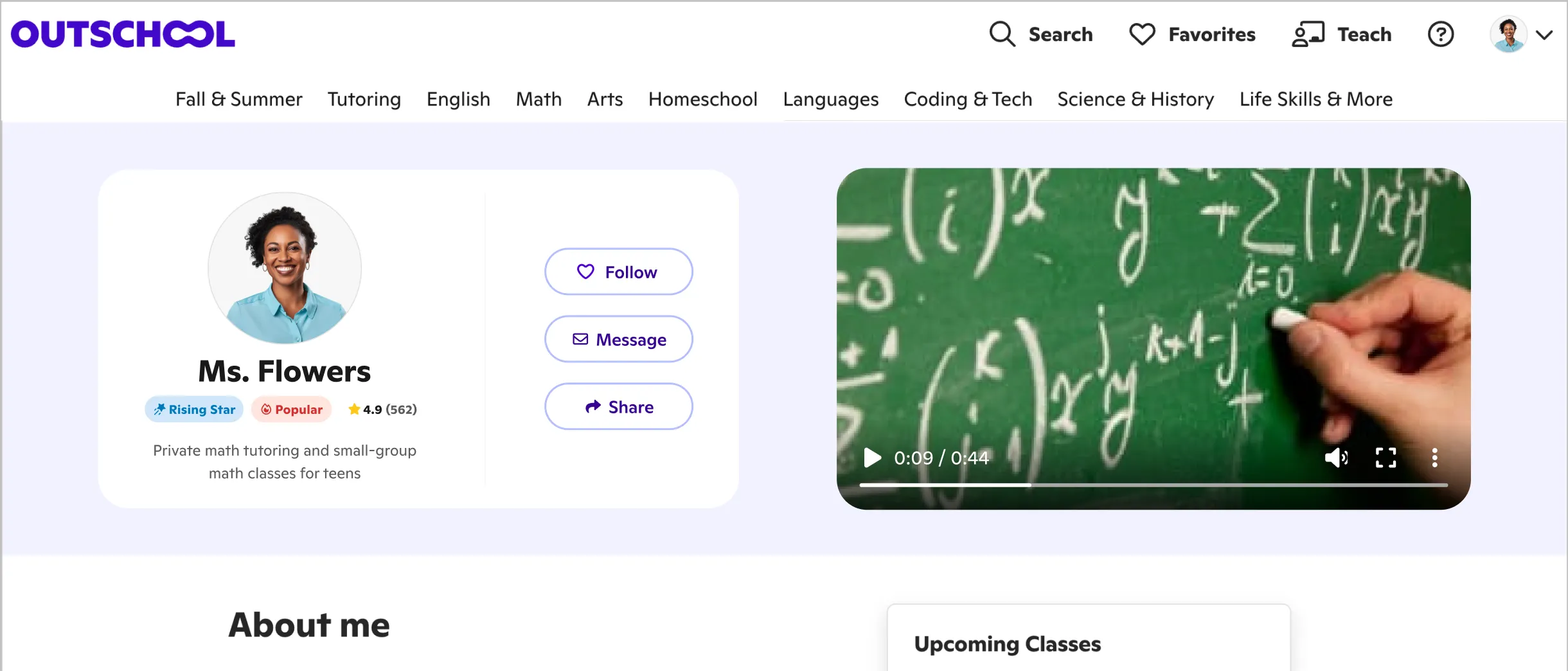
A short intro video reduces uncertainty and builds connection.
🎯 Ask yourself: Do I clearly explain learning outcomes for this class while letting my personality and teaching style shine?
💡Key Takeaway: When families can see and hear you, confidence (and enrollment) goes up.
A high-performing listing works because every element reinforces the others. It matches what families are searching for, looks trustworthy in search results, clearly communicates value, sets accurate expectations, and ultimately converts interest into enrollment. Your cover image drives clicks, your title improves matching, your description strengthens conversion, and strong conversion supports ranking over time. When everything aligns, your listing doesn’t just generate views—it attracts the right learners.
Try our free Outschool Class Listing Optimizer—a custom AI tool that uses this guide to help you improve your title, summary, and more in minutes.
Integer in porta leo, vitae dignissim nisl. Etiam imperdiet, ligula at tincidunt laoreet, nisi ligula euismod quam, eu pulvinar magna dui ut ante.